

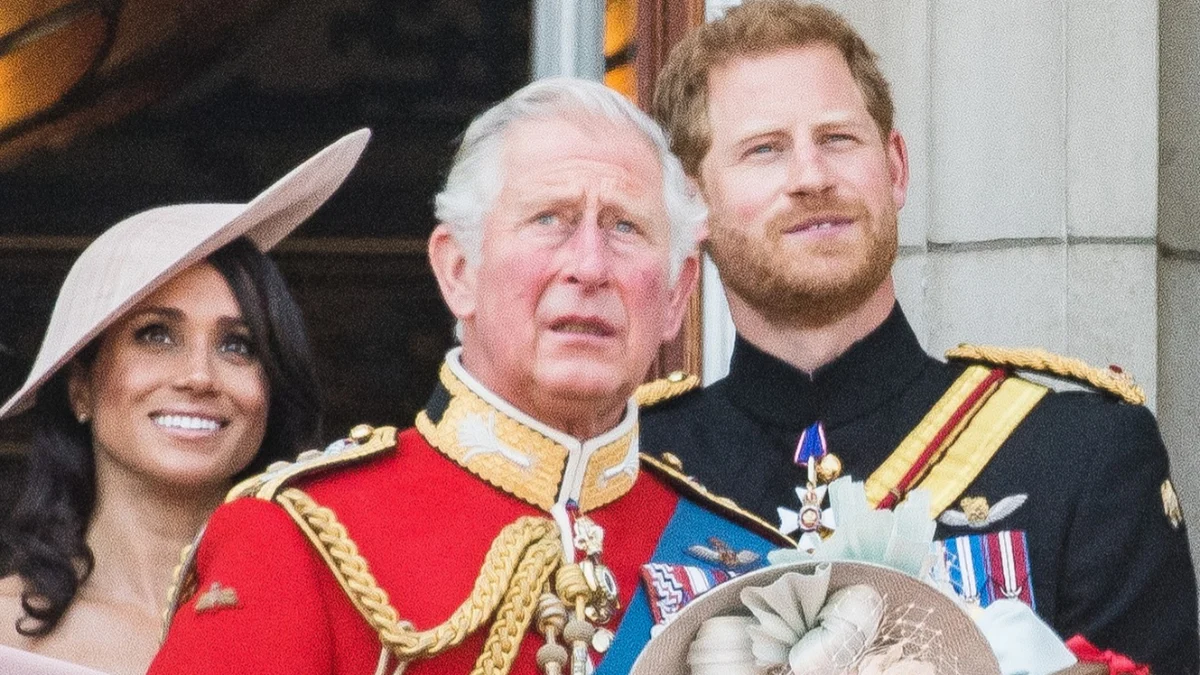
In a calculated move designed to eliminate ambiguity surrounding the Duke and Duchess of Sussex, King Charles III has issued a formal memorandum to senior government officials, military leadership, and the Crown’s representatives across the United Kingdom. Following the return of Prince Harry and Meghan Markle to British soil with their children, Archie and Lilibet, the King sought to preemptively address public and bureaucratic confusion by codifying the couple’s current standing within the monarchical structure.
While the document does not alter the fundamental arrangement established in 2020—commonly referred to as the “Sandringham Summit” terms—its dissemination serves as a stark reminder of the firm boundaries separating private life from official royal duty.
The Core Mandate: An Attempt to End Bureaucratic Confusion
The catalyst for this directive was a surge in inquiries reaching Buckingham Palace from government agencies and ceremonial officials. As Harry and Meghan re-established a base in the UK, questions regarding protocol, security, and official representation began to mount. To prevent a fractured public narrative, the King directed his private office to circulate a clarification memorandum.
The core of the message is definitive: Prince Harry and Meghan Markle remain non-working members of the Royal Family. While they retain their titles as the Duke and Duchess of Sussex, their "His and Her Royal Highness" (HRH) styles remain suspended, and they possess no mandate to represent the Crown. Their charitable endeavors, while ongoing, are to be conducted exclusively in a private capacity, with their administrative operations remaining entirely independent of the Royal Household.
Chronology: From 2020 to the Present Day
To understand the weight of the King’s recent missive, one must examine the timeline of the Sussexes’ departure and their recent reentry into the British sphere.
- January 2020: The "Megxit" crisis culminates in a meeting at Sandringham. It is agreed that the couple will step back as senior working royals, relinquish their HRH styles, and cease using the “Royal” branding for their commercial enterprises.
- 2020–2024: The couple resides primarily in California, establishing the Archewell Foundation and pursuing independent media and philanthropic projects. Public tensions with the Firm remain high, punctuated by the release of the memoir Spare and various televised interviews.
- August 2026: Prince Harry and Meghan Markle return to the United Kingdom for a prolonged stay. The relocation of their children, Archie and Lilibet, into the British school system signals a shift in the couple’s lifestyle.
- September 2026: As the couple settles into a new domestic routine, the influx of protocol-related questions from government and military figures prompts the King to intervene, leading to the distribution of the formal guidance letter.
Expert Analysis: A Strategic Communication Tool
PR expert Sam Gauchier, who has closely tracked the evolution of the House of Windsor’s media strategy, suggests that the King’s decision to put this guidance in writing is a masterstroke of administrative discipline.
“I think King Charles is saying that Harry and Meghan returning to the UK shouldn’t be mistaken for a return to royal life,” Gauchier explained in an interview with The Express US. “They may still be the Duke and Duchess of Sussex, but they speak for themselves, not the King or the monarchy.”
Gauchier emphasizes that the distribution list for the letter is as important as its contents. By ensuring that military commanders and government officials—many of whom are accustomed to traditional royal protocol—received the document, the King has effectively insulated the Palace from any accidental association with the Sussexes’ independent activities.
“It feels less like a reminder to Harry and Meghan and more like instructions for everyone dealing with them now that they’re back,” Gauchier noted. By preempting potential misunderstandings, the King is essentially "firewalling" the monarchy, ensuring that the Sussexes’ private projects cannot be conflated with the official agenda of the Sovereign.
The Subtle Language of Sovereignty
The specific phrasing of the letter—"To help avoid doubt or confusion, The King has directed that the following information be shared"—is viewed by constitutional historians as a classic example of royal "dignified silence" being replaced by "pragmatic clarity."
The document explicitly states that "there is no change to the current status" of the couple. By emphasizing that this is a maintenance of existing policy rather than a new punitive measure, the King is signaling to the public that the status quo is the desired, permanent state of affairs. This prevents the press and the public from speculating that the couple’s return might lead to a "rehabilitation" or a return to public-facing royal duties.
Implications for the Monarchy and the Sussexes
The implications of this directive are multifaceted, affecting everything from diplomatic protocol to public perception.
1. Administrative Insulation
For government and military officials, the letter provides a clear "rule of thumb." When the Duke or Duchess approaches these agencies regarding their private initiatives, the officials now have a documented, Palace-sanctioned framework to navigate the interaction. This prevents the risk of unauthorized use of royal patronage or the appearance of state endorsement.
2. The Separation of Brand
The Sussexes have spent the last six years cultivating an independent brand. This directive reinforces that their brand is, and will remain, separate from the "Firm." For the King, this is essential to maintaining the integrity of the monarchy as a state institution, which is inherently apolitical and bound by constitutional constraints.
3. Impact on Public Perception
The public often oscillates between nostalgia for the "Fab Four" era and frustration with the couple’s outspoken critiques of the institution. By formalizing this separation, the King is attempting to guide public expectation. If the public understands that the Sussexes are acting as private citizens, the political heat surrounding their every move—from charity galas to school runs—may, in theory, be reduced.
The Role of the Wider Royal Family
While the letter focuses on the Sussexes, it implicitly places a burden on the remaining working royals to maintain the same level of discipline. If the King is strictly enforcing boundaries for his son, he is also setting a standard for the rest of the family. The message is clear: the monarchy is an institution of service, and any deviation from that path, while permitted as a personal choice, results in a loss of institutional standing.
As the children of the Duke and Duchess begin their education in the UK, the family’s presence will inevitably become more visible. However, this memorandum ensures that their visibility does not equate to influence. The King’s move is a testament to the fact that, in the modern age, the monarchy relies as much on clear communication as it does on tradition.
Conclusion: A Future of Parallel Paths
The directive issued by King Charles III represents a mature, if somewhat cold, approach to managing a complex family dynamic within the public eye. By codifying the boundaries, the King has provided a roadmap for the future: a path where the Sussexes can exist within the United Kingdom as private citizens, while the Crown continues its official duties, distinct and undisturbed.
Whether this move will satisfy the media or the Sussexes themselves remains to be seen. However, from the perspective of the Palace, the goal was never to silence or penalize—it was to clarify. In an era where information travels instantly and misinformation can cause significant diplomatic friction, the King’s decision to put pen to paper serves as a vital tool for institutional stability. As the Sussexes move forward with their private lives, they do so with a clear understanding of the parameters set by the Sovereign: they are part of the family, but they are no longer part of the official mechanism of the State.
 Neng Nana
 Azzam Bilal Chamdy
 Nana
Nana
