

By Crystal Bell
Published October 11, 2026
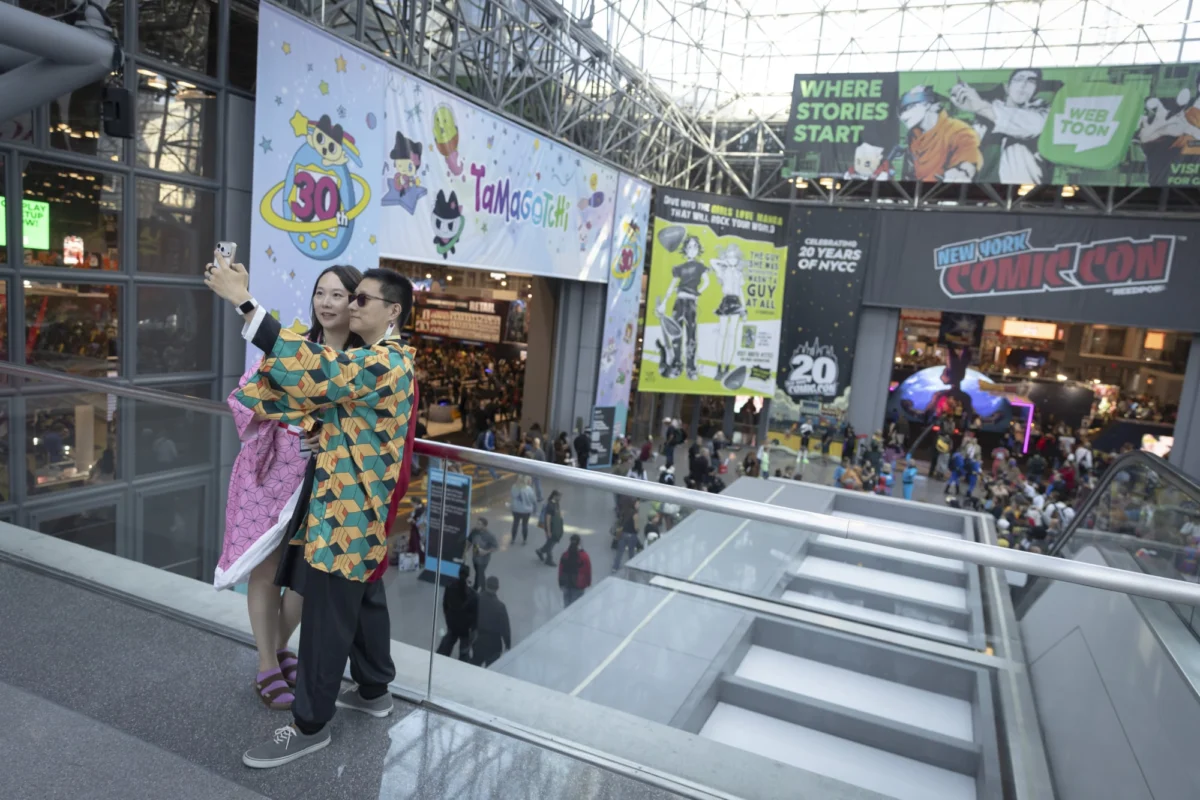
From the dedicated creator lounge at New York Comic Con (NYCC), the view of the Javits Center’s main entrance is an absolute sensory overload. Below, thousands of fans stream through the doors in a kaleidoscopic procession of elaborate, hand-crafted cosplays, oversized cinematic props, and meticulously recreated pop-culture personas. Towering overhead are massive banners celebrating everything from legacy properties like Tamagotchi and The Apothecary Diaries to prestige fall television properties like YAGA, alongside branding commemorating NYCC’s landmark 20th anniversary.
It is a spectacle in its own right, and perhaps more importantly, it serves as the ultimate backdrop for a viral TikTok video.
This convergence of live fandom and social media production is entirely intentional. For the 2026 convention, organizers purposefully engineered the physical architecture of the venue—specifically designing the lower portions of the Crystal Palace entrance banners with optimized photo and video framing in mind. They anticipated precisely how attendees, influencers, and digital journalists would capture, curate, and blast their experiences across the internet.
The bustling creator lounge offers a bird’s-eye vantage point of this phenomenon. Outfitted with high-speed, reliable Wi-Fi, dedicated charging stations, and ample staging area for filming and editing, the space represents a fundamental shift in how mega-conventions accommodate the contingent of digital creators who arrive at the Javits Center armed with mirrorless cameras, wireless microphones, and massive online followings.
On the crowded show floor below, cosplayers strike poses for impromptu photo-shoots, attendees film real-time vlogs for their feeds, and independent creators stop passersby for man-on-the-street interviews. Today, modern comic conventions function just as much as functional content studios as they do physical marketplaces for fandom. For some attendees, capturing the event is a hobby to share with friends; for others, it is a demanding full-time job. Increasingly, it is an intersection of both.

The Main Facts: The Structural Shift at NYCC
The modern pop-culture convention has transcended its traditional roots as a localized bazaar for comic book collectors and sci-fi devotees. As modern fandom has migrated decisively to digital platforms like TikTok, YouTube, Instagram, and Twitch, marquee events like NYCC are evolving in lockstep.
Rather than viewing social media influencers as outside interlopers or unauthorized media, convention organizers are actively rewriting their floor plans, accreditation processes, and hospitality offerings to integrate creators directly into the event’s infrastructure.
Key elements defining this shift include:
- Dedicated Creator Infrastructure: Providing centralized hubs equipped with high-speed Wi-Fi, professional lighting, equipment charging banks, and tripods to ease the rigorous production schedules of digital media workers.
- Architectural Optimization: Designing physical installations, sponsorships, and signage specifically to be "shareable," ensuring that every square foot of the venue doubles as an appealing aesthetic backdrop for short-form video.
- Formalized Creator Badging: Establishing dedicated application pathways and complimentary badge tiers specifically tailored to digital personalities who wield immense cultural influence, bridging the gap between traditional press and independent influencers.
Chronology: How Fandom Met the Feed
The transformation of comic conventions into content studios did not happen overnight. It was accelerated by structural disruptions in the live events industry and the meteoric rise of short-form video platforms.
2021: The Post-Pandemic Pivot
For NYCC, this evolutionary pivot began in earnest in 2021. As live events cautiously re-emerged following pandemic-related hiatuses, event executives recognized that short-form video was fundamentally rewriting how audiences discovered and interacted with entertainment. That year, NYCC organizers took a calculated risk by hiring two independent digital creators to take complete control of the convention’s official TikTok account over a four-day span.
According to Marketing Director Fallon Prinzivalli, that single experiment yielded staggering results, reaching more than 8 million unique viewers in just under 96 hours. It proved that peer-to-peer digital storytelling resonated far deeper with younger demographics than traditional press releases or corporate marketing campaigns.

2022–2024: Formalizing the Creator Program
Buoyed by the success of the 2021 takeover, NYCC instituted a more formal operational approach toward working with digital talent. Historically, social media influencers seeking access to the convention floor had little choice but to apply for traditional editorial press credentials—a system that often resulted in friction, as many creators did not fit the strict journalistic criteria of legacy publications.
Recognizing that creators delivered a unique brand of engagement that benefited exhibitors, studios, and fans alike, NYCC established a dedicated creator relations tier. What started as informal access gradually expanded into specialized registration categories, clear metric guidelines, and eventually, physical real estate dedicated solely to creators.
2026: The Full Content Studio Era
At the 2026 convention, this strategy reached maturity. With thousands of applications flooding in from creators across the globe, submissions had to be capped and closed months in advance. The convention floor was no longer just a place to buy variant covers or view exclusive movie trailers; it was an expansive, multi-acre production lot where the lines between fan, reporter, and celebrity dissolved entirely.
Supporting Data and Metrics: The Scale of the Creator Economy
The numbers underpinning the creator-con convention pipeline highlight an undeniable economic and cultural reality: digital influencers are driving massive audience engagement that legacy media outlets can no longer replicate alone.
- Audience Reach: Initial TikTok takeovers in the post-pandemic era proved capable of generating millions of impressions within days, establishing a baseline for digital return-on-investment.
- High Barrier to Entry: NYCC’s creator badge guidelines nominally require applicants to maintain a baseline of at least 200,000 followers across their combined social platforms. However, organizers regularly make exceptions for micro-influencers who demonstrate high community engagement, creative originality, and specialized niche impact.
- Overwhelming Demand: The appetite for creator access at NYCC 2026 far outpaced available capacity. Organizers received thousands of applications, forcing submission windows to close as early as August due to strict safety and venue occupancy limits.
- Massive Follower Bases on the Floor: Prominent creators operating within the creator lounge frequently manage audiences dwarfing regional television markets—such as lifestyle and dance creator Dominique Little (@nojill), who commands a following of 1.8 million dedicated TikTok users.
Official Responses and Perspectives
To understand the scope of this operational evolution, one must examine the viewpoints of both the convention organizers managing the logistics and the creators navigating the chaotic convention floor.
The Organizers’ View
Fallon Prinzivalli, marketing director for NYCC, noted that the relationship between the convention and the creator economy is fundamentally circular. Digital communities coalesce online, drive ticket sales for live events, and then translate their physical convention experiences back into digital media that feeds the online ecosystem year-round.

"We started engaging with them very intentionally following the pandemic when live events were coming back," Prinzivalli explained to Mashable. "We wanted to give them dedicated Wi-Fi. We wanted it to be in the middle of the energy. We wanted it to be a space where they can film videos, or they can connect with other creators… We’re very conscious that everything we create now is a shareable moment."
Prinzivalli also pointed out that the physical boundary lines separating fans, traditional journalists, and digital influencers have thoroughly collapsed. Today, top creators are treated with the reverence of A-list celebrities by convention attendees, frequently mobbed in the halls for selfies and impromptu meet-and-greets.
The Creators’ View
For the digital talent on the ground, attending NYCC is a high-stakes professional undertaking balanced against genuine fandom.
- Kallen Zborovsky-Fenster (@king_kallen): A Columbia University student studying entertainment law and production, Zborovsky-Fenster treats NYCC as a cornerstone of his annual content calendar. Weeks of pre-planning go into drafting interview questions, securing portable audio rigs, and mapping out schedules. For him, the creator lounge acts as a vital sanctuary. "This is one of my highest priority events," he noted. "When you meet new people, through them, you meet more people." Yet, he balances his production schedule with organic social experiences: "I want to go where the people are."
- Caroline Martini (@newyorkcaroline): Specializing in cosplay vlogs and convention walkthroughs across TikTok, Instagram Reels, and YouTube Shorts, Martini maintains a running inventory of shots in her iPhone notes before arriving. While she values the creator lounge’s lighting and aesthetic setups, she intentionally limits her time there to ensure she can experience the convention alongside her friends, many of whom lack creator badges.
- Brandon Bullock (Anime News Guy): For news-driven creators, the infrastructure provided by modern conventions is essential for survival in a 24-hour news cycle. Bullock’s coverage relies heavily on breaking announcements regarding anime and manga adaptations. He utilizes the show floor for rapid-fire reporting and rushes to the creator lounge to edit and publish updates while the news remains fresh. "I think the creator economy is becoming so much larger now, and big entities are really starting to take it seriously," Bullock remarked.
Implications: What This Means for the Future of Fandom
The integration of content studios into the DNA of massive pop-culture gatherings carries profound implications for the entertainment industry, independent media, and the future of live events.
1. The Redefinition of Entertainment Journalism
The traditional paradigm of the accredited press bullpen—historically reserved for print journalists, trade publications, and television broadcast crews—has been permanently disrupted. Studios and event organizers now recognize that a TikTok creator with an engaged, hyper-targeted audience of 300,000 followers can drive ticket sales, merchandise purchases, and streaming viewership far more effectively than a traditional press release. As a result, the barrier between "fan commentary" and "authorized industry reporting" has vanished.
2. Physical Design Dictated by Digital Aesthetics
As conventions realize that their financial viability depends on digital word-of-mouth and viral social media impressions, event architecture will increasingly mirror television production stages. Sponsors, toy manufacturers, and publishing houses will no longer build simple static booths; they will construct experiential, highly photogenic installations engineered specifically to maximize algorithmic distribution across short-form video apps.

3. Democratization vs. Commercialization of Fandom
While dedicated lounges and streamlined badge access empower creators to build sustainable media businesses, it introduces a subtle tension into spaces originally designed for egalitarian fan worship. When every moment of leisure, cosplay, and community interaction is viewed through the lens of production schedules and engagement metrics, the boundary between authentic passion and commodified content becomes razor-thin.
Nevertheless, as New York Comic Con has demonstrated, resisting this shift is no longer an option. By embracing the creator economy, conventions have ensured that the magic of the Javits Center floor is no longer confined to the thousands who manage to buy a ticket, but can be shared in real-time with millions across the globe.
 Nana
 Muslim
