

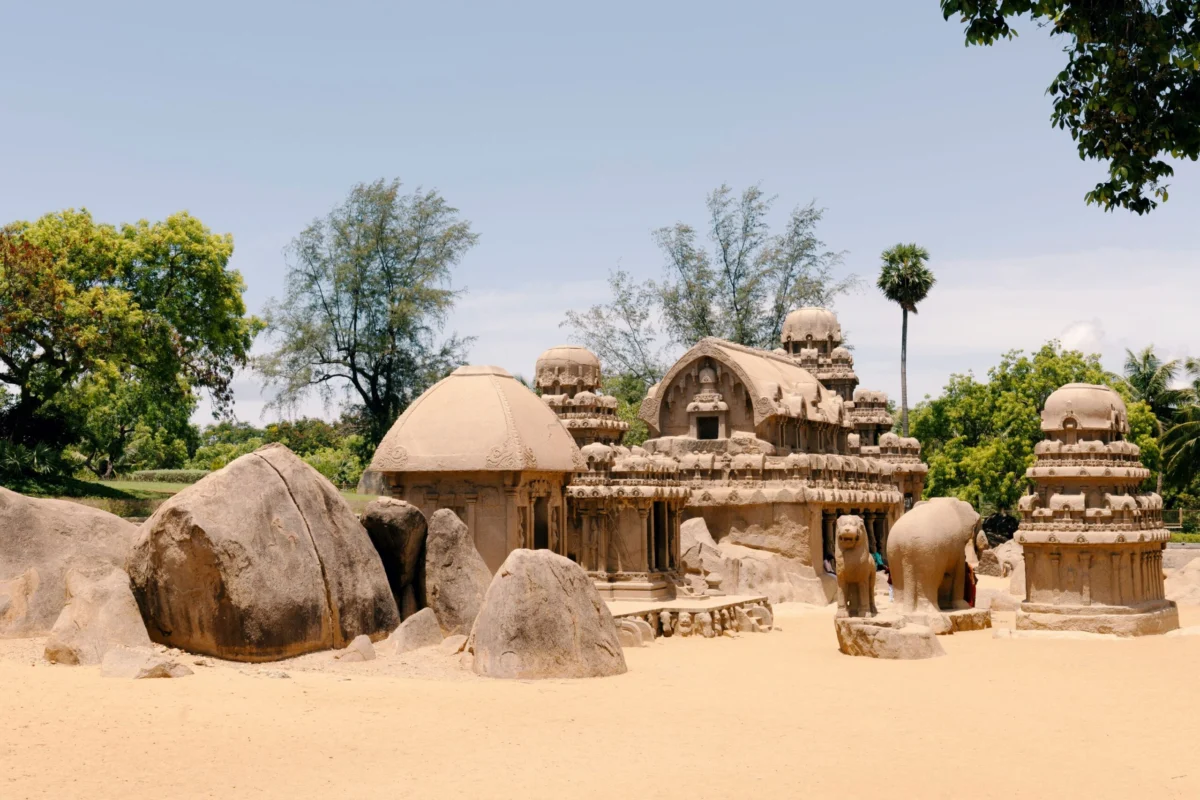
Under the midday sun on the tapering shoreline of Mahabalipuram, the air is thick with the scent of salt and the silent, heavy history of the Pallava dynasty. Here, I rest my head against the mighty flank of Nandi, the sacred bull of the god Siva. There is a Nandi in every Siva temple in the south, but this one—sculpted more than 1,300 years ago from a single, massive boulder of granite—possesses a unique warmth, as if it has been absorbing the sunlight of thirteen centuries. The craftsmen who shaped this icon, using nothing more than mallets, chisels, and files, were the architects of the first flower of a Tamil-speaking civilization that mastered the art of coaxing flowing, organic forms from stubborn rock.
.jpg)
This is Tamil Nadu, a state where the past is not a museum piece but a living, breathing component of the present. Over an eight-day immersion, the centuries seem to ripen and coalesce, revealing a landscape where the eternal and the everyday exist in a constant, beautiful dialogue.
.jpg)
The Architecture of Eternity: Main Facts and Historical Context
The architectural marvels of Tamil Nadu serve as the primary conduits for understanding its history. Unlike the royal palaces and forts that define the historical narrative of northern India, the southern dynasties—most notably the Pallavas and the Cholas—channeled their immense resources and social consciousness into temple building.
.jpg)
The Divine Bridge
As my guide, N. Paneer Selvam, a man whose passions are divided equally between ancient temples and local birdlife, explains, the king’s primary duty in old India was to act as a bridge between the divine and the human. "The temples were at the heart of everyday life," Selvam notes. "They were centers of learning, schools of music and dance, and places of refuge during times of unrest."
.jpg)
Notable Landmarks
- The Shore Temple and Friezes at Mahabalipuram: Dating back to approximately AD 600, these structures represent some of the world’s earliest "street art." The 43-foot-tall open-air frieze features life-sized elephants and celestial beings that seem to emerge from the stone with startling fluidity.
- The Brihadeeswara Temple, Thanjavur: Built by the 11th-century monarch Rajaraja Chola, this structure is an engineering feat of the medieval world. Its 80-ton cupola was reportedly hauled to the summit by elephants via a ramp stretching more than four miles.
- Meenakshi Amman Temple, Madurai: A vast complex housing over 30,000 statues of celestials, this site serves as a testament to the sheer scale of devotion that defined the Chola and Nayak eras.
Chronology of a Civilization
The story of Tamil Nadu is one of layers. The Pallava period (roughly 3rd to 9th century) established the aesthetic language of rock-cut temples. This was followed by the golden age of the Cholas, who expanded the reach of the Tamil empire across the seas, leaving behind architectural behemoths that still dominate the skyline today.
.jpg)
By the 17th century, the landscape saw the introduction of more eclectic influences, as seen in the Thirumalai Nayak Palace in Madurai. This structure, with its white stucco façade and foliated arches, bears the distinct mark of a fusion between local traditions and Italian architectural sensibilities. In the 18th and 19th centuries, the Nattukottai Chettiars, a mercantile community, brought global materials—Italian marble, Belgian stained glass, and Burmese teak—to the arid Chettinad region, creating a unique "global-local" architectural style that is currently experiencing a massive hospitality renaissance.
.jpg)
Supporting Data: The Human Element
The soul of Tamil Nadu, however, is not found solely in the grand stone monuments. It is found in the workshops of the village artisans who continue to practice crafts passed down through generations.
.jpg)
- Village Economies: In the art village of Vilachery, pottery and papier-mâché work remain the lifeblood of the community. Here, artisans like Sheela, who paints intricate jewels and peacock feathers onto statues of Meenakshi, represent a continuity of knowledge that defies modern industrialization.
- Athangudi Tiles: In the village of Athangudi, master craftsmen create intricate floor tiles using memory-based motifs. A single artisan can produce dozens of complex designs without a single reference, embodying the intersection of "deep time" and manual labor.
- Auroville: Representing the modern facet of this region, the township of Auroville hosts approximately 3,500 people from over 60 nations. The Matrimandir, with its 1,400 gold-plated discs, serves as a meditation space that strips away traditional iconography in favor of a minimalist, modern approach to the divine.
Perspectives from the Ground: Official and Local Responses
Conversations with those who maintain these traditions reveal a profound philosophical framework. For the artisans, their work is not merely a job; it is a form of communion.
.jpg)
"Every day we work directly with the gods," says Sheela. "That is a source of happiness for me." This sentiment is echoed across the state. In Madurai, I observe women stooping over their thresholds at dawn to create kolams—intricate geometric patterns made of rice flour. These patterns are not meant to last; they are swept away by the day’s traffic and redrawn the next morning. It is a sophisticated, daily ritual of finding the eternal in the ephemeral.
.jpg)
Selvam notes that the survival of these crafts is largely due to the dignity that the artisans derive from their work. "Anyone can work for money," he says. "But to work in this way—learning at the feet of a family member, bearing the knowledge of dozens of generations—is something special."
.jpg)
Implications: The Renaissance of Heritage
The resurgence of interest in Tamil Nadu’s cultural heritage has significant implications for its future. The conversion of historic Chettiar mansions into boutique hotels—such as the Chidambara Vilas—has provided a sustainable economic model for preserving architecture that might otherwise have fallen into ruin.
.jpg)
A New Model for Tourism
The move toward curated, small-group travel—such as the collaboration between Abercrombie & Kent and Condé Nast Traveler—highlights a shift in how the modern traveler engages with the region. By focusing on direct interactions with artisans and deep-dive historical tours, the industry is moving away from superficial sightseeing and toward a model of cultural preservation through economic empowerment.
.jpg)
The Lingering Spirit
As the Tamil sage Thiruvalluvar wrote 2,000 years ago: "A good country is where unfailing yields, men of integrity and compassionate rich people are found." The Tamil Nadu of today seems to strive for this ideal. It is a land of sensory overload—the smell of jasmine and coffee, the sight of gold-leaf paintings, the sound of temple bells—but it is also a land of rigorous, quiet philosophy.
.jpg)
As I prepare to leave, watching a peacock open its tail against the backdrop of a temple tower, the distinction between the physical world and the transcendent realm feels thinner than ever. In the Tamil country, time is not a linear progression from past to future; it is a cyclical, breathing force. It is the hot breath of a cow fed with spinach in a morning market; it is the cool, smooth surface of a 1,300-year-old stone bull. It is, in every sense, earth and heaven, woven into a single, vibrant, and enduring fabric.
.jpg)
For those seeking to experience this journey, the 10-day "Tamil Nadu: The Soul of Southern India" curated escape is available through Abercrombie & Kent, offering an in-depth look at the region’s artisans, heritage sites, and living traditions.
 Asro
Asro
 Siti Muinah
