

A Vision in Pink: Style Meets Substance in New York City
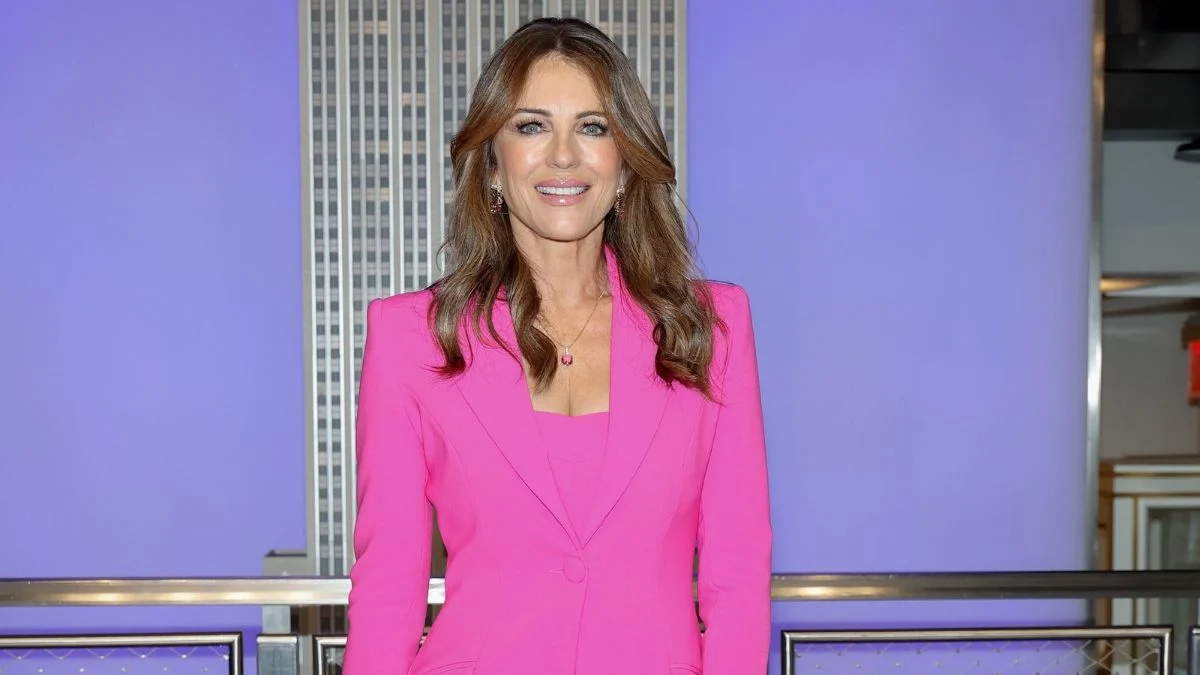
In a display of enduring glamour and steadfast commitment, Elizabeth Hurley descended upon New York City this week to spearhead a cause that has defined much of her professional and philanthropic life. The 60-year-old actress and entrepreneur made a commanding appearance at the iconic Empire State Building, draped in a bespoke, hot-pink Nina Morris suit that served as both a fashion statement and a symbolic tribute to Breast Cancer Awareness Month.
The ensemble, characterized by a plunging, structured blazer and perfectly tailored wide-leg trousers, underscored Hurley’s reputation for timeless elegance. Yet, as the flashbulbs illuminated the skyscraper’s signature pink lighting, it was clear that the vibrant hue was not merely a stylistic choice, but a visual extension of her thirty-one-year advocacy for the Estée Lauder Companies’ Breast Cancer Campaign.
The Aesthetic of Advocacy: A Bespoke Masterclass
Elizabeth Hurley’s sartorial choices have long been a subject of public fascination, but her recent appearance in the Nina Morris creation elevated the concept of "power dressing." The suit, a masterpiece of modern tailoring, featured sharp, architectural shoulders that provided a crisp contrast to the daring, low-cut neckline.
The monochromatic aesthetic—a trend that has dominated recent fashion cycles—was executed with precision. By opting for a coordinating pink top and high-waisted, flared trousers, Hurley created a silhouette that was both elongated and authoritative. Fashion critics have noted that the choice of Nina Morris, a label celebrated for its clean lines and sophisticated structural integrity, perfectly complemented Hurley’s penchant for feminine, curve-hugging designs that never sacrifice professionalism for allure.
Styling the look with understated elegance, Hurley opted for signature brunette waves, delicate jewelry, and oversized sunglasses, maintaining a balance between red-carpet readiness and the solemnity of the cause she was championing. Online, the response was immediate and overwhelming, with fans and fashion enthusiasts alike labeling the look "beyond fabulous" and a masterclass in ageless style.
Chronology of a Three-Decade Commitment
To understand the gravity of Hurley’s presence at the Empire State Building, one must look back at a journey that began in the mid-1990s.
- 1994: Elizabeth Hurley began her association with The Estée Lauder Companies, eventually becoming the face of the brand’s Breast Cancer Campaign.
- The Early 2000s: Hurley transitioned from a brand ambassador to a global activist, traveling the world to demystify breast cancer, promote early detection, and challenge the stigma associated with the disease.
- 2010–2020: As the campaign expanded its reach, Hurley became instrumental in high-profile fundraising galas and the illumination of global landmarks, including the Eiffel Tower and the Sydney Opera House.
- October 2024: Marking her 31st year as Global Ambassador, Hurley returned to the heart of Manhattan to preside over the lighting ceremony at the Empire State Building, reinforcing her status as one of the most consistent celebrity advocates in the history of medical philanthropy.
This three-decade-long tenure is an anomaly in the fast-paced world of celebrity endorsements. While many partnerships are ephemeral, Hurley’s work with the Estée Lauder Companies has evolved into a life mission, proving that celebrity influence, when applied with longevity and genuine conviction, can translate into tangible global change.
The Financial and Medical Impact: Beyond the Pink Ribbon
While the visual impact of the pink-lit Empire State Building is profound, the substance behind the campaign is grounded in significant financial and scientific progress. As Hurley highlighted during her appearance, the Estée Lauder Companies’ Breast Cancer Campaign has contributed more than $182 million toward global research, education, and medical services.
This capital has been directed toward the Breast Cancer Research Foundation (BCRF), an organization that remains at the forefront of medical innovation. The funding has been instrumental in several critical areas:
- Clinical Trials: Supporting the development of targeted therapies that have drastically increased survival rates for patients with early-stage diagnoses.
- Early Detection Education: Launching global campaigns to educate women—and men—about the importance of routine screenings and self-examinations.
- Medical Infrastructure: Providing grants to hospitals and clinics to upgrade diagnostic technology, ensuring that high-quality mammography and biopsy services are accessible to underserved populations.
Hurley’s role is to ensure that these figures—often relegated to corporate annual reports—remain in the public consciousness. By serving as the bridge between scientific research and the general public, she ensures that the "pink" of October is not just a commercialized color, but a reminder of the life-saving work funded by donors and corporate partners.
Official Responses and Strategic Implications
The partnership between Elizabeth Hurley and the Estée Lauder Companies is frequently cited by marketing experts as the "gold standard" for corporate social responsibility (CSR). In an era where consumers are increasingly skeptical of "cause-washing," the stability of this relationship provides a level of authenticity that few other brands can replicate.
"Elizabeth is not just an ambassador; she is an architect of our campaign," a representative for the campaign noted. "Her ability to bridge the gap between high-fashion visibility and deep-seated medical advocacy is what allows us to maintain the momentum needed to reach our research goals."
From a strategic perspective, the Empire State Building lighting serves as a "call to action" for the global community. The illumination of the landmark on October 1 functions as a beacon, signaling the start of a month-long focus on health equity. The implications are clear: the campaign is shifting its focus toward inclusive care, ensuring that medical breakthroughs reach all demographics, regardless of socioeconomic status.
The Cultural Significance of the "Hurley Effect"
Elizabeth Hurley’s career has spanned modeling, acting, and business, but her advocacy work has arguably left the most lasting impact on public health. Her ability to remain relevant and visible at age 60 is a testament to her work ethic and her understanding of personal branding.
However, the "Hurley Effect" is not just about her physical appearance; it is about the normalization of the conversation surrounding breast cancer. In the 1990s, the topic was often treated with hushed tones. Through her consistent presence in media, television, and public appearances, Hurley has helped transition breast cancer from a taboo subject to a matter of open, proactive public health discussion.
The choice of a bold, plunging suit in 2024 is, in its own way, an act of defiance against the aging process and a celebration of vitality. It sends a message that breast cancer awareness is not a somber, shrinking activity—it is a bold, loud, and necessary fight that requires the energy and participation of everyone.
Conclusion: A Legacy of Resilience
As the pink glow fades from the spire of the Empire State Building, the message delivered by Elizabeth Hurley remains clear. Her appearance was a fusion of high-fashion optics and high-impact philanthropy. By leveraging her status as a global icon to draw attention to the $182 million in funding provided by the Estée Lauder Companies, she has once again proven that beauty and advocacy are not mutually exclusive.
Looking forward, the campaign aims to continue its support of the Breast Cancer Research Foundation, with an eye toward future breakthroughs that could potentially turn breast cancer into a manageable, or even curable, condition for every patient. For Hurley, the work is far from finished. As she looks toward the future of her ambassadorship, her presence in that hot-pink Nina Morris suit stands as a vibrant, enduring symbol of hope, progress, and the power of one individual to influence the course of a global movement.
 Neng Nana
 Azzam Bilal Chamdy
 Nana
Nana
