

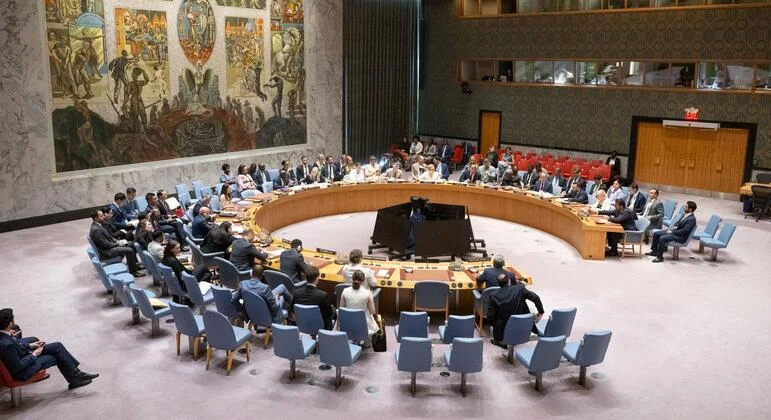
UNITED NATIONS, New York — The United Nations Security Council convened in an emergency session on Thursday, July 2, 2026, as the international community watches with mounting anxiety the rapid deterioration of security across the Persian Gulf. The meeting follows a series of unprecedented military provocations, including recent Iranian strikes on Bahrain and Kuwait, and a burgeoning direct confrontation between Tehran and Washington regarding the strategic Strait of Hormuz.
The 15-member Council, tasked with maintaining international peace and security, faces its most significant challenge in the region in decades. With global energy markets teetering and the risk of a full-scale regional conflict looming, the UN is scrambling to facilitate diplomatic off-ramps before the situation spirals into an uncontrollable conflagration.
The Escalation: A Chronology of Recent Hostilities
The current crisis did not emerge in a vacuum but is the result of a month-long series of escalations that have fundamentally altered the regional security architecture.
The Catalyst: Disruptions in the Strait of Hormuz
The tensions first spiked in early June 2026, when Iranian naval forces began exercising increased "inspection rights" over commercial vessels transiting the Strait of Hormuz. This critical maritime chokepoint, through which approximately 20% of the world’s petroleum consumption passes, became a flashpoint after the U.S. Navy attempted to escort tankers, leading to a series of high-stakes close-encounter maneuvers.
The Shift to Direct Strikes
By late June, the "shadow war" transitioned into open kinetic conflict.
- June 28, 2026: Reports surfaced of unidentified drone strikes targeting critical infrastructure in Kuwait, specifically near oil processing facilities. Tehran denied involvement, though U.S. intelligence officials alleged the drones were launched from Iranian-backed militias in the region.
- June 30, 2026: In a significant escalation, military installations in Bahrain were hit by a coordinated barrage of ballistic missiles. The attack resulted in significant material damage and prompted immediate defensive posture shifts from regional partners.
- July 1, 2026: In retaliation for the Bahraini strikes, U.S. Central Command authorized surgical air strikes against Iranian maritime radar facilities and command-and-control nodes located along the Iranian coast.
Supporting Data: Economic and Strategic Implications
The international community is currently grappling with the reality that a conflict in the Gulf is not merely a regional security issue, but a global economic emergency.
Global Energy Markets
Following the news of the strikes on July 1, Brent crude oil futures surged by 18% in overnight trading, hitting a record high for the 2020s. Analysts from the International Energy Agency (IEA) have warned that any sustained closure of the Strait of Hormuz could lead to a catastrophic supply shock. "The global economy is currently in a fragile state of recovery," noted Dr. Elena Vance, a senior energy analyst. "A prolonged blockade would force a shift to emergency reserves, which are already stretched thin, potentially triggering a global recession."
Maritime Insurance and Logistics
Lloyd’s of London has designated the Persian Gulf as a "high-risk" area, causing maritime insurance premiums for commercial vessels to skyrocket. Many shipping lines have begun diverting vessels around the Cape of Good Hope, adding weeks to transit times and significantly increasing the cost of consumer goods worldwide.
Official Responses: Voices from the Chamber
The emergency session of the Security Council saw a polarized debate, reflecting the deep divisions that have long paralyzed the UN’s most powerful body.
The United States Position
U.S. Ambassador to the United Nations, Linda Thomas-Greenfield, opened the session by characterizing the Iranian actions as an "unprovoked assault on the sovereignty of peaceful nations and a direct threat to the global economy." The U.S. maintained that its strikes were "measured, defensive, and necessary to protect the rules-based international order."
The Iranian Perspective
Representing the Islamic Republic of Iran, the Permanent Representative argued that the Iranian military actions were a legitimate response to "years of coercive economic warfare and illegal foreign military encroachment" in the region. Tehran has called for the immediate withdrawal of foreign naval forces, claiming that their presence is the primary source of regional instability.
Regional Perspectives: GCC Concerns
Representatives from the Gulf Cooperation Council (GCC) issued a joint statement demanding an immediate ceasefire and international protection for their territorial integrity. "Our sovereignty is not a bargaining chip in the geopolitical rivalries of global powers," the statement read. "We call upon the Security Council to move beyond rhetoric and enforce a robust security framework that guarantees the safety of our citizens and our borders."
Implications for Regional and Global Stability
As the Security Council continues its deliberations, the long-term implications of this crisis remain a subject of intense debate among international relations scholars and diplomats.
The Risk of Regional Contradiction
The current situation threatens to draw in a web of alliances that could expand the conflict well beyond the Persian Gulf. If the conflict persists, regional actors may be forced to choose sides, effectively ending the period of diplomatic rapprochement that defined the early 2020s. The fear among UN observers is a "domino effect," where local skirmishes ignite proxy conflicts in Lebanon, Syria, and Yemen.
The Efficacy of International Law
This emergency meeting serves as a litmus test for the United Nations. Critics have long argued that the Security Council’s structural limitations—particularly the veto power held by permanent members—render it toothless in the face of conflict between major powers or their proxies. The ability of the Council to reach a consensus on a resolution—either a ceasefire or a call for de-escalation—will determine the UN’s perceived relevance in this new era of geopolitical competition.
Humanitarian Consequences
Beyond the military and economic statistics, there is a profound human cost. Thousands of migrant workers in the Gulf region have been left in a state of uncertainty, with many humanitarian agencies preparing for potential mass displacement should the conflict intensify. The UN High Commissioner for Refugees (UNHCR) has urged all parties to prioritize the protection of civilians and to establish "humanitarian corridors" to ensure the safe movement of foreign nationals and displaced populations.
The Path Forward: What to Expect Next
The session, which is currently ongoing, is expected to result in a draft resolution calling for:
- An immediate cessation of hostilities: A call for all sides to halt missile and drone strikes.
- Diplomatic Mediation: The appointment of a UN Special Envoy tasked with facilitating direct talks between Tehran and Washington.
- Maritime Security: A proposal for a neutral, international maritime observer mission to monitor traffic in the Strait of Hormuz.
However, diplomatic sources indicate that the path to a consensus is narrow. Russia and China have signaled hesitation regarding any resolution that could be interpreted as endorsing U.S. military strikes, while Western powers remain adamant that any agreement must include strict language regarding Iranian proliferation of regional weaponry.
As the UN News team continues to monitor the situation, the mood inside the chamber remains tense. The outcome of these deliberations will not only shape the future of the Gulf region but will also set a precedent for how the international community addresses the intersection of energy security, territorial sovereignty, and military escalation in the coming decade.
Stay tuned to UN News for real-time updates as the Security Council session concludes and further statements are released from the delegates.
How to follow this story:
- Receive daily updates: Subscribe to our newsletter for the latest briefs.
- Mobile access: Download the UN News app on iOS or Android.
- Multimedia: Visit the UN Photo Library for high-resolution images from the Security Council chambers.
 Lina Hope
 Layla Zulfa
