

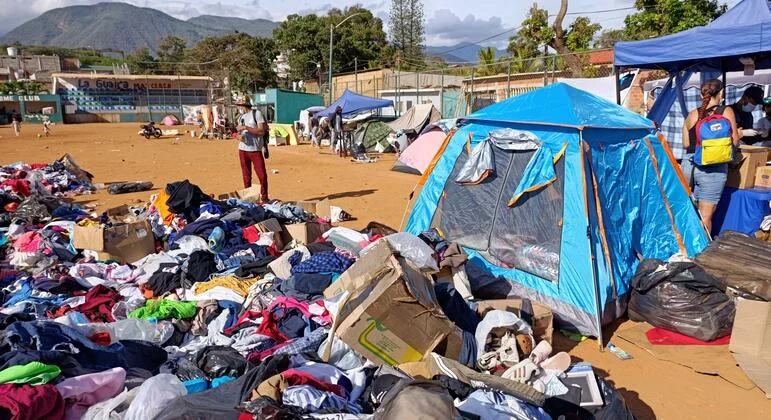
Main Facts: A Dual Crisis of Disaster and Hunger
In the wake of a series of powerful earthquakes that have shattered the infrastructure of Venezuela, the nation is facing a rapidly escalating humanitarian emergency. For thousands of families, the tragedy of losing their homes and loved ones has been compounded by a desperate, immediate struggle for survival: the lack of access to consistent food and clean water.
The World Food Programme (WFP), which was already operating in the country to support approximately 500,000 individuals through school meal programs and community-based nutritional support, has been forced to pivot its entire operational mandate toward emergency disaster relief. As the dust settles in the hardest-hit coastal regions—most notably La Guaira—humanitarian workers are confronting a landscape of profound despair. Families are being left without shelter, exposed to the elements, and increasingly unable to secure the basic caloric intake required for survival.
The situation is categorized by the UN as a "critical intersection of disaster and poverty," where the destruction of local markets and the loss of household incomes have rendered even those with access to cooking facilities unable to purchase food.
Chronology of the Disaster and Response
The sequence of events following the seismic tremors has triggered a rapid, albeit complex, mobilization of international aid.
- The Initial Impact: The earthquakes struck with little warning, causing widespread structural collapse. In cities like La Guaira, entire neighborhoods were reduced to rubble, and critical infrastructure, including electricity and water supply lines, were severed.
- The First 48 Hours: Initial emergency response focused on search and rescue. During this phase, it became apparent that the "hidden" victim of the quake was the food supply chain. Families were seen scavenging for remnants of their lives, while parents faced the harrowing reality of empty pantries.
- The Shift to Emergency Relief: Within 72 hours, the WFP formally transitioned from its long-term development programs to emergency food distribution. The agency set up integrated service centers to provide a centralized hub for food, water, and essential humanitarian services.
- Current Operations: As of this week, the WFP has successfully distributed emergency food packages to 1,200 of the most vulnerable individuals in La Guaira. These packages include both ready-to-eat products for families who have lost their kitchens and dry goods for those still able to prepare meals.
- Logistical Mobilization: The agency is currently scaling its supply chain. With over 3,000 tonnes of food already prepositioned within Venezuelan borders, the focus is now on the "last-mile" delivery to isolated communities that remain cut off by road damage.
Supporting Data: The Logistics of Survival
The sheer scale of the logistical operation required to prevent a prolonged hunger crisis is immense. The WFP’s data provides a sobering look at the resources being mobilized to combat the growing insecurity.
Supply and Capacity
The agency currently maintains a significant stockpile to manage the immediate aftermath:
- Internal Reserves: More than 3,000 tonnes of food are currently warehoused inside Venezuela, a volume sufficient to sustain over 10,000 families for a period of two months.
- Regional Backstop: In the event that domestic supply chains buckle, the WFP has secured supply reserves in neighboring Colombia. These can be diverted into Venezuela at short notice.
- International Hubs: Furthermore, a secondary safety net is in place in Panama, where the WFP’s regional logistics hub holds over 1,400 tonnes of non-food relief items, including emergency shelter materials and medical kits, ready for immediate air or sea dispatch.
Financial Requirements
To sustain these operations for the next three months, the WFP has launched an initial appeal for $15 million. This funding is earmarked for:
- Emergency Food Distribution: Reaching a target of 500,000 people.
- Logistical Infrastructure: Repairing or bypassing damaged roads to reach isolated mountain and coastal communities.
- Communication Networks: Establishing emergency connectivity for aid workers to coordinate the distribution of goods in areas where cellular and internet infrastructure has been destroyed.
However, officials stress that this $15 million figure is a "floor, not a ceiling." As assessment teams penetrate further into the interior of the country, the total cost of the intervention is expected to rise significantly.
Official Responses and Humanitarian Testimony
The human cost of this disaster was crystallized in a virtual press briefing held by Stephanie Hochstetter, the WFP’s Director in Venezuela. Speaking from one of the integrated service centers, Ms. Hochstetter provided a harrowing account of the desperation on the ground.
"It is heartbreaking to see the desperation," she stated, noting that for many, the trauma of the earthquake is being eclipsed by the daily anxiety of not knowing where the next meal will come from.
One particular story shared by humanitarian teams involves a father in La Guaira who arrived at a distribution center holding his three children by the hand. He possessed nothing—no home, no water, no food. His wife was hospitalized in Caracas, and he had lost multiple relatives under the rubble of their neighborhood. His story is not unique; it is representative of thousands of families whose support systems have been utterly decimated.
The UN’s strategy involves close cooperation with local authorities to ensure that the ports of La Guaira and Puerto Cabello—the arteries through which food aid flows—remain operational. "We are working around the clock to ensure that the tragedy of the earthquake does not turn into a famine," said one field coordinator.
Implications: The Long Road to Recovery
While the immediate focus remains on life-saving interventions, experts are already warning of the long-term implications for Venezuelan society.
The "Spotlight" Phenomenon
A major concern among aid workers is the eventual withdrawal of international media attention. Ms. Hochstetter warned that history provides a clear lesson: "What we have learned from other earthquakes of this magnitude is that when the spotlight fades, the needs do not disappear."
The danger is that the global community will move on to the next breaking news cycle while thousands of Venezuelans are still living in temporary shelters, struggling with the psychological trauma of the event and the economic reality of destroyed livelihoods.
Infrastructure and Economic Instability
The earthquake hit at a time when the country was already experiencing economic fragility. The loss of infrastructure is not just a physical problem; it is an economic one. Small businesses, local farms, and regional markets have been destroyed, meaning that even when food aid eventually scales back, the local capacity to produce and distribute food will be severely diminished.
The WFP’s current operations are a stopgap. The eventual transition will require massive investment in rebuilding the "hard" infrastructure of the nation—roads, power grids, and water systems—without which food security cannot be restored.
The Challenge of Remote Areas
While the integrated service centers are effective for urban centers, the most isolated communities remain at the highest risk. Many families are trapped in mountainous terrain where road access has been severed. Reaching these people will require specialized, dedicated operations involving off-road logistics and potentially airlifts, significantly increasing the complexity and cost of the humanitarian response.
Preventing a Chronic Crisis
The ultimate goal of the current WFP operation is to prevent "acute" hunger from hardening into "chronic" food insecurity. By providing both immediate ready-to-eat meals and longer-term dry food supplies, the agency aims to stabilize the population while the government and international partners begin the long, arduous process of reconstruction.
As the relief effort continues, the message from the humanitarian community is clear: the earthquakes were only the beginning. The real challenge lies in the coming months, as the nation attempts to rebuild not just its buildings, but the very foundation of its food security. For the families currently waiting in line at the service centers in La Guaira, the international response is not just a matter of aid—it is a matter of survival.
 Lina Hope
 Asro
Asro
 Layla Zulfa
