

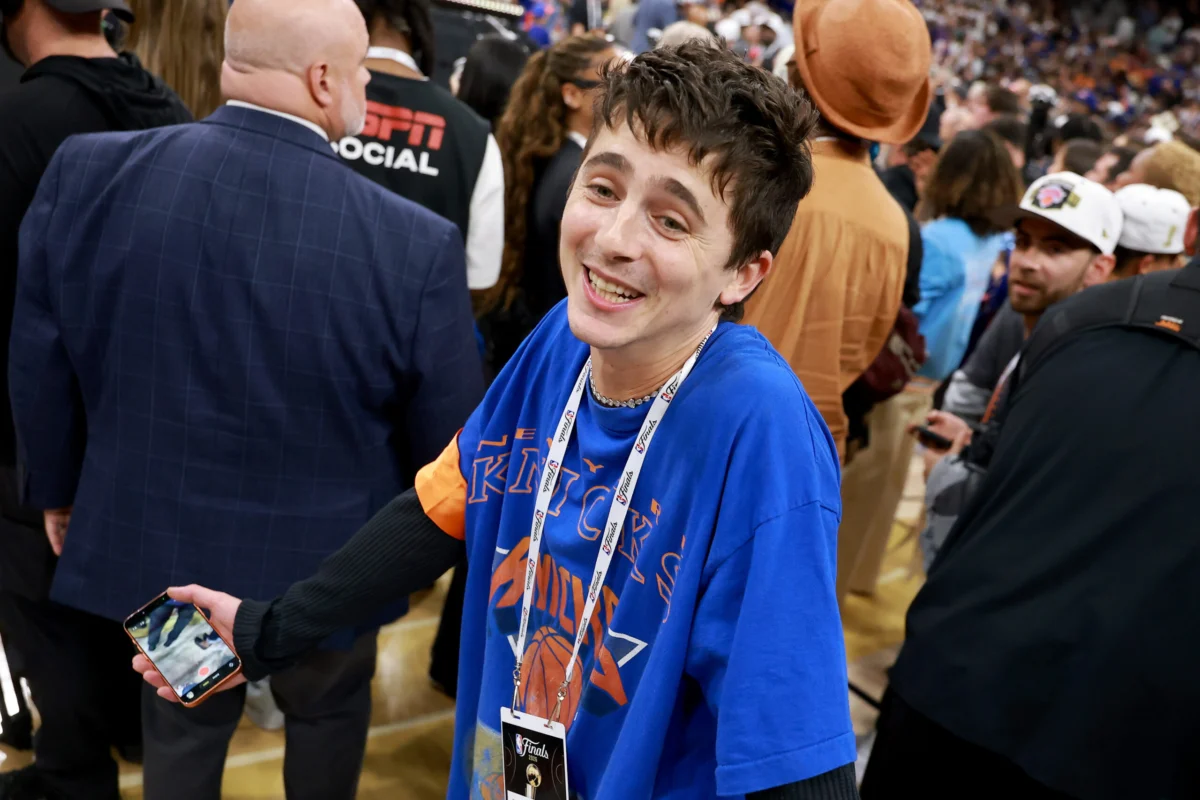
For Timothée Chalamet, the 2026 awards season was a masterclass in the fickle nature of prestige. As the clear frontrunner for Best Actor throughout the precursor circuit, the Marty Supreme star watched his golden trajectory stall in the final act, ultimately losing the Academy Award to a late-surging Michael B. Jordan. It was a stinging defeat, one that punctuated a difficult period for the actor following a similar disappointment for his work in A Complete Unknown.
However, in the volatile world of celebrity fortunes, relief often comes from the most unexpected quarters. On a Saturday night that will be etched into the annals of New York sports history, Chalamet found the ultimate balm for his professional wounds: a historic, series-clinching championship win for his beloved New York Knicks.
A Championship Drought Ended: The Scene at MSG
In the immediate aftermath of the Knicks’ Game 5 victory over the heavily favored San Antonio Spurs—a win that officially ended a grueling 53-year championship drought—a jubilant Chalamet was caught by ESPN cameras. His reaction was unfiltered, visceral, and perhaps the most honest assessment of his current priorities.
"Way rather this than the Oscars! Come on, baby! The Knicks are champions, baby!" the actor exulted, his voice straining with the raw emotion of a fan who had endured decades of frustration. For a man whose life is often meticulously curated by press tours and red-carpet appearances, the raw, unscripted joy of the Garden floor represented a cathartic release from the high-stakes, often clinical environment of the Academy Awards.
Chronology of a Double Upset
To understand the weight of Chalamet’s reaction, one must examine the parallel narratives of his 2026. The year has been defined by two major "upsets," both involving heavy favorites falling to long-shot narratives.
The Oscar Fall
At the height of his Marty Supreme campaign, Chalamet was perceived by pundits and oddsmakers alike as the heir apparent to the Best Actor trophy. Data from the Gold Derby charts indicated that Chalamet held a staggering 79% probability of winning the award at the peak of the season. However, as the voting window approached, a late-season momentum shift—fueled by critical re-evaluations and the undeniable pull of Michael B. Jordan’s performance—saw Chalamet’s lead evaporate. The loss was not merely a defeat; it was a public unraveling of a narrative that had seemed cemented for months.
The NBA Resurrection
Conversely, the Knicks entered the NBA Finals as the clear underdogs. Despite their storied history, the New York franchise was viewed by the analytics community as a team fighting against the tide. The Kalshi prediction market had pinned the San Antonio Spurs as a 64% favorite to take the series, while Las Vegas sportsbooks solidified this sentiment, listing the Spurs at -205—a roughly 68% statistical probability of securing the title.
The Knicks’ defiance of these odds mirrored the very thing that had cost Chalamet his Oscar. In a cruel twist of irony, the same force of "unexpected victory" that derailed his Academy run was exactly what provided the most memorable night of his year.
A Star-Studded Supporting Cast: The Knicks’ Hollywood Contingent
Chalamet was far from the only high-profile observer during this historic playoff run. Madison Square Garden has long served as a secondary office for the entertainment industry, but this year, the "Knicks faithful" reached a critical mass of celebrity density that blurred the lines between the front row and the marquee.

Throughout the playoffs, the celebrity rotation at the Garden included a veritable "Who’s Who" of Hollywood royalty. Spike Lee, the franchise’s most loyal and vocal devotee, was flanked by legends such as Ben Stiller, Jerry Seinfeld, Larry David, and Adam Sandler. The cultural impact of the team’s success seemed to draw in everyone from music icons like Nas and Fat Joe to industry heavyweights like Whoopi Goldberg, Julianne Moore, and Jeremy Strong.
Even global phenomena like Taylor Swift made a rare appearance, signaling that the Knicks’ championship run had become the cultural epicenter of the United States. For Chalamet, sharing the stands with girlfriend Kylie Jenner and fellow artists such as Keke Palmer, Alana Haim, and John Turturro provided a sense of community that the solitary nature of an Oscar campaign simply cannot replicate.
Data and Disparity: The Metrics of Failure and Success
When analyzing the volatility of 2026, the discrepancy between the "Oscar bubble" and the "NBA reality" is striking.
| Event | Favorite | Pre-Event Probability | Outcome |
|---|---|---|---|
| Best Actor Oscar | Timothée Chalamet | 79% | Michael B. Jordan (Winner) |
| NBA Finals | San Antonio Spurs | 68% | New York Knicks (Winner) |
These figures highlight a fascinating psychological phenomenon: the pain of losing a high-probability event (the Oscars) is often sharper than the joy of witnessing a low-probability victory (the Knicks), yet the latter provides a communal redemption that the former never could. Chalamet’s ability to pivot from the disappointment of the academy to the elation of the arena is a testament to the displacement of professional ego in favor of shared regional identity.
Implications for the Future: Looking Toward 2027
While the sting of the 2026 Oscars remains, the industry is already looking ahead, and Chalamet’s path to potential redemption is becoming increasingly clear. Despite the back-to-back losses for Marty Supreme and A Complete Unknown, the actor’s standing in Hollywood remains virtually untouched.
The conversation has already shifted toward his upcoming role in Denis Villeneuve’s Dune: Part Three. While the film is not slated for a wide release until December 2027, early buzz from CinemaCon and industry analysts suggests that the conclusion of the Dune saga may finally provide the material necessary to secure his elusive first Academy Award.
However, as the events of this weekend have proven, Chalamet’s life is no longer solely defined by the opinions of the Academy. By anchoring his joy in the collective success of his team, he has insulated himself against the mercurial nature of awards season. He has learned that while a golden statue is a testament to individual achievement, a championship ring—or at least the experience of witnessing one—is a memory that transcends the ballot box.
As the Knicks parade prepares to wind its way through the canyons of New York City, Timothée Chalamet stands not as a man who lost a race, but as a fan who helped carry his team to the finish line. In the grand tapestry of his career, this chapter will likely be remembered not for the award he didn’t receive, but for the night he forgot all about it.
 Ammar Sabilarrohman
 Siti Muinah
 Iffa Jayyana
