

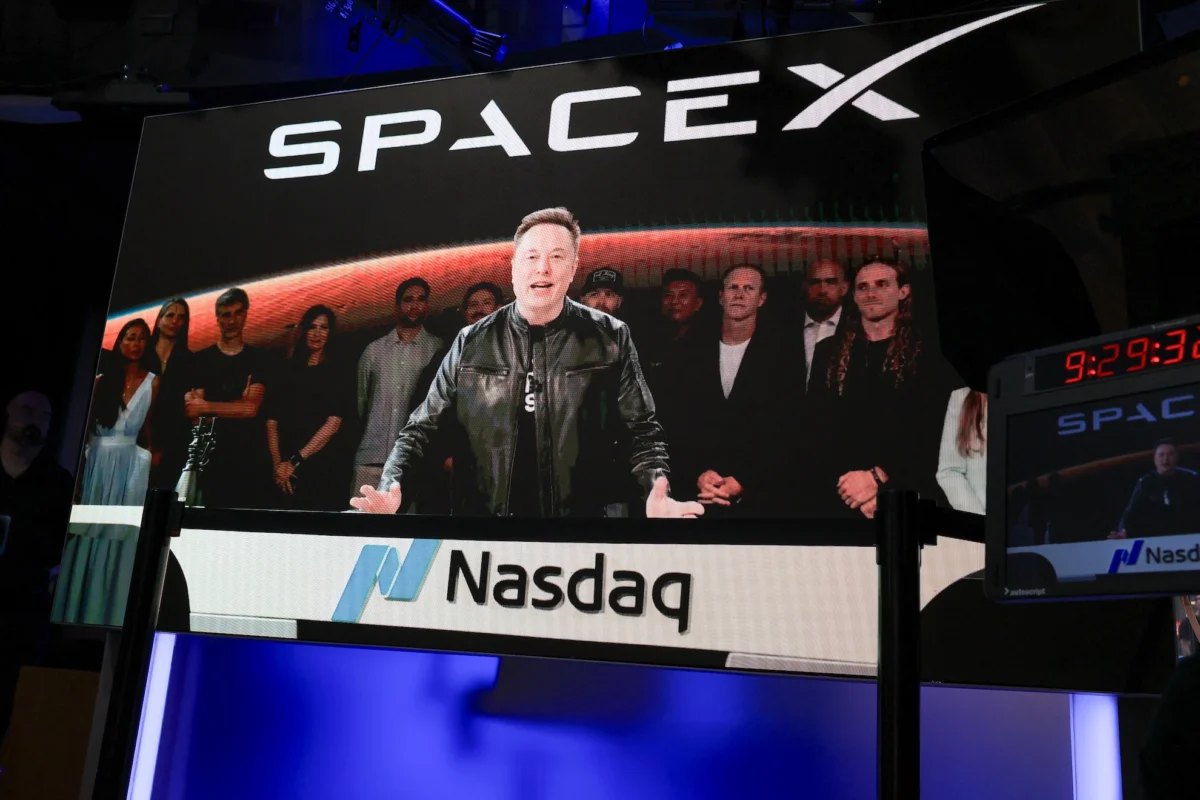
The meteoric rise of SpaceX’s public offering has hit a period of significant atmospheric turbulence. In a sobering turn of events for investors, shares of the space exploration giant fell below the $135 threshold—the price established by CEO Elon Musk and his underwriters ahead of the company’s blockbuster June 12 initial public offering (IPO).
The IPO, which successfully raised nearly $86 billion, was initially hailed as a watershed moment for the aerospace and tech sectors. However, after slipping beneath $133 per share on Wednesday afternoon, the stock has struggled to maintain its footing, oscillating around the $135 mark. This decline represents a stark contrast to the euphoria surrounding the company’s debut, where shares briefly soared past $200, granting SpaceX a valuation that placed it in the same stratosphere as tech titans like Amazon and Microsoft.
A Chronology of Market Volatility
The journey of SpaceX as a publicly traded entity has been defined by extreme swings. Following its June 12 debut, the stock saw a rapid, speculative rally that pushed its market capitalization to dizzying heights. Investors, emboldened by Musk’s grand promises of Mars colonization and global satellite internet, drove the price upward with fervor.
However, the reality of the market has since set in. In the month following that peak, SpaceX shares have experienced a persistent, weekly erosion of value.
- The Debut: June 12 marked the historic IPO, with an initial price point of $135.
- The Peak: Within days of the listing, intense retail and institutional buying pushed shares past the $200 mark.
- The Correction: Throughout late June and early July, a steady decline erased the early gains, reflecting broader anxieties in the technology sector.
- The Breach: On Wednesday, the stock definitively slipped below the $135 IPO price, signaling a shift in investor confidence.
Market analysts suggest that this volatility is, in part, a technical byproduct of the IPO structure. Only 4% of the company’s total shares were made available for trading on the Nasdaq. This exceptionally small "float" creates a situation where even modest shifts in sentiment lead to outsized price movements. In the absence of a large volume of available shares to stabilize the market, the intense media scrutiny and the speculative nature of Musk’s long-term vision have created a "whiplash" effect for early shareholders.
Supporting Data and the "Sobering Up" Phase
The downward pressure on SpaceX is not happening in a vacuum. It is part of a broader, systemic deflation in the technology sector, where high-growth, high-risk assets have seen their multiples contract over the last month.
Beyond the equity markets, the "SpaceX premium" is also taking a hit in the credit markets. Recent reports indicate that bonds issued by the company in the wake of the IPO are underperforming. When both the stock and the corporate debt of a company show simultaneous weakness, it typically suggests that the market is beginning to price in a higher risk profile for the company’s future operations.
Investors are now looking past the glossy marketing of "otherworldly" promises and focusing on the underlying fundamentals. The disconnect between the astronomical valuations seen in June and the operational realities of the capital-intensive space industry is being corrected in real-time.
The Implications for the "Space Age" IPO Pipeline
The performance of SpaceX is being treated by Wall Street as a bellwether for the broader "deep tech" sector. Because SpaceX has been the primary vehicle for investors to gain exposure to Musk’s space ambitions, its stock price is viewed as a proxy for the viability of the entire industry.
This is particularly critical for the upcoming pipeline of IPOs. High-profile firms such as Anthropic and OpenAI have filed confidentially to go public. These companies are operating at the cutting edge of artificial intelligence, promising to change the world in ways that are just as speculative—and expensive—as SpaceX’s mission to Mars.
If SpaceX continues to struggle, the institutional appetite for these upcoming IPOs may dampen. Bankers and venture capitalists are watching closely to see if the market has the stomach for companies that require massive R&D spending with long horizons for profitability. The "SpaceX effect" could determine whether these AI giants receive a warm welcome on the public markets or face the same grueling scrutiny currently being applied to Musk’s rocket manufacturer.
Operational Hurdles: The Starship Litmus Test
As if the financial pressure weren’t enough, SpaceX faces a critical operational milestone this Thursday. The company is scheduled to conduct a test launch of its Starship rocket—the first such event since the company went public.
Starship remains in the early, experimental stages of development. It is the centerpiece of Musk’s vision, yet it is notoriously prone to failure. SpaceX has famously adopted a "fly, fail, fix" philosophy, prioritizing rapid iteration over the conservative, risk-averse testing cycles common in traditional aerospace.
The "Destructive" Test Protocol
This upcoming flight is particularly high-stakes. It marks the first launch since the catastrophic booster failure in May. Perhaps most notably, SpaceX has announced it does not intend to attempt a recovery of the Starship booster or the upper stage. Instead, the flight plan calls for a simulated landing in the Gulf of Mexico.
For the general public and casual investors, this poses a communication challenge: the flight is designed to end in an explosion. Even if every system performs perfectly, the rocket is destined for destruction. In the current climate of cooling investor sentiment, the visual of a multi-million-dollar vehicle erupting into a fireball—regardless of whether it is a "successful" test in the eyes of engineers—could potentially rattle shareholders who are already sensitive to the company’s "burn rate."
Looking Ahead: Can the Vision Survive the Reality?
The core question facing SpaceX investors is whether the company’s long-term mission can survive the short-term volatility of the public markets. Elon Musk has built his reputation on defying the odds, but the public markets operate under a different set of rules than private venture capital.
The public markets demand transparency, steady growth, and, eventually, clear paths to profitability. Musk’s "otherworldly" ambitions—while technically impressive—are difficult to quantify on a quarterly earnings report. As the company prepares for the Starship test, the intersection of engineering reality and financial perception will be under the microscope.
If the test is successful in terms of gathering data, it may reassure investors that the company’s development timeline remains on track. If, however, the test suffers from unforeseen failures that deviate from the expected "fly, fail, fix" rhythm, the stock could face even further downward pressure.
Ultimately, the first month of SpaceX on the Nasdaq has been a reminder that space is not just a frontier for exploration; it is a frontier for finance. The transition from a private "moonshot" venture to a publicly traded company involves a fundamental change in how the company is evaluated. For now, the market is no longer looking at the stars; it is looking at the balance sheet.
As the company moves forward, it must balance the high-risk, high-reward nature of its rocket development with the need to build a stable foundation for the shareholders who have bought into the dream. The next few months will likely define whether SpaceX is the vanguard of a new industrial revolution or simply the most high-profile casualty of a cooling tech market.
 Asep Darmawan
 Siti Muinah
 Ali Ikhwan
