

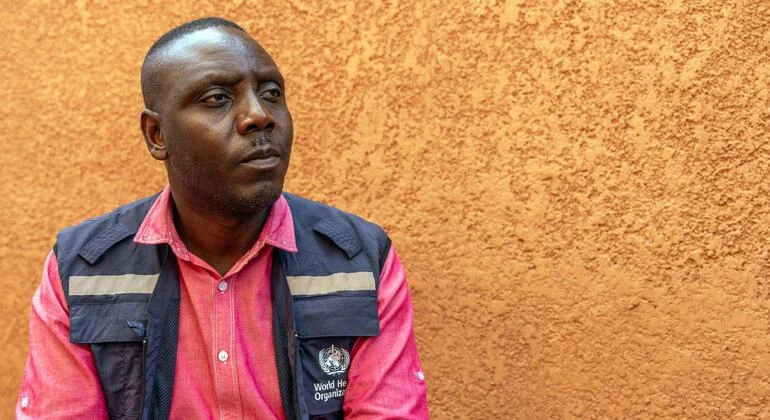
The Ebola virus remains one of the most formidable public health challenges of the modern era. Beyond the biological devastation of the pathogen, outbreaks trigger a secondary, equally corrosive epidemic: the contagion of fear. In Uganda, where the threat of the Bundibugyo virus strain looms over communities already grappling with regional instability and cross-border trade tensions, the frontline of the fight is not just in the hospital ward, but in the living rooms and marketplaces of the public.
As of the latest reports, over 1,400 confirmed cases and 350 deaths have been recorded across the DRC-Uganda border region. With Ituri province serving as a critical nexus for commerce and human movement, the risk of transmission is constant. However, as the medical community races to contain the physical spread of the virus, dedicated professionals like Dr. Chris Opesen, an anthropologist with the World Health Organization (WHO), are working to contain the spread of stigma—a force that can be as isolating and damaging as the virus itself.
The Midfielder of the Outbreak: A Professional Perspective
To understand the complexity of the current response, one must look at the role of the anthropologist. Dr. Opesen describes his work using a football analogy: "The anthropologist is the midfielder of the outbreak response. I connect response teams with communities and deliver feedback, from community to response teams, citing concerns, fears, and grievances."
In the high-stakes environment of an Ebola outbreak, medical teams often arrive with clinical precision, yet they may lack the local nuance required to navigate deep-seated cultural anxieties. When a patient is flagged for potential infection, the intervention is often perceived by the community as a disruptive, frightening event. Dr. Opesen’s task is to bridge that chasm, ensuring that the clinical response is grounded in empathy and mutual understanding.
Chronology of a Crisis: A Sunday in Kampala
The intensity of this work is best illustrated by a single, pivotal day in Kampala.
05:30 – The Call to Action
The day begins long before dawn. Dr. Opesen receives a call from local authorities regarding a patient, Lilian (a pseudonym), who had been transferred to the Mulago Hospital isolation unit three days prior. She was exhibiting symptoms consistent with Ebola, and while the transfer was a necessary medical precaution, it had left her family and neighborhood in a state of paralyzing anxiety. The call was a request for support: Lilian was nearing the end of her observation period, and her reintegration into the community needed to be managed with extreme care to prevent social ostracization.
10:00 – Facilitating the Dialogue
Recognizing that fear breeds in the dark, Dr. Opesen and his colleagues from the Kampala Capital City Authority convened a community meeting. The goal was to provide a forum for neighbors and family members to voice their fears. Initially, the meeting was fraught with tension; participants were guarded, their words laced with the stress of the previous three days.
Dr. Opesen introduced a structured format, allowing the group to elect a chairperson and a secretary—Lilian’s sister, Angela. By formalizing the process, he shifted the dynamic from a chaotic protest of fear to a collaborative exercise in community safety.
13:00 – Addressing the Silent Stigma
The battle against stigma is often fought in the small, everyday spaces of society. During the meeting, it emerged that a local shopkeeper had treated Lilian’s mother with open hostility the previous day. Understanding that such actions could lead to the permanent social exclusion of the family, Dr. Opesen and his colleague, Henry Bwire, visited the shopkeeper.
"Ebola is a disease that everyone fears," Mr. Bwire noted. "Stigma can come through miscommunication and fear. It was our role to bring Lilian back and clear up that miscommunication." Through a calm, educational dialogue, the team helped the shopkeeper realize the harm caused by his prejudice. The result was a commitment to treat Lilian with dignity upon her return.
18:30 – The Moment of Truth
The most critical phase of the day involved the wait for laboratory results. Rather than returning to the neighborhood prematurely, the team waited on "neutral ground," staying in constant communication with the lab. At 6:30 p.m., the call finally came: the results were negative. Lilian was suffering from a severe bacterial infection, not Ebola. The relief was palpable, but the work of reintegration was only beginning.
20:00 – A Dignified Welcome
Returning home, Lilian was greeted not as a pariah, but as a member of the community. Dr. Opesen brought a cake and water—symbolic gestures meant to normalize the return. As Lilian cut the cake and shared it with her neighbors, the act served as a powerful metaphor for acceptance. By accepting food from her hand, the community collectively signaled that the fear had been extinguished.
Supporting Data and Epidemiological Context
The Ebola Bundibugyo virus remains a significant public health threat in the Great Lakes region. The data suggests that over 90 percent of current infections are concentrated in the Ituri province of the Democratic Republic of the Congo (DRC). The proximity of this region to Uganda, coupled with the high volume of cross-border trade, creates a persistent risk profile.
Data from the World Health Organization indicates that community engagement is one of the most effective tools for reducing the reproduction number ($R_0$) of the virus. When communities trust the response teams, they are more likely to report symptoms early, adhere to quarantine protocols, and cooperate with contact tracing. Conversely, when stigma is allowed to flourish, patients often hide their symptoms, leading to late-stage hospitalizations and higher mortality rates.
Official Responses and Strategic Implications
The WHO’s strategy in Uganda represents a shift toward "community-led" health security. By embedding anthropologists and social scientists within the Emergency Medical Teams (EMTs), the organization is acknowledging that health crises are fundamentally social phenomena.
"As a family, we appreciate you coming to the ground," Lilian remarked during her homecoming. "Stigma can be too much. Thank you for listening to and addressing our concerns."
This feedback is critical for the long-term sustainability of the response. The implications are clear:
- Communication is Clinical: Information is a form of medical intervention. Clarity regarding symptoms, transmission routes, and the nature of the recovery process is essential to maintaining social order.
- Local Governance: Utilizing community members—like the committee formed by Lilian’s sister—empowers the local population to take ownership of their safety.
- The Human Element: The "cake and water" approach, while seemingly simple, serves a vital psychological function. It replaces the sterile, clinical image of an "isolation patient" with the familiar image of a neighbor.
Conclusion: The Long Road Ahead
By 9:00 p.m., after a 15-hour day, Dr. Opesen’s work concluded. His reflection on the experience encapsulates the spirit of the modern Ebola response: "If I do my job well, I can make a difference and support WHO’s leadership on the frontline of a safe and dignified response."
The fight against Ebola in Uganda is far from over, but the story of Lilian serves as a beacon of what is possible when science is coupled with empathy. In the struggle against a disease that thrives on isolation, the most effective vaccine remains the bonds of community. By tackling stigma at the source, responders are not just saving individuals; they are protecting the social fabric that holds society together in the face of an invisible,, terrifying threat.
 Lina Hope
 Asro
Asro
 Layla Zulfa
