

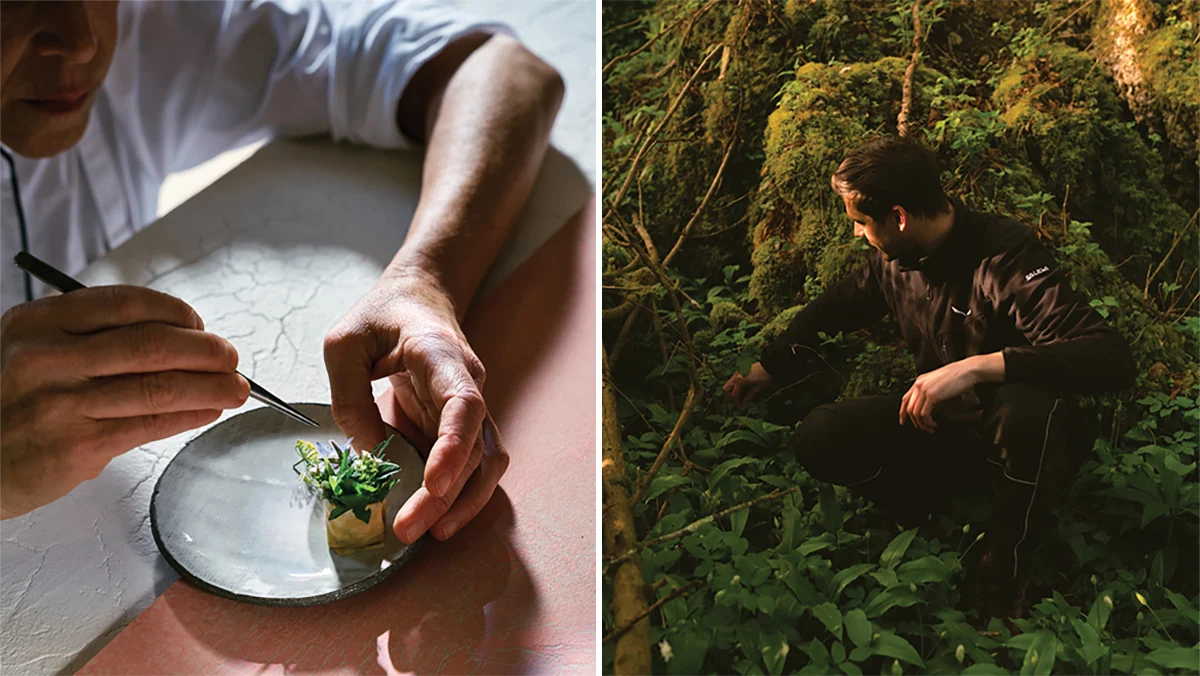
In the quiet, emerald-hued folds of the Soča Valley, the scent of wild hay and alpine air is more than just atmosphere—it is the foundational ingredient of one of the world’s most celebrated culinary experiences. At Hiša Franko, the three-Michelin-starred sanctum of chef Ana Roš, diners are currently being served a dish that defies the conventional logic of fine dining: the "One-Euro Potato." It is a humble, earthy tuber, slow-cooked within a scorched hay crust, served with a delicate pairing of local honey and sour cream. To eat it is to understand the soul of modern Slovenia.
For decades, the nation of Slovenia—a country roughly the size of New Jersey, wedged between the cultural gravity of Italy, Austria, Hungary, and Croatia—was a hidden corner of Europe. Today, it is an essential pilgrimage site for the global gastronome. With 13 Michelin-starred establishments and a philosophy rooted in hyper-locality and forest-to-table foraging, Slovenia has transformed from a transit country into a destination defined by its plate.
The Genesis of a Culinary Legend
The story of the "One-Euro Potato" is a testament to the ironies of fame. Legend dictates that an Italian food critic once dismissed Roš, a self-taught chef, as a talent trapped in a "land of poor ingredients." Rather than taking offense, Roš took the challenge to heart. She utilized the most modest staple of the region to prove that greatness is not found in the price of the import, but in the technique of the artisan.

This dish, now a hallmark of a roughly $380, three-hour culinary journey, helped launch Roš to global superstardom. It served as a catalyst for her appearance on Netflix’s Chef’s Table, her consistent presence on the "World’s 50 Best" lists, and her second-place finish at the 2025 Best Chef Awards in Milan.
A Chronology of Slovenian Gastronomy
- Pre-2000s: A period of relative obscurity, where Slovenian cuisine was largely perceived as a derivative mix of its neighbors’ influences.
- 2010–2015: The rise of the "New Slovenian" movement. Chefs begin rejecting mass-produced imports, looking instead to the wild bounty of the Julian Alps and the Adriatic coast.
- 2020: The Michelin Guide officially arrives in Slovenia, awarding stars to a cluster of restaurants and validating the country’s independent culinary identity.
- 2024–2025: Slovenia cements its status as a destination for "gastrotourism," with chefs like Ana Roš and Uroš Štefelin winning international awards, drawing thousands of high-net-worth travelers annually.
The Immersive Dining Experience: More Than a Meal
What truly separates the Slovenian culinary experience from the high-octane dining rooms of Paris or Tokyo is the sense of place. The country’s most prestigious restaurants are not located in sterile urban hubs, but rather in historic, lived-in landscapes.
At Hiša Franko, the experience is designed to be immersive. Guests are provided with keys to an 1861 guesthouse. There are no televisions to distract from the view; instead, there are creaky timber floors and windows that frame the wild meadows and the looming peaks of the Alps. This is the new luxury: a complete detachment from the digital world in favor of the sensory.

Similar models of "culinary hospitality" are popping up across the country:
- Monstera Estate: Located in the Goričko hills, Michelin Green Star chef Bine Volčič and his wife, Katarina, operate a private residence where the line between host and guest vanishes. The estate offers family-style dinners and morning yoga sessions, emphasizing the holistic connection between the body and the land.
- Hiša Linhart: In the village of Radovljica, master chef Uroš Štefelin has revitalized a 500-year-old property, offering guests the chance to sleep within the history of the region. His menu is a literal map of the surrounding valley.
- Chalet Sofija: Perched in the ski-resort town of Kranjska Gora, this property represents the height of modern mountain luxury. Owned by legendary restaurateur Svetozar "Pope" Raspopovic, it features amenities fit for a cinematic thriller, including private hot tubs and terrace views of the Špik mountain range, with nightly rates reaching upwards of $1,370.
Supporting Data: The Forest-to-Table Reality
Slovenia’s culinary success is not an aesthetic choice; it is an ecological imperative. Over 50 percent of the nation is blanketed in dense, protected forests. This landscape provides a year-round larder that few other nations can claim.
The sourcing process is perhaps best exemplified by Miha, a local forager who works closely with the region’s top chefs. Miha’s life is governed by the cycles of the earth. He spends his days gathering wild garlic, oxalis, elderflower, and rare mushrooms, providing a constant stream of wild, seasonal ingredients that change by the week.

"If you are standing on top of the mountain and you look around, you can see all the places from where we source," Roš has frequently noted. This proximity creates a "zero-kilometer" philosophy that is the envy of the European restaurant circuit. The ingredients are not just fresh; they are wild, uncultivated, and possess a depth of flavor that domesticated produce simply cannot match.
Official Perspectives: The Forager’s Wisdom
The history of this land is etched into the memories of those who harvest it. Miha, who has been foraging since he was a child helping his family collect herbs for breakfast omelets, reflects on the evolution of his trade.
"Years ago, I would bring mushrooms to the border to sell to Italians crossing over," he says. "They were looking for cheaper gas, but they would see my basket and start shouting, ‘Oh, fungi, fungi!’ I would sell out in minutes."

That early commerce has evolved into a sophisticated supply chain that sustains three-star kitchens. The local forager is no longer just a hobbyist; he is a vital stakeholder in the national economy. When guests visit these estates, they are often treated to tours or demonstrations, learning that the "luxury" of a tasting menu is often hidden in a patch of forest floor that most travelers would walk past without a second glance.
Implications for Global Gastronomy
The success of the Slovenian model holds significant implications for the global culinary industry. As the world moves away from the globalized, industrial food system, there is an increasing demand for "hyper-local" authenticity.
- The Rise of the Gastrotourist: Slovenia has successfully captured a segment of the market that prioritizes environmental sustainability and personal connection over mere prestige. This has turned the country into a case study for sustainable tourism.
- Redefining Value: By elevating humble ingredients like potatoes, hay, and wild herbs to the level of caviar and foie gras, Slovenian chefs are effectively decoupling "fine dining" from "expensive ingredients." This makes the industry more sustainable and more creatively flexible.
- The "Slow" Movement: The integration of accommodation with fine dining suggests that the future of the luxury hospitality industry is "slow." Guests are not looking for a quick meal; they are looking for a weekend-long experience that connects them to the geography of the host nation.
Slovenia’s emergence as a culinary superpower proves that when a culture stops trying to emulate the trends of the global capitals and instead turns its focus inward—toward its own dirt, its own forests, and its own history—it can create something that is not just delicious, but truly world-changing. The "One-Euro Potato" is no longer a punchline; it is a symbol of a nation that has finally learned to define its own worth, one plate at a time.
 Ali Ikhwan
 Laily UPN
 Raul Delapena Setiawan
