

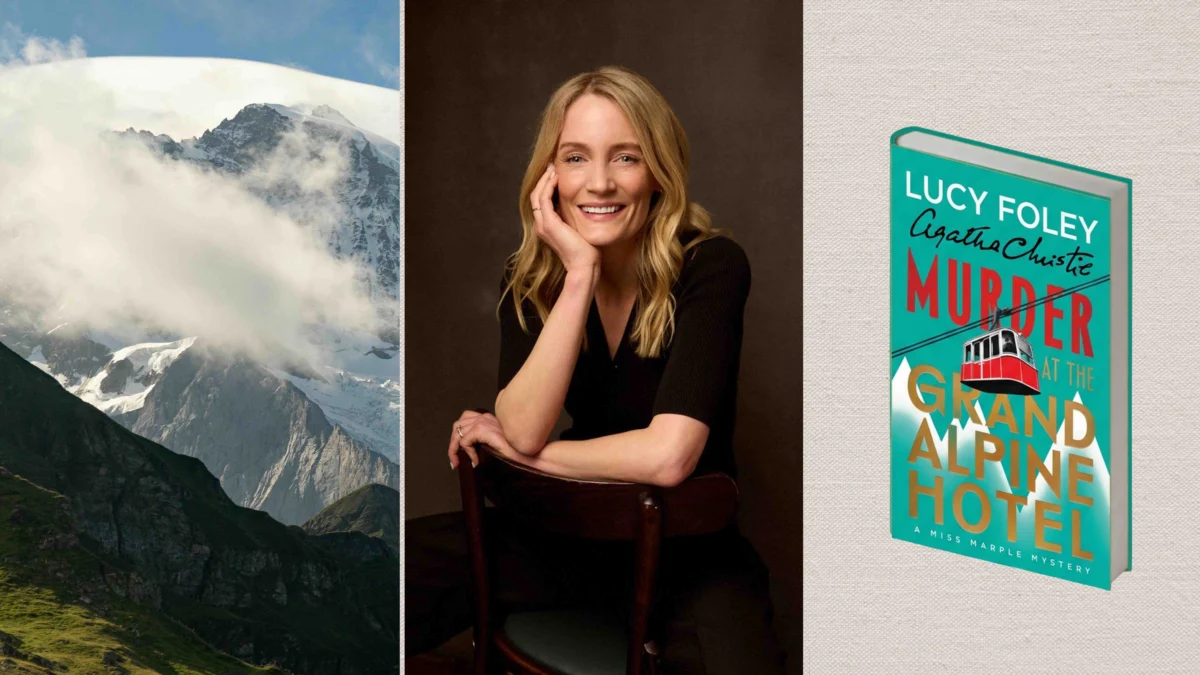
For decades, the image of Jane Marple has been inextricably linked to the quiet, rolling greens of St. Mary Mead. She is the quintessential English spinster: knitting needles in hand, sharp-eyed, and perpetually underestimated by those who mistake her modesty for frailty. While Hercule Poirot has enjoyed a cinematic renaissance—traversing the globe from the luxury of the Orient Express to the sun-drenched banks of the Nile—Miss Marple has remained, in the public imagination, rooted to her local parish.
That changes this year. In a landmark literary event, author Lucy Foley has been tapped by the Agatha Christie estate to pen the first new Miss Marple mystery in half a century. Titled Murder at the Grand Alpine Hotel, the novel thrusts the beloved amateur detective into the high-altitude, high-stakes world of a 1950s Swiss ski resort. It is a bold departure for a character defined by the "cozy" mystery genre, trading the garden gate for the precarious, snow-dusted ridges of the Alps.
The Genesis of an Alpine Whodunnit
The impetus for this project was, according to Foley, a desire to honor the original canon while pushing the boundaries of what a Miss Marple story could be. "The estate said they wanted my take on a Miss Marple book rather than a paint-by-numbers Agatha Christie," Foley explains. "I went back and forth on whether I should set it in St. Mary’s Mead, but then I had this idea of taking Miss Marple on another holiday. She only gets to go on one in the original books, and I felt for her because of that."
Foley, known for her mastery of the modern locked-room mystery in novels like The Guest List, saw an opportunity to bridge the gap between Christie’s classic structure and the "masculine" thriller tropes of the mid-20th century. By placing an elderly, unassuming woman in a setting traditionally occupied by the likes of James Bond—think rugged mountain passes, isolated chalets, and international intrigue—Foley creates a dynamic shift in the power structures of the narrative.
Chronology and Context: A Half-Century Wait
To understand the magnitude of this release, one must look at the timeline of the Miss Marple canon. The character last appeared in novels published in the mid-1970s, such as Sleeping Murder and Nemesis. For 50 years, the estate has been protective of the character, ensuring that any continuation of the series remains true to the specific, nuanced voice Christie crafted.
- The 1930s-1970s: The original Golden Age of the Miss Marple mysteries, characterized by the microcosm of St. Mary Mead and occasional excursions.
- The 1970s-2020s: A period of archival preservation, during which Marple remained a static, iconic figure in literary history.
- 2024-2025: The "Alpine Shift." Foley’s new installment represents a modern approach to the classic mystery, utilizing the 1950s—a pivotal, transitional decade for Europe—as the backdrop.
Researching the Heights: A Traveler’s Perspective
The authenticity of Murder at the Grand Alpine Hotel is rooted in Foley’s extensive, hands-on research. She did not merely rely on archival descriptions of the Swiss Alps; she traversed them. "I went to several different spots in the Alps," Foley notes. "My big trip was to Chamonix in the French Alps, but from there, I drove to Zermatt, went to Saint Moritz, and traveled through the Mont Blanc tunnel to Le Corbier and various Italian resorts."
Foley’s research highlights a fascinating dichotomy in the history of the Alps. She explains that before the Romantics reframed the mountains as places of sublime beauty, they were viewed by locals as terrifying, haunted landscapes filled with dragons and malevolent spirits. This historical tension—the clash between the terrifying wilderness and the opulent, civilized world of the grand hotel—serves as the primary thematic engine for the book.
"Every time you go out into the mountains as a skier or a climber, you’re exposing yourself to more danger than we otherwise really experience," says Foley. Her discovery of the Refuge du Montenvers—an isolated, atmospheric hotel accessible by a red train—became the blueprint for the setting of her mystery.
The Hotel as a Crucible of Suspense
Why a hotel? For Foley, the hotel is the perfect laboratory for a murder mystery. "There is a specific geography with a hotel," she observes. "You have these hidden spaces—secret bars, service corridors, and staff quarters—that only seasoned or favored guests would know about."
In the 1950s, hotels were more than just temporary lodging; they were democratizing, anonymous spaces where social classes bled into one another. In the aftermath of World War II, this was particularly volatile. "In the first scene of the book, you see all these different groups of people on the train—Italians, French, British, Americans, and even some Germans—who are suddenly thrown together," Foley explains. "People were bristling at that. It’s only been five years post-war, and they can’t believe they are cheek by jowl with their former enemy."
This social friction provides the perfect cover for a murderer. Anonymity allows characters to reinvent themselves, to hide their wartime pasts, or to rewrite their histories to suit their own ends.
Implications: The Enduring Nature of Miss Marple
One of the central questions surrounding this release is whether Miss Marple can function outside of the English countryside. Foley’s answer is a resounding yes, predicated on the character’s greatest strength: her observation.
"She is such a great reader of character," Foley says. "She refers everything back to her experience in St. Mary’s Mead because it is a microcosm of everything humanity can be. Whether she is in the Caribbean or the Alps, she takes people as they are and sees the truth of them."
Foley distinguishes Marple from other literary detectives by noting her moral clarity. While Hercule Poirot is occasionally susceptible to his own ego or the charm of a suspect, Marple is, according to Foley, immune. "She can be a figure of nemesis, in a very powerful, shape-shifting way. She is the Gray Man of mystery, yet she remains uniquely herself."
Future Prospects: Will Marple Travel Again?
While Murder at the Grand Alpine Hotel is currently presented as a singular event, the ending of the book—and the hints dropped by Foley—suggest that there is more to discover about the detective’s history.
"Miss Marple hasn’t always lived in St. Mary’s Mead," Foley teases. "We find out that in her youth she lived in a different country for a time, so I think I would take her back there."
Whether this marks the beginning of a new, globetrotting era for the world’s most famous spinster remains to be seen. However, by effectively blending the classic Christie "cozy" with the atmospheric intensity of the Alpine thriller, Lucy Foley has breathed new life into an icon, proving that even after 50 years, Jane Marple still has secrets to uncover.
Supporting Data: The Setting’s Real-World Inspirations
- Refuge du Montenvers (France): Served as the primary inspiration for the hotel’s isolation and atmosphere.
- Badrutt’s Palace and Kulm Hotel (St. Moritz, Switzerland): Provided the historical research for 1950s luxury, specifically the tradition of "ice-skating waiters" in black tie.
- Post-War Context: The novel captures the specific socio-economic reality of the 1950s, noting the contrast between the well-heeled travelers of different nations and the lingering, gray rationing of post-war Britain.
Murder at the Grand Alpine Hotel is now available, inviting readers to pull on their woolens and prepare for a mystery that, while set in the snow, is as sharp as a needle.
 Nana
 rifanmuazin
 Lina Irawan
