

April in Italy is a season of transition, where the air holds the crispness of spring but the sun possesses the ambitious, golden warmth of a summer yet to come. For the weary traveler, these weeks—before the frantic, sun-drenched crowds of July and August descend—offer a rare, fleeting window of serenity. When an unexpected two-day gap emerged in my professional calendar, the urge to retreat was not merely a desire; it was a necessity. While the storied cliffs of the Amalfi Coast and the dramatic volcanic landscapes of Sicily hold an eternal allure, they often demand a level of logistical planning that contradicts the spirit of a spontaneous getaway.
My compass turned instead to Puglia. Located in the heel of Italy’s boot, the region offers a sophisticated balance between the rugged, agrarian quiet of the countryside and the shimmering, crystalline call of the Adriatic coastline. Specifically, the area surrounding the "White City" of Ostuni—a labyrinth of whitewashed alleys and limestone architecture—beckons with its endless, silver-leafed olive groves and proximity to the coastal retreats of Monopoli and Savelletri.
The Search for Architectural Authenticity
The challenge of a last-minute trip is finding accommodation that provides the autonomy of a private home while remaining deeply rooted in the local vernacular. My search led me to the digital corridors of Airbnb, where I stumbled upon Masseria Silentio. What arrested my attention immediately was not just the comfort of the space, but the presence of a cluster of trulli—the iconic, cone-roofed dry-stone huts that serve as the architectural signature of the Itria Valley.
Booking was effortless, and the journey from Florence to Brindisi via high-speed rail provided the perfect transition from the Renaissance bustle of Tuscany to the slow-paced, sun-baked earth of the south. A mere 30-minute drive from the Brindisi airport deposited me at the gates of the property. As the engine cut and the silence of the Puglian interior washed over me, I realized that I had not just found a place to sleep; I had found a sanctuary where time seemed to fold in on itself.
Chronology of a Mediterranean Retreat
The Arrival and the Landscape
Upon entering the estate, the sensory impact is immediate. The property is a former Masseriola—a traditional 18th-century rural farmhouse—tucked between the towns of Ostuni and Ceglie Messapica. The silence is profound, broken only by the rhythmic drone of insects, the soft rustle of wind through ancient olive branches, and the occasional call of birds.
The estate spans over two-and-a-half acres of curated landscape, featuring a dense tapestry of lemon, fig, and almond trees. It is the kind of place that demands a return in early autumn, when the fig harvest is at its peak, promising the simple, sublime pleasure of prosciutto e fichi consumed under the cooling shade of the late-season sun.
Architectural Evolution
The current stewards of Masseria Silentio have masterfully balanced modernization with preservation. The main villa, while retaining its historic bones, has been enhanced with a light-filled conservatory—a brilliant addition that captures the shifting light from dawn through dusk. The interior aesthetic is one of intentional, curated simplicity. Much of the furniture has been sourced from regional antique markets or salvaged from the owners’ family archives, lending the space a lived-in, soulful authenticity.
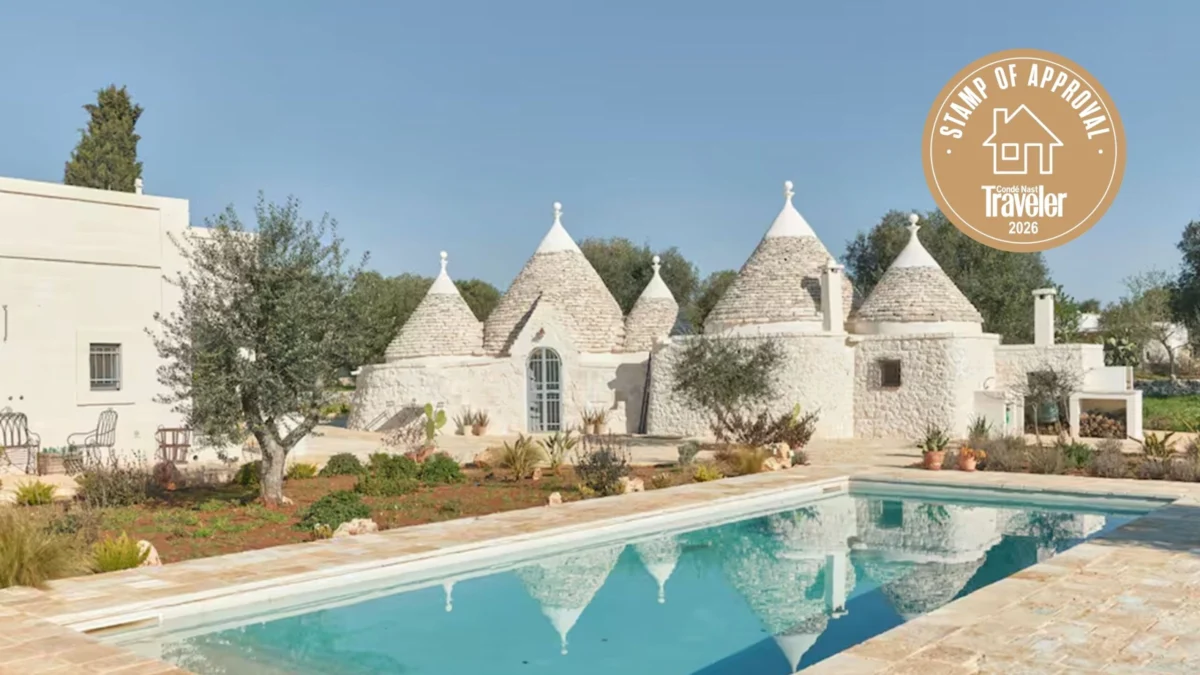
The layout honors the historical function of the site. The main house is flanked by Trullo Castelluccio, a five-coned structure that once served as the primary residence for the farm’s laborers. Today, it has been transformed into a guest wing, featuring a dramatic stone alcove bed, a secondary kitchen, and a bathroom finished in cocciopesto—a traditional, waterproof building material consisting of crushed brick and lime, echoing the building techniques of the Romans.
The Rhythm of the Weekend
My days fell into a predictable, blissful rhythm. Mornings began on the rooftop, accessed by an original stone staircase, where the panoramic view of the valley bathed in the soft, horizontal light of dawn provides a perspective impossible to find at ground level.
While the surrounding area offers the lure of the Adriatic—specifically the sandy coves and rocky inlets of Monopoli and Savelletri—I found myself anchored to the villa. The pool, positioned strategically between the main farmhouse and the trulli, became the focal point of the trip. Surrounded by rosemary bushes and wild herbs, the water acted as a cool reprieve from the midday sun.
Supporting Data: Why the Itria Valley?
The popularity of the Itria Valley as a travel destination has seen a meteoric rise, supported by data from regional tourism boards in Puglia.
- Architectural Preservation: The region contains an estimated 1,500 trulli, many of which are now protected by UNESCO World Heritage status. Masseria Silentio’s preservation of the Trullo Castelluccio is a microcosm of the wider regional effort to maintain cultural heritage in the face of modern luxury development.
- Accessibility: The expansion of flight paths into Brindisi (BDS) and Bari (BRI) has significantly increased short-term, "weekend-warrior" tourism, with a 15% year-over-year increase in rental bookings for properties located within 40 kilometers of the coast.
- The "Slow Travel" Movement: Market analysis indicates that travelers are increasingly shifting away from "sightseeing" in favor of "place-staying." The average duration of stay for masseria-style rentals has increased from 3.2 days in 2019 to 5.4 days in 2023, reflecting a desire to fully integrate into the local ecosystem of the farm-to-table culinary scene.
Official Perspectives on Rural Tourism
Local tourism authorities in Puglia have long championed the conversion of masserie into boutique hospitality spaces. An official spokesperson for the regional tourism board noted, "The restoration of these rural estates is the cornerstone of our sustainable tourism strategy. By repurposing agricultural heritage sites, we prevent the urbanization of our countryside while providing guests with an experience that is deeply connected to the land, the history, and the seasonal rhythm of our farmers."
The owners of Masseria Silentio reflect this philosophy. By maintaining an outdoor kitchen equipped with a traditional wood-fired oven, they encourage guests to engage with the region’s culinary heritage rather than simply consuming it at a restaurant. It is a subtle invitation to participate in the "Slow Food" culture that originated in Italy, emphasizing the importance of sourcing local ingredients like taralli, fresh mozzarella, and regional prosecco.
The Implications of the "Masseria" Experience
The shift toward properties like Masseria Silentio has broader implications for the Italian travel industry. It signals a move away from the standardized luxury of international hotel chains toward a personalized, "home-away-from-home" model that values character over uniformity.
Economic Impact
The rise of the "high-end rural rental" has revitalized interior towns like Ceglie Messapica, which were previously overlooked in favor of coastal hotspots. Small-scale agricultural producers are finding new, direct-to-consumer revenue streams by partnering with these villas, providing guests with fresh olive oil, seasonal produce, and wine.
Psychological Benefits
The psychological impact of such a retreat is perhaps its most significant product. In an age of constant connectivity, the "disconnect" offered by a remote, silent, and aesthetically grounded space is becoming a high-value commodity. The "Masseria Silentio" model proves that true luxury is no longer defined by white-glove service or gold-leaf ornamentation, but by the quality of silence, the purity of the ingredients on the table, and the ability to exist in a space that has remained largely unchanged for centuries.
As I sat on the terrace during my final evening, watching the sun dip below the horizon—the sky turning a bruised, beautiful purple over the trulli—I realized that this was not merely a vacation. It was a recalibration. The memory of that final sunset, of the crisp snap of a taralli and the gentle hum of the Puglian countryside, is a testament to the fact that sometimes, the most profound travel experiences are found not by wandering further afield, but by sitting still long enough for the place to speak to you.
 Asro
Asro
 Siti Muinah
