

For decades, the standard museum dining experience in New York City was a utilitarian afterthought—a place to grab a lukewarm coffee or a pre-packaged sandwich before rushing back to the galleries. But the tides of the city’s culinary scene have shifted. Today, the museum restaurant is no longer merely a "complement" to the art on the walls; it is increasingly a destination in its own right, often functioning as an immersive art experience that stands on its own merits.
As Apicius famously noted, “We eat with our eyes first.” In 2024, New York City’s most prestigious institutions are taking this adage to heart, transforming their dining spaces into sophisticated, design-forward hubs that command attention long after the galleries have dimmed their lights.
The New Frontier of Institutional Dining
The city is witnessing a renaissance of the museum-restaurant model. Recent high-profile openings—such as Zoli at the Amant, Marcel at the Breuer, and the Westmoreland café at the Frick Collection—have joined established titans like The Modern at the Museum of Modern Art and Café Sabarsky at the Neue Galerie. These establishments have shattered the "tethered" model, where a restaurant’s relevance vanished the moment the museum’s turnstiles clicked shut for the night.

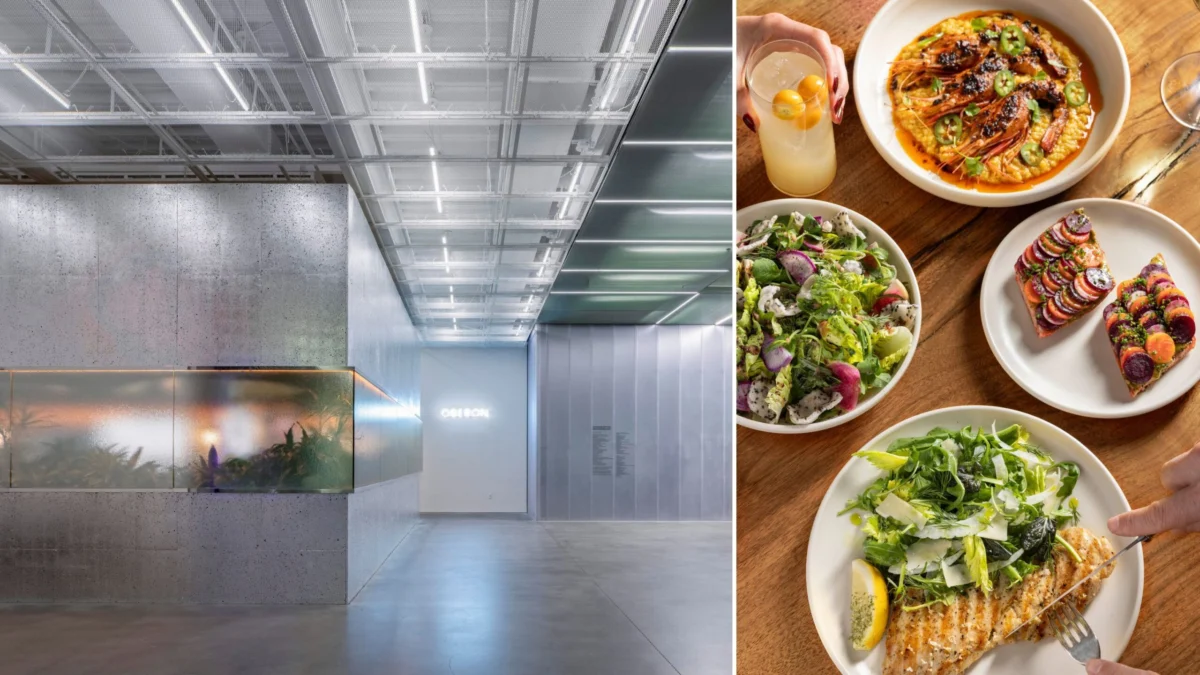
The latest, and perhaps most audacious, entry into this fray is Oberon, the final flourish in the New Museum’s ambitious $82 million, two-year expansion. Designed by Shohei Shigematsu of the Office for Metropolitan Architecture (OMA) and Rem Koolhaas, the project is a masterclass in modern institutional integration.
A Chronology of Expansion: From Blueprint to Bistro
The New Museum’s evolution began in earnest with its commitment to nearly doubling its footprint. With the addition of 60,000 square feet dedicated to new exhibition galleries, artist residencies, and public gathering spaces, the museum sought to fundamentally alter how the public navigates the building.
- March 2024: The New Museum officially opens its expanded wing, signaling a shift toward a more permeable, community-integrated architecture.
- The Conceptual Phase: Shohei Shigematsu and his team at OMA begin investigating the "DNA" of the original building—designed by Sejima and Nishizawa—to ensure the new wing did not simply act as an annex but as a complementary partner.
- The Oberon Launch: As the capstone of the expansion, Oberon opens its doors, managed by The Oberon Group. The restaurant is strategically designed to function as a public anchor for the downtown arts community.
- Operational Shifts: Unlike traditional museum cafes, Oberon establishes a dual-entry system. By day, it serves as a lobby-accessible retreat for museum-goers. By night, it pivots to a standalone venue, accessible via an industrial walkway from Freeman Alley, remaining open until 1 a.m. to serve the vibrant downtown nightlife.
The Architecture of Taste: Sustainability Meets Futurity
The physical manifestation of Oberon is, in a word, singular. Housed in a freestanding, brutalist-inspired box within the lobby, the restaurant hides a warm, cave-like interior behind an exterior of silver-leafed, CNC-milled cork.

The Materiality of the Space
The use of cork is not merely an aesthetic choice; it is a statement on sustainability. Sourced from Portugal, the material is heated and bound into blocks, then sculpted to create an organic, tactile environment. The textured laminated glass surrounding the space creates a subtle two-way mirror effect, reflecting the frenetic energy of the museum lobby while offering diners a sense of secluded intimacy.
Inside, the design evokes the familiarity of a classic American diner, albeit one from the future. Three-dimensional domes carved into the ceiling provide acoustic and visual intimacy for individual booths, while lighting and ventilation systems are hidden within the cork structure, ensuring that technology remains subservient to the atmospheric experience.
Supporting Data: An Interdisciplinary Ecosystem
The success of Oberon lies in its refusal to exist in a vacuum. It is a collaborative project that draws from the deepest wells of New York’s creative talent.

- Culinary Curation: Executive Chef Julia Sherman, author of Salad for President, emphasizes a vegetable-forward, approachable menu. Signature dishes, such as the prawn and yellow lentil dal with salsa negra, are designed to offer comfort without sacrificing complexity.
- Uniforms and Tableware: Fashion designer Mary Ping (Slow and Steady Wins the Race) curated the staff uniforms. Tableware is a collaborative effort between The Noble Studio and Powerhouse Arts Ceramics Studio, grounding the high-concept environment in local craftsmanship.
- Artistic Integration: The bar is home to Shrine Oberon, an interactive LED installation by artist Ian Cheng. Using AI, the work features a digital "shrinekeeper" that tracks and learns from patrons, creating an evolving portrait of the museum’s demographic over time.
Official Perspectives on the "Third Space"
The philosophy behind Oberon is articulated clearly by its creators. Shohei Shigematsu notes, “We sought to create a similar dynamic between Oberon and the greater museum, believing that a museum restaurant best serves the institution by offering its own unique, self-contained experience.”
This sentiment is echoed by Julia Sherman, who views the restaurant as an essential "exhale" for visitors. "A museum offers so much visual and intellectual stimulation," Sherman explains. "We imagined the restaurant as a kind of grounding experience—a place to process the whirlwind of ideas encountered throughout the galleries."
Henry Rich, managing partner of The Oberon Group, highlights the social engineering at play: "The process is really about understanding the community and creating a restaurant that serves its social, aesthetic, and civic needs. We aren’t just feeding people; we are providing a nexus for the downtown art world."

The Implications: A New Civic Model
The rise of destination dining in museums like the New Museum signals a broader shift in how we value public space.
1. The Death of the "Museum Hours" Constraint
By decoupling the restaurant’s operational hours from the museum’s gallery schedule, institutions like the New Museum are maximizing the utility of their real estate. This transforms the museum from a destination visited once or twice a year into a "third space" visited weekly for dinner or drinks, deepening the connection between the institution and the local neighborhood.
2. The Commercialization of Atmosphere
As museums face shifting funding landscapes, revenue-generating entities like high-end restaurants provide a buffer. However, the success of these ventures depends on their ability to avoid feeling like a concession stand. By bringing in acclaimed chefs and collaborating with artists, these spaces justify their price points through the lens of cultural experience.

3. The Integration of Digital and Physical Worlds
The inclusion of AI-driven art like Ian Cheng’s Shrine Oberon marks a turning point. It suggests that the "museum restaurant" of the future will be a hybrid space—part lounge, part art installation, and part community center. It reflects a growing desire for spaces that can "remember" their patrons, providing a personalized layer to the anonymous experience of city living.
Conclusion: An Invitation to Linger
As New York City continues to evolve, the definition of an art institution is expanding. It is no longer defined solely by the white cube of the gallery, but by the fluidity of the spaces that surround it. Through projects like Oberon, the New Museum has demonstrated that the most effective way to engage the public is to invite them to sit down, share a meal, and interact with the environment in a way that is as intellectually stimulating as it is physically satisfying.
In an age where digital interaction dominates, the return to tactile, communal dining—framed by thoughtful design and artistic intent—is a welcome evolution. Whether one is a serious collector, a casual visitor, or a local looking for a late-night escape, the message of the modern museum restaurant is clear: come for the art, stay for the dialogue.
 Asro
Asro
 Siti Muinah
