

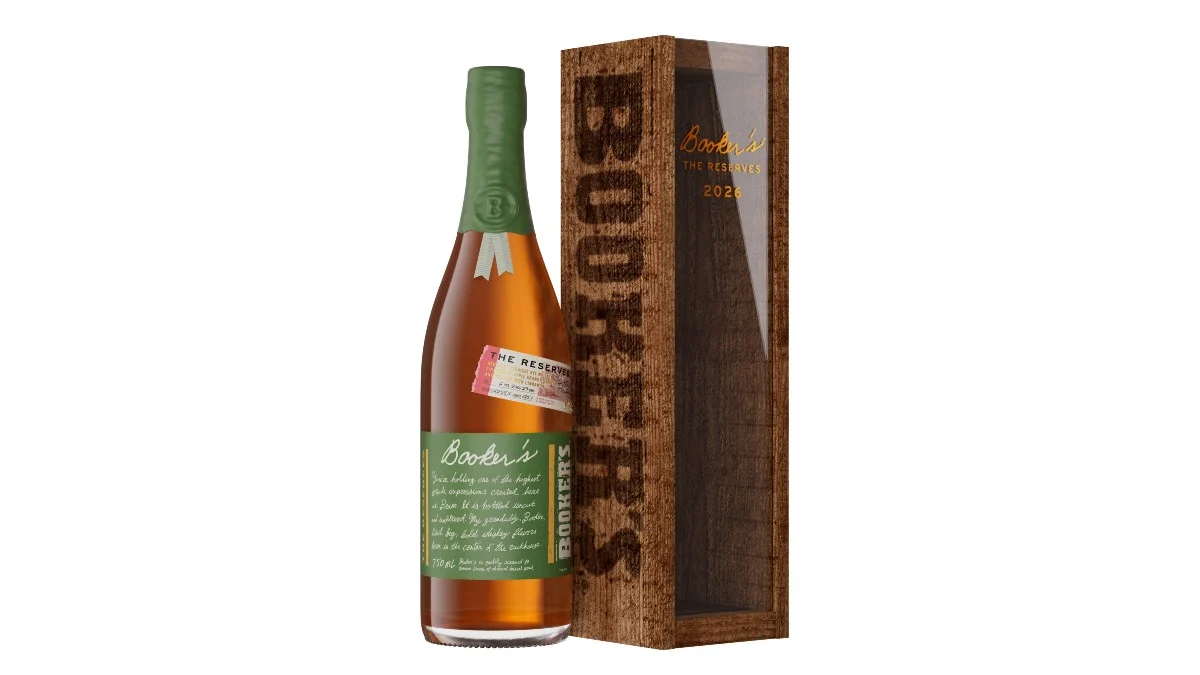
Welcome to Taste Test, where every week our critic Jonah Flicker explores the most buzzworthy and interesting whiskeys in the world. Check back each Sunday for his latest deep dive into the evolving landscape of global spirits.
In the world of ultra-premium American whiskey, few names carry the weight and reverence of Booker’s. Known for its uncut, unfiltered, barrel-strength bourbon, the brand is a cornerstone of the James B. Beam Distilling Co. portfolio. A decade ago, the brand made waves by releasing its first-ever rye whiskey. That bottle, the legendary "Big Time Batch," became a cult classic, a unicorn bottle that now commands upwards of $2,000 on the secondary market.
Now, the distillery has returned to the rye category with its second-ever release, but the reception has been anything but uniform. In a move that has baffled purists and sent shockwaves through the whiskey community, the brand has finished this new rye in apple brandy barrels and—most controversially—infused it with cinnamon sticks. It is a bold, perhaps even reckless, experiment that challenges the very definition of what a "Booker’s" release should be.
The Chronology of a Controversial Recipe
To understand why this release has sparked such a heated debate, one must look at the history of the Booker’s label. The brand was the brainchild of the late, legendary master distiller Booker Noe, who established a legacy of high-proof, robust, and unfiltered spirits. For years, the brand stuck to a rigid philosophy: provide the drinker with the purest expression of the liquid as it came from the barrel.
When the first rye was released, it was hailed as a masterpiece. According to the brand, it utilized a specific, proprietary mashbill developed by Booker Noe in the early 2000s. This recipe remains shrouded in mystery, though industry insiders estimate it sits at approximately 65 percent rye, striking a delicate balance between the standard Beam rye mashbill and the more traditional Pennsylvania-style recipes used for Old Overholt.
The new release, part of the "Reserves" series curated by eighth-generation master distiller Freddie Noe, takes a sharp detour from this tradition. The process began with a rye whiskey matured for six years, two months, and 23 days. From there, the whiskey underwent an "inexplicable" finishing process: maturation in apple brandy barrels, paired with the direct infusion of cinnamon sticks. While the internet was quick to label it "Booker’s Fireball," Freddie Noe maintains the inspiration is rooted in family history, specifically an old apple wine recipe his grandfather used to craft, which relied on the combination of apples, bourbon barrels, and cinnamon.
Supporting Data: Behind the Proof and Profile
Despite the unconventional finishing, the technical specifications of the whiskey remain grounded in the brand’s high-proof heritage. The liquid is substantial, carrying the weight and mouthfeel expected from a barrel-proof release.
Upon tasting, the primary note is, inevitably, cinnamon. However, it is important to distinguish this from the artificial, syrupy sweetness found in mass-market flavored whiskies. This is not the cloying "potpourri" cinnamon often associated with amburana-finished spirits; rather, it is a sharp, woody, and direct hit of cinnamon stick. Behind that dominant spice, there are glimpses of the classic Booker’s DNA—notes of oak, roasted peanuts, and rich, dark caramel. The apple brandy influence adds a subtle, tart fruitiness that bridges the gap between the rye’s inherent spice and the added cinnamon.
When analyzed alongside its predecessors in the Reserves series—the first being a blend of aged bourbons and the second finished in El Tesoro tequila barrels—this new release represents a radical shift toward experimentation. While the tequila finish was seen as a nod to global craft, the cinnamon-apple treatment is viewed by some as an intrusion into the sanctity of the spirit.
Official Responses and Industry Skepticism
The lead-up to this launch was characterized by a level of skepticism rarely seen for a brand of this stature. Online forums were ablaze with criticism long before the bottle hit shelves. One industry writer famously dubbed it "Booker’s Fireball," a jab at its perceived lack of seriousness. Others speculated that the decision to infuse the liquid was a "fix" for a barrel finish that had gone wrong, rather than an intentional, creative choice.

The distillery, however, remains steadfast. Freddie Noe’s defense of the product is rooted in the idea that distilling, at its core, is a creative pursuit. The official stance is that the Booker’s label, while prestigious, should not be a cage. By drawing on his grandfather’s personal recipes, Noe argues that he is honoring the spirit of experimentation that defined Booker Noe’s life, even if the result pushes the boundaries of traditional rye whiskey.
Implications for the Future of Premium Whiskey
The release of this rye whiskey raises a fundamental question for the modern whiskey drinker: Is whiskey a sacred, static craft, or is it a medium for innovation?
For the "entrenched" drinker—the collector who prizes the 2014 rye and views barrel-proofing as a religion—this release is an affront. The implication is that the brand is prioritizing novelty over the purity of the grain. If a brand as storied as Booker’s can "mess with convention," it suggests that no bottle is safe from the current trend of "finish-heavy" whiskey production.
Conversely, there is an argument to be made for breaking the mold. The industry has become saturated with similar flavor profiles, and by introducing a product that is undeniably different, the brand is forcing a conversation about the nature of the spirit. If nothing else, the controversy has ensured that this bottle will be discussed, debated, and tasted—perhaps more than any other release this year.
The Verdict: Why It’s Worth a Try
After spending a week with the bottle, returning to it periodically to see how the profile evolved, my perspective shifted. It is not an everyday pour. It does not replace the classic, deep, earthy rye whiskeys that fans have come to love. However, it is an intriguing study in flavor manipulation.
When used in an Old Fashioned, the cinnamon and apple notes harmonize with bitters and sugar in a way that feels almost festive, elevating the cocktail into a winter-appropriate treat. While it may not be the "unicorn" that collectors were hoping for, it is a fascinating, if odd, addition to the Booker’s catalog.
Ultimately, the whiskey world should perhaps take a breath. It is, at the end of the day, just spirits. If we are to demand innovation, we must be willing to accept that some experiments will be polarizing. The Booker’s Reserves 2026 may not win over the purists, but it is a bold, unapologetic expression that demands to be judged on its own merits rather than the shadow of its predecessors.
Score: 86
Final Thoughts on the Collection
As we continue to track the "Taste Test" series, this bottle serves as a reminder that the industry is in a state of flux. Whether this release becomes a forgotten footnote or a precursor to a new era of experimental barrel-proof finishes remains to be seen. For now, it serves as a reminder to keep an open mind—even when the bottle seems determined to prove you wrong.
 Ali Ikhwan
 Laily UPN
 Raul Delapena Setiawan
