

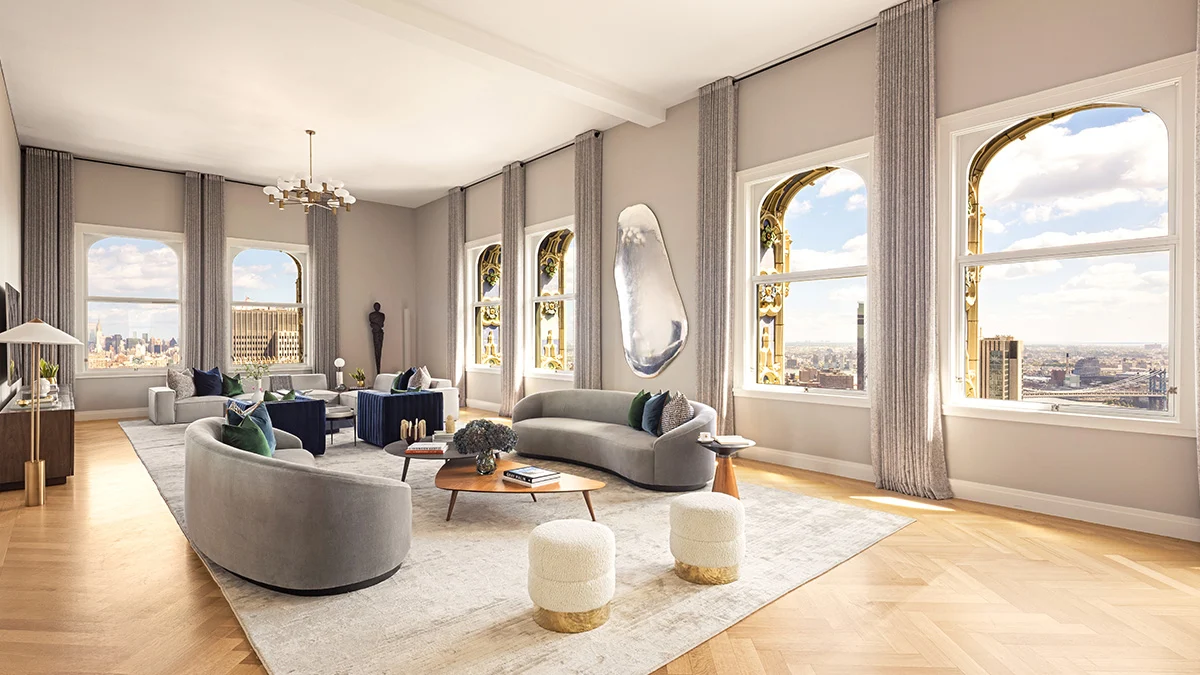
High above the bustling streets of Lower Manhattan, perched 516 feet above the verdant canopy of City Hall Park, lies a piece of American retail history that has been reimagined for the modern era. Residence 40, located in the iconic Woolworth Building, is more than just a luxury condo; it is a time capsule of the Gilded Age, once serving as the private executive retreat for F.W. Woolworth, the titan who revolutionized the retail landscape with his eponymous "five-and-dime" stores.
Today, this 6,000-square-foot residence has hit the market, listed for $18.5 million by Catherine Juracich of Corcoran. It stands as a testament to the intersection of historic preservation and contemporary high-end living, offering a rare opportunity to own a fragment of the skyline’s most storied skyscraper.

Main Facts: A Sky-High Sanctuary
Residence 40 occupies a rarefied position within the neo-Gothic masterpiece commissioned by F.W. Woolworth and completed in 1913. At the time of its inception, the tower was the tallest building in the world, a title it held for 17 years.
The residence is defined by its dramatic proportions and authentic detailing. It is the only unit within the building that retains the original, exquisite polychromatic terra-cotta detailing in a floral motif, which frames the oversized windows. Combined with 15-foot ceilings, the space feels both cavernous and intimate. A private elevator grants immediate, exclusive access to a 50-foot great room that serves as the heart of the home, offering panoramic vistas that span from the Hudson River to the East River, effectively framing the entirety of Lower Manhattan.

The home’s culinary center is a study in modern refinement, featuring custom Dada cabinetry, deep Calacatta Caldia marble surfaces, and a suite of high-performance Miele appliances. The dining area, designed to comfortably accommodate over 20 guests, is surrounded by the building’s signature arched windows, ensuring every meal is served against a backdrop of New York City’s most historic architectural landmarks. The private quarters are equally impressive, with four bedrooms—each with an en-suite bathroom—and a corner primary suite that boasts a sprawling dressing room and a spa-like marble bathroom with heated flooring.
The Chronology of a Landmark
The history of the Woolworth Building is inextricably linked to the meteoric rise of the American consumer economy.

- 1910–1913: Commissioned by Frank Winfield Woolworth, the building was designed by architect Cass Gilbert. It was built to be a "Cathedral of Commerce," a moniker it earned due to its soaring, ecclesiastical Gothic lines and intricate terra-cotta facade.
- 1913: The skyscraper is officially opened. It reigned as the tallest building in the world at 792 feet, symbolizing the global reach of Woolworth’s retail empire.
- The Mid-20th Century: The tower remained the headquarters for the F.W. Woolworth Company for decades. As the company evolved and eventually morphed into the entity now known as Foot Locker, the building transitioned from a singular corporate hub to a multi-tenant commercial office tower.
- 2012–2015: Alchemy Properties acquired the top 30 floors of the building to execute a complex residential conversion. The late, renowned architect Thierry W. Despont was brought on to oversee the interiors, tasked with balancing the building’s historic soul with the demands of 21st-century ultra-luxury.
- 2024–Present: The building has become a magnet for high-profile residents and pop-culture fame, with its units frequently featured in prestige media, including the hit HBO series Succession, where the tower’s interiors served as the backdrop for the life of the Roy family.
Supporting Data: Architectural and Market Context
The conversion of the Woolworth Building was a massive undertaking, requiring the delicate preservation of the facade while gutting the interior to accommodate 33 private, high-end residences.
- Architectural Detail: The terra-cotta, which features gargoyles and intricate floral patterns, was painstakingly cleaned and restored. The interior design by Despont utilized high-quality finishes—white oak cabinetry, marble slab bathrooms, and soundproofed glazing—to ensure that the heritage feel was not sacrificed for modern convenience.
- Building Amenities: Beyond the private walls of Residence 40, the building offers a suite of white-glove amenities that were unthinkable in 1913. These include a 50-foot lap pool, a state-of-the-art fitness studio, a temperature-controlled wine cellar with a private tasting room, and a dedicated, full-time staff. The "Gilbert Lounge," named in honor of the building’s original architect, serves as an exclusive social space for residents.
- Market Positioning: At $18.5 million, the residence is priced competitively for the current Lower Manhattan ultra-luxury market. Its status as a "landmarked" property with historical provenance provides an investment floor that standard modern luxury towers in Hudson Yards or Billionaires’ Row lack.
Official Responses and Professional Perspectives
Real estate observers note that properties like Residence 40 are increasingly rare. Catherine Juracich, the listing agent, has emphasized that the home is not merely a place to reside, but a piece of New York City’s identity.

In previous discussions regarding the building’s conversion, developers noted that the goal was to "reintroduce the building to the city" as a living space. The conversion has been lauded by architectural preservationists, who feared that such a historic structure might be stripped of its character. Instead, the incorporation of the Gilbert Lounge and the restoration of the terra-cotta detailing have been viewed as a model for how historic skyscrapers can adapt to changing urban needs without losing their aesthetic integrity.
Implications: The Evolution of Lower Manhattan
The listing of Residence 40 arrives at a pivotal time for Lower Manhattan. Long considered the "financial center," the neighborhood has transformed into a vibrant residential community. The presence of such significant historic assets in the hands of private owners—and the willingness of those owners to maintain the building’s legacy—suggests a shift in the neighborhood’s prestige.

The Woolworth Building serves as a anchor for this transformation. As noted by the recent activity in the building—such as the $7.9 million listing by The RealReal’s Julie Wainwright—there is a sustained interest in the "pre-war" aesthetic among the city’s elite. The building acts as a bridge between the industrial grit of the early 20th century and the ultra-refined, high-tech comfort of the 2020s.
Ultimately, Residence 40 represents more than just a transaction. It represents the permanence of New York’s history. As the city continues to rise around it, the Woolworth Building stands as a reminder of the ambition that built the modern metropolis. For the next owner, the purchase is an invitation to live at the summit of a legacy, watching over the city that Frank Winfield Woolworth helped build, one dime at a time.
 Ali Ikhwan
 Laily UPN
 Raul Delapena Setiawan
