

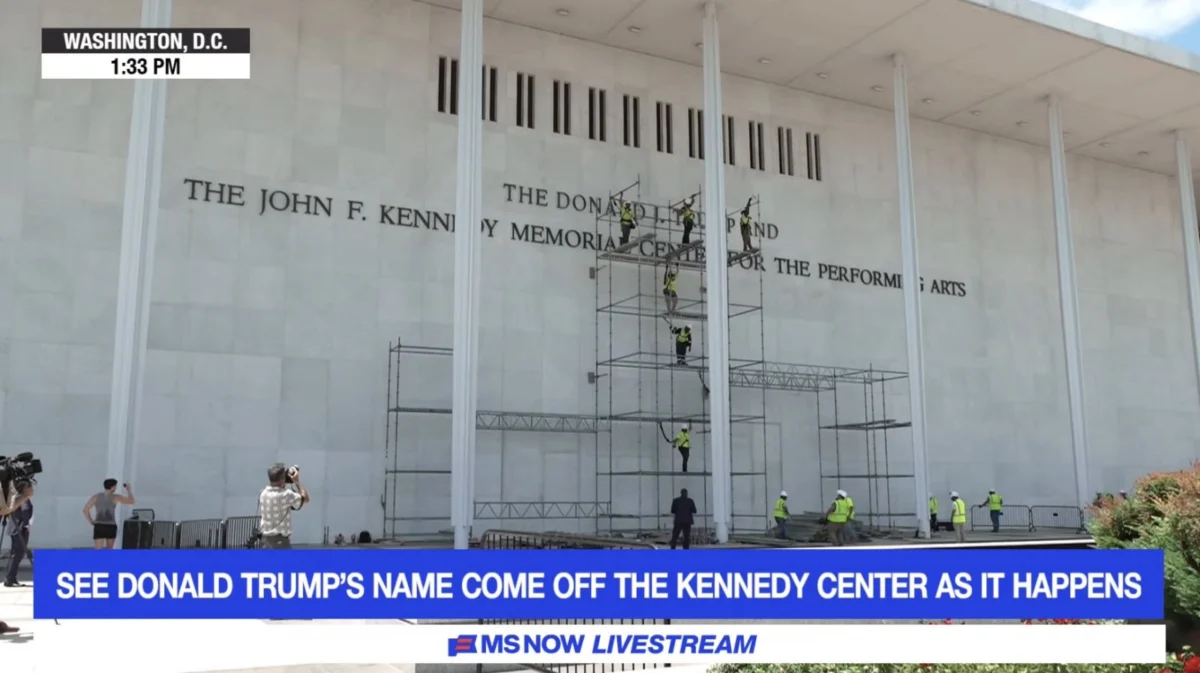
The iconic white marble facade of the John F. Kennedy Center for the Performing Arts—a symbol of American cultural prestige and artistic excellence—has finally been restored to its original, singular identity. Following a protracted legal battle that captivated Washington D.C. and polarized the national arts community, the final vestiges of Donald Trump’s name have been physically removed from the building’s exterior. This act marks the conclusion of a tumultuous 18-month chapter that saw the historic institution become a flashpoint for constitutional overreach, artistic rebellion, and judicial intervention.
The Chronology of a Controversial Takeover
The saga began in early 2025, shortly after Donald Trump assumed the presidency for his second term. Seeking to exert influence over the nation’s cultural landmarks, the administration moved swiftly to install new leadership at the Kennedy Center. By December 2025, this newly appointed board took the unprecedented step of rebranding the institution, formally appending the president’s name to the title.
The building’s signage was overhauled to read, "The Donald J. Trump and The John F. Kennedy Memorial Center for the Performing Arts." The move was immediately met with widespread condemnation from historians, lawmakers, and the arts community, who viewed it as a partisan appropriation of a federal memorial dedicated to a predecessor.
The administration’s agenda extended beyond mere branding. Shortly after the name change, Trump’s allies proposed a two-year closure of the facility, citing "necessary renovations." Critics, however, viewed the move as an attempt to shutter the venue to avoid the public backlash that had already begun to manifest in the form of artist boycotts and plummeting ticket sales.
The situation reached a breaking point in May 2026, when U.S. District Judge Casey Cooper issued a blistering ruling against the administration. Cooper concluded that the executive branch had acted illegally by bypassing Congress to alter the legal identity of a federal institution. The court ordered a total reversal of the name change within 14 days, a deadline that culminated in the physical removal of the lettering this week.
Legal Precedent and Constitutional Authority
The core of the dispute rested on the separation of powers. In his ruling, Judge Cooper was unequivocal regarding the limits of executive authority over national memorials. He noted that the original legislation establishing the Kennedy Center—named in honor of the 35th President of the United States—vested naming authority exclusively in the Legislative Branch.
"The law makes crystal clear that the Center is to be named for President John F. Kennedy, and it cannot bear any other formal name or public memorial based on the Board’s unilateral say-so," Cooper wrote in his May opinion. "Congress gave the Kennedy Center its name, and only Congress can change it."
This judicial rebuke effectively nullified the board’s decision-making power regarding the facility’s nomenclature. When the Trump administration attempted an 11th-hour appeal to stay the order, the federal court swiftly denied the motion, ensuring that the physical erasure of the name proceeded without further delay. The final moments of the removal—a symbolic end to a controversial tenure—were broadcast live by MS Now, providing a visual capstone to a year and a half of institutional strife.
The Toll on the Performing Arts
The ripple effects of the Trump administration’s tenure at the Kennedy Center extended far beyond the name on the facade. The institution, once a bastion of non-partisan artistic expression, became a theater for ideological conflict.
As the rebranding became official, the Center saw a wave of cancellations from world-class musicians, theater troupes, and performance ensembles. Many artists publicly cited the politicization of the venue as their reason for withdrawal. This mass exodus of talent led to a drastic decline in revenue, as the Center’s programming schedule was decimated by the loss of performers who refused to appear under the rebranded name.
One of the most notable legal skirmishes involving this decline was the lawsuit filed by the administration against jazz drummer Chuck Redd. The Center’s management had attempted to sue the musician for breach of contract after he canceled a scheduled Christmas concert in protest of the name change. However, in June 2026, a D.C. judge threw out the lawsuit, ruling that no binding contract existed to begin with, effectively shielding the artist from the administration’s litigation tactics.
Institutional Implications and Future Stability
The restoration of the Kennedy Center’s original name raises significant questions about the future of federal cultural institutions. Observers point to the case as a watershed moment for the protection of national landmarks from short-term political interference. By reinforcing that an act of Congress is required to alter a memorial, the judiciary has erected a guardrail that may prevent future administrations from treating national monuments as personal political branding tools.
For the Kennedy Center itself, the challenge now lies in rebuilding its reputation. The institution faces a long road toward restoring its standing with the global artistic community. Sources within the arts management sphere suggest that the Center will need to implement a series of initiatives aimed at transparency and autonomy to regain the trust of the performers and patrons who fled during the 2025–2026 crisis.
The appointment of a new, independent board, and the formal audit of all institutional policies adopted during the "Trump era," are expected to be the first steps in this recovery. The goal is to move the Center back toward its mission of "presenting the greatest performances of music, dance, and theater," rather than serving as a platform for political maneuvering.
Official Responses and Public Sentiment
The reaction to the name removal has been largely celebratory among the D.C. arts community and political figures who opposed the change. Ohio Representative Joyce Beatty, who served as a primary plaintiff in the lawsuit against the administration, hailed the removal as a victory for the rule of law.
"Today, the Kennedy Center belongs to the American people again," Beatty stated in a press release following the removal. "No individual, regardless of their position in the executive branch, has the right to rewrite history or usurp the authority of the people’s representatives in Congress."
Conversely, supporters of the former administration have characterized the judicial ruling and subsequent removal as an act of "political bias" by the federal courts. They argue that the rebranding was an attempt to modernize the institution and bring it under more direct oversight. However, these voices have remained largely marginalized as the legal consensus solidified around the sanctity of the Center’s original legislative charter.
Conclusion: Lessons Learned
The forced removal of Donald Trump’s name from the Kennedy Center is more than a mere change in signage; it is a restoration of a federal mandate. The saga serves as a cautionary tale for those who seek to use cultural institutions for political purposes, illustrating the resilience of established administrative law and the collective power of the artistic community to resist encroachment.
As the physical scaffolding comes down and the name "John F. Kennedy Memorial Center for the Performing Arts" remains the sole title on the building, the institution begins a new chapter. The scars of the last 18 months remain, but the precedent has been set: the nation’s cultural treasures are protected by law, not by the shifting whims of political power. For those who believe in the importance of maintaining non-partisan space for the arts, the outcome is a significant, if hard-won, affirmation of institutional integrity.
 Asro
Asro
 Lina Irawan
 rifanmuazin
