

The landscape of the DC Cinematic Universe has undergone a seismic shift. Since the inception of HBO’s Lanterns, audiences have been captivated by the simmering, complex rivalry between the seasoned Hal Jordan (Kyle Chandler) and the determined, reluctant successor John Stewart (Aaron Pierre). While the series initially focused on their interpersonal friction, keen-eyed fans of James Gunn’s rebooted DC continuity—specifically the events of last summer’s Superman—knew that the mantle of Earth’s primary Green Lantern had already transitioned to the brash, unconventional Guy Gardner (Nathan Fillion).
In the sixth episode of the series, titled "Bad Optics," co-creators Damon Lindelof and Tom King finally bridge the gap between these disparate timelines. The episode is a masterclass in narrative economy, weaving together the fallout of the "Battle of Rushville" with the grim realities of a post-superhuman-disaster world.
The Architect of Survival: John Stewart’s New Path
Following the chaotic events of the Rushville conflict, the narrative jumps to the present day of 2026. The episode finds John Stewart in a state of profound transition. Having walked away from the Green Lantern ring at the precise moment he was finally poised to claim it, Stewart has pivoted toward a civilian life defined by construction and protection.
Now working as an architect alongside his brother, Stewart is pitching a revolutionary concept to the U.S. military and various municipal governments: the "Ark." These are not merely shelters; they are fortified bastions designed to protect vulnerable civilian populations from the collateral damage inherent in a world populated by gods and monsters. Whether it is the lingering trauma of the Rushville incident or the near-total destruction of Metropolis witnessed in Superman, Stewart’s "Ark" project represents a shift in focus from planetary policing to humanitarian survival.
However, the political machinery of the city government—while initially impressed—demands a military endorsement. Before Stewart can navigate the bureaucratic labyrinth of defense contracts, his past pulls him back to the very ground that broke him.

A Diner at the End of the World
The narrative heart of "Bad Optics" lies in the reunion between John Stewart and Hal Jordan. The scene is framed with the deliberate, claustrophobic intensity of a Michael Mann crime drama. In a quiet, unremarkable diner, the two men engage in a tense, oblique conversation that serves as a meta-commentary on their roles within the DC hierarchy.
The dialogue is punctuated by references to the man currently occupying the spotlight: Guy Gardner. Hal, ever the cynic, dismisses Gardner as "that gym teacher on TV," a biting critique of the current status quo. In a nod to the wider DC continuity, Hal reveals that Gardner’s presence in Rushville—specifically the installation of a massive Green Lantern beacon—was a clumsy imitation of the "Bat-guy" in Gotham. It is a moment that highlights the generational divide between the legacy heroes and the current, media-savvy wave of protectors.
But the meeting is short-lived. The weight of their shared history is cut through by a chilling phone call from Kerry (Kelly Macdonald). The news is devastating: Hal Jordan is dead. This revelation finally brings the series full circle, connecting the present day to the cryptic, high-stakes cliffhanger that defined the series premiere.
The Hostility of Rushville
One of the most compelling aspects of "Bad Optics" is the town’s reaction to the loss of a legend. In Rushville, Hal Jordan’s death is not treated as a tragedy, but as a public nuisance. The townspeople, still harboring deep-seated resentment regarding the fallout of the Manhunter incident, view the Green Lanterns with active hostility.
This tension explodes when Stewart attempts to activate the Green Lantern signal. A truckload of locals, led by Billy (Jason Ritter), confronts Stewart, intending to intimidate him. The confrontation underscores the central thesis of the episode: the populace is tired of being the playground for superhuman ego. Stewart’s brutal, efficient dismantling of the group—leaving them incapacitated and struggling—serves as a grim reminder that while he may have left the ring behind, he has not lost his edge.

Confronting the Successor: The Jail Cell Revelation
The climax of the episode occurs in a local jail, where Stewart finds himself face-to-face with the man who officially took his place: Guy Gardner.
The interaction is icy. Gardner is quick to blame the "antics" of Jordan and Stewart for the irreparable damage to the Green Lantern "brand." He recounts a past attempt to seek counsel from Hal, only to be told to "go climb a rope." This reveals that Hal’s mentorship was not just absent; it was actively obstructive.
Yet, Stewart holds the high ground. "Guy, everything you have is because I didn’t take it," he tells him, a statement that shatters Gardner’s veneer of superiority. This guilt-driven interaction leads to a begrudging alliance: Gardner agrees to retrieve Hal’s decommissioned ring so that the fallen hero might be buried with it. In a parting blow of exposition, Gardner reveals that the cosmic prison system has suffered a breach, and the dangerous Sinestro (Ulrich Thomsen) is now at large.
Official Responses and Behind-the-Scenes Insights
In the official post-show featurette, showrunners Damon Lindelof, Tom King, and Chris Mundy discussed the immense weight of the decision to kill off a character as iconic as Hal Jordan.
"It was a creative gamble," Mundy explained. "We knew we needed a reason for John to return to the heart of his trauma. Hal’s death provides that catalyst. It’s a way to explore the character of Hal through the lens of memory and legacy, even when he’s no longer physically present."

Kelly Macdonald, who plays the pivotal character Kerry, noted the performative nature of the final farewell. "The funeral scene is very Hal," she said. "It feels like he’s stunting at the gravesite."
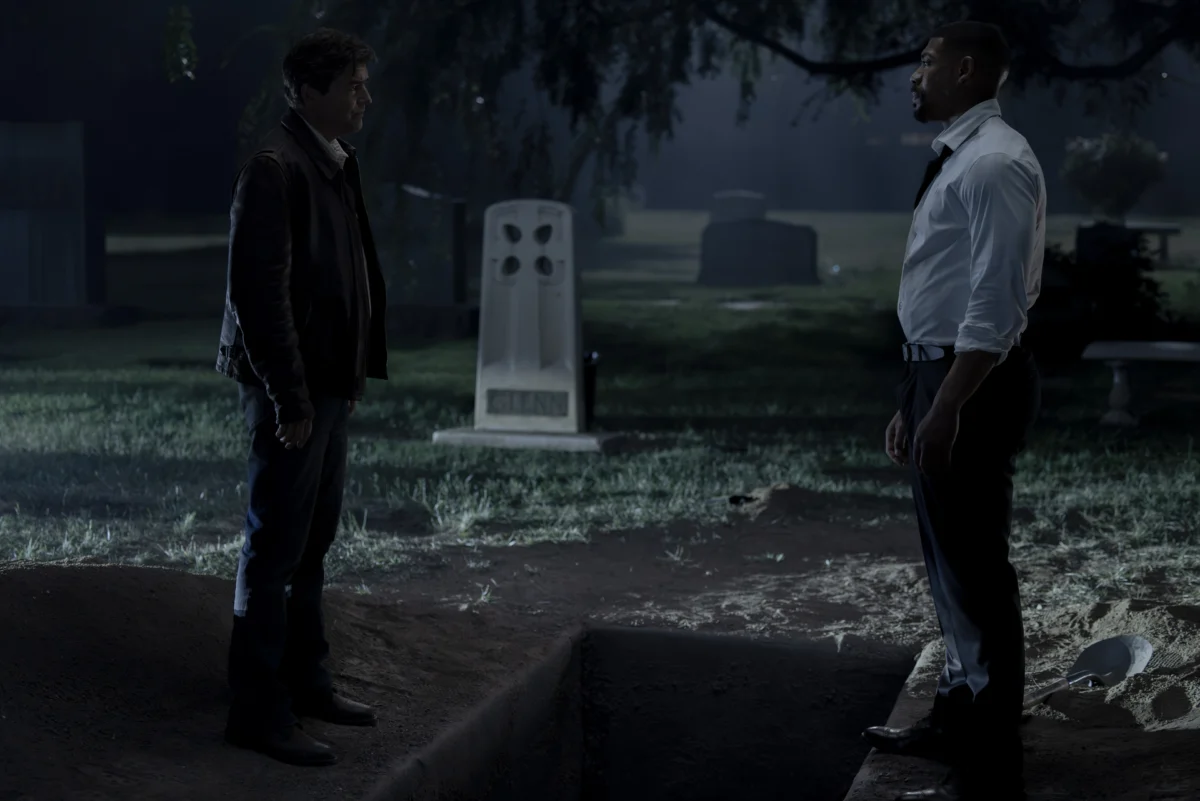
This is confirmed in the episode’s closing moments. After the public service, Stewart returns to the grave under the cover of darkness. He digs up the coffin—not to pay respects, but to retrieve the ring. He needs it to activate the "sentry protocol," a hidden contingency that allows him to access Hal’s holographic memory, essentially resurrecting a digital version of his mentor to help solve his murder.
Implications for the DC Universe
The ramifications of "Bad Optics" are far-reaching. By positioning Hal Jordan’s death as a murder mystery, the show has shifted from a character-driven drama into a high-stakes investigation. Furthermore, the introduction of Sinestro as an active, escaped threat suggests that the series is building toward a conflict that will involve more than just the domestic issues of a small town.
Writer Justin Britt-Gibson offered a sobering perspective on the episode’s themes: "What I want audiences to take away from that scene is, look what this ring did to Hal Jordan. It made him so possessive, it made him so selfish."
This warning serves as the moral compass for the remainder of the season. John Stewart, now in possession of a dead man’s ring and tasked with hunting a galactic villain, faces a future that is anything but certain. The "sentry protocol" suggests that the truth about Hal’s life—and his death—will be revealed in pieces, forcing Stewart to confront the flaws of the man he once looked up to.

As the series moves forward, the audience is left with a stark reality: the era of the "Golden Age" Green Lanterns is over. In its place is a cold, calculated, and dangerous reality, where the only thing separating justice from chaos is a man who didn’t want the power, but now finds it to be the only tool capable of finding the truth. Whether Stewart can maintain his humanity while wielding a weapon that destroyed his predecessor remains the central question of the series. For now, one thing is certain: the legacy of the Green Lanterns has never been more complicated, or more perilous.
 Ammar Sabilarrohman
 Siti Muinah
 Iffa Jayyana
