

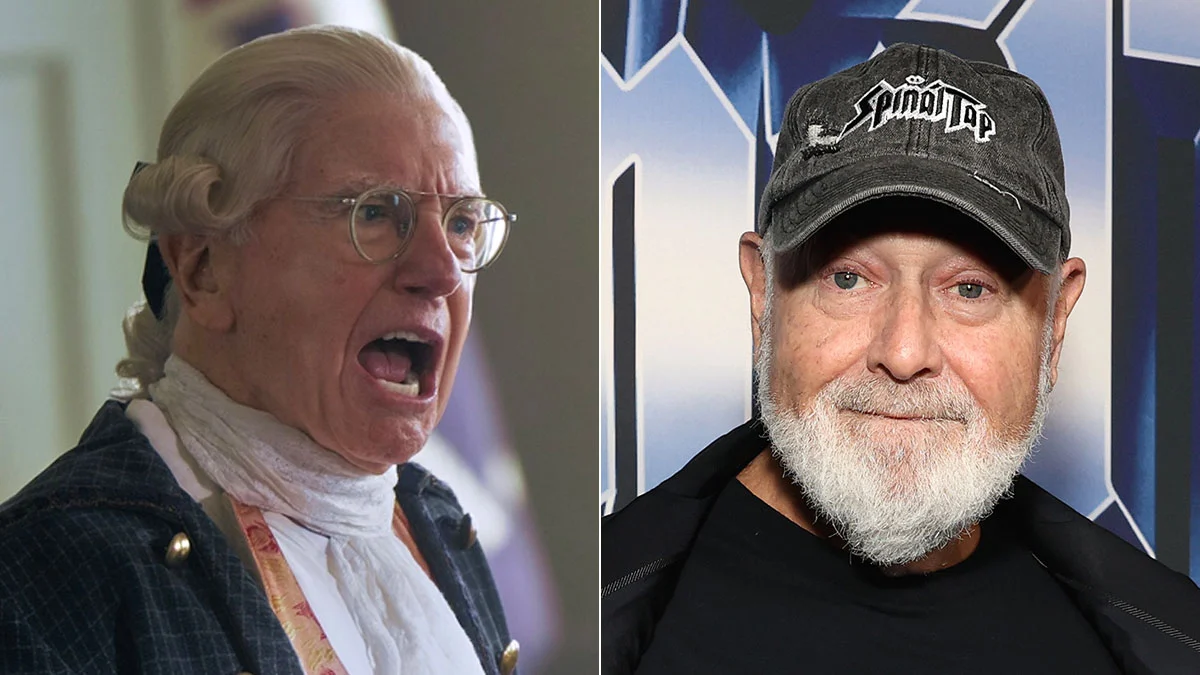
Editor’s Note: The following contains significant spoilers for Episode 2 of "Life, Larry, and the Pursuit of Unhappiness," titled "Farewell."
In the annals of television history, few guest appearances have carried the emotional and political weight of the most recent installment of HBO’s historical comedy series, Life, Larry, and the Pursuit of Unhappiness. The second episode, "Farewell," features a poignant and blistering performance by the late filmmaker and activist Rob Reiner, who portrays George Washington in his final days of the presidency. For audiences, the appearance serves as a surreal bridge between the founding ideals of the United States and the turbulent reality of the modern era. For the show’s star, Larry David, it marks a pivot toward a more aggressive form of satire that refuses to shy away from the most polarizing figures in contemporary politics.
Reiner, who passed away in December 2025, remains a towering figure in both the cinematic and political landscapes. His posthumous return to the screen has ignited a firestorm of discourse, not only for its technical execution but for its unapologetic dismantling of the current administration.
The Chronology of a Satirical Masterpiece
The sketch begins with a historical recreation of George Washington’s 1796 Farewell Address. In the scene, Reiner’s Washington stands before a restless crowd, preparing to announce his refusal to seek a third term—a foundational moment in American democratic precedent. However, the scene quickly devolves from a period piece into a scathing indictment of modern American governance.
As Washington begins to recite his famous warning regarding the dangers of political parties—cautioning that they might become "potent engines by which cunning, ambitious, and unprincipled men will be enabled to subvert the power of the people"—the tone shifts. Narrator Samuel L. Jackson introduces a layer of deliberate irony, emphasizing the specific adjectives used by the first president.
The scene then introduces Larry David, playing a member of the 18th-century crowd, who begins to challenge Washington not on his historical policy, but on his predictions for the future. The dialogue spirals into a meta-commentary on the current state of the executive branch. The pair engage in a heated debate concerning the potential for a "narcissistic prick" to occupy the highest office in the land, one who would prioritize personal enrichment over constitutional duty and systematically dismantle the nation’s checks and balances.
Supporting Data and Context: Bridging History and Reality
The sketch does not merely rely on general complaints; it actively catalogs the grievances of the current political moment. The script explicitly references the January 6th insurrection and the subsequent, highly controversial deaths of Renée Good and Alex Pretti. By weaving these specific, tragic events into a sketch set in 1796, the show highlights a terrifying cyclical nature of American political violence.
The appearance of Jimmy Kimmel—another crowd member adorned in a historically inaccurate tricorner hat—serves as the comedic and ideological anchor for the segment. Kimmel’s character questions the possibility of a leader so thin-skinned that they would weaponize the office of the presidency against private citizens who dared to criticize them.
"Are you suggesting that the president would taketh the time to challenge anyone who dare make fun of him, as if he were a big baby?" Kimmel’s character asks, staring directly into the camera. "I don’t see it."
The scene descends into physical comedy as the crowd members turn on one another, mirroring the fractured state of modern political discourse. As chaos erupts around him, Reiner’s Washington attempts to restore order, but finding the task impossible, he pivots to the camera for a final, blunt assessment: "We’re fucked."
The Political Legacy of Rob Reiner
To understand the gravity of this performance, one must acknowledge the late Rob Reiner’s lifelong commitment to political activism. Throughout his career, Reiner was an outspoken voice on the liberal spectrum, utilizing his platform as a director and producer to champion causes ranging from early childhood education to environmental protection.
His relationship with Donald Trump was notoriously antagonistic. Following Reiner’s death in late 2025, the former president made headlines for mocking the filmmaker—a decision that drew rare bipartisan condemnation. Even right-wing commentator James Woods, often a fierce critic of the Hollywood establishment, publicly criticized the president’s reaction as "beyond the pale" and "a fundamental failure of character."
The sketch in Life, Larry, and the Pursuit of Unhappiness can be viewed as the final chapter in this long-standing ideological feud. By casting Reiner as the Founding Father who warned against the very brand of leadership the current administration embodies, the show’s creators have framed the performance as a defiant, final act of civic duty. It is a moment of television that feels less like a scripted joke and more like a historical intervention.
Official Responses and Public Reception
The industry and public reaction to the episode has been polarized, reflecting the very divides the show seeks to satirize. HBO has remained relatively quiet regarding the production process, letting the work stand on its own, but critics have noted the immense technical challenge of integrating a posthumous performance into a live-action comedy sketch.
"The performance is haunting," says television critic Marcus Thorne. "Reiner’s delivery of that final line isn’t just a punchline; it’s a resignation. It’s a man who helped build a republic staring at the wreckage of his own dreams. It is arguably the most powerful five minutes of television produced this year."
Conversely, supporters of the current administration have decried the episode as "hateful propaganda," calling for boycotts of HBO. The debate has migrated from entertainment circles into the halls of government, with several lawmakers weighing in on whether satire has crossed the line into defamation. However, constitutional scholars argue that the sketch is protected under the broadest interpretations of free speech, noting that even if the content is "unsubtle," its placement within a satirical comedy show grants it significant legal insulation.
The Broader Implications for Satire
The inclusion of this sketch suggests that the creators of Life, Larry, and the Pursuit of Unhappiness are leaning into a strategy of "aggressive relevance." In an era where the news cycle moves at a breakneck speed, traditional comedy often struggles to keep pace. By using a historical setting to discuss modern grievances, the show is able to sidestep the transience of daily headlines and instead address the deeper, systemic issues that underpin them.
This episode suggests that television is entering a new phase of political engagement. As audiences grow increasingly weary of "both-sidesism," the demand for explicit, ideological content is rising. Whether this trend will lead to a more informed public or merely deepen existing silos remains to be seen.
Ultimately, the "Farewell" episode stands as a testament to the power of the medium. Rob Reiner’s final appearance is not a victory lap; it is a warning. Through the guise of George Washington, Reiner was able to articulate the anxieties of a nation in a way that feels both timeless and urgent. As the credits roll, the lingering image is not of a celebrity, but of a citizen concerned for the future of his country.
Life, Larry, and the Pursuit of Unhappiness airs new episodes every Friday at 9:00 p.m. ET on HBO and is available for streaming on Max. The network has yet to announce if future episodes will continue this trend of high-profile, politically charged cameos, but the bar has been set—and it is arguably higher than anyone anticipated.
 Asro
Asro
 Lina Irawan
 rifanmuazin
