

Main Facts: The Vision for a Shared Future
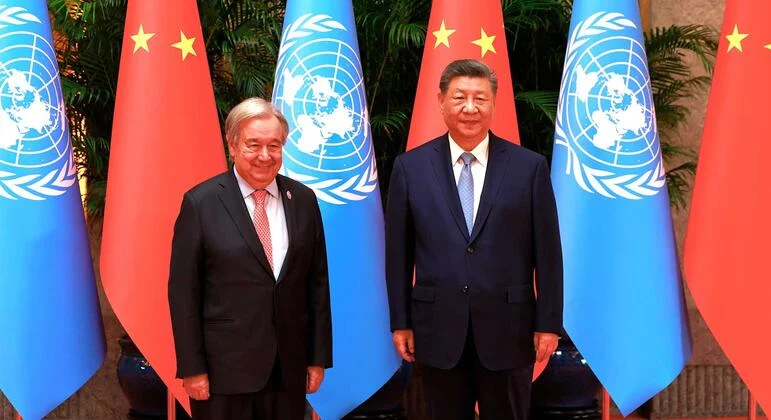
At the World Artificial Intelligence Conference (WAIC) in Shanghai, United Nations Secretary-General António Guterres delivered a stark yet hopeful mandate to the international community: the future of artificial intelligence must be authored by the collective, not the privileged few.
Framing AI as the 21st century’s most profound opportunity—and simultaneously one of its most perilous risks—Guterres argued that the current trajectory of AI development threatens to exacerbate global inequality. With computing power, venture capital, and intellectual property concentrated within a handful of wealthy nations and dominant corporations, the UN leader warned that the world risks creating a "digital divide" that could prove insurmountable for developing economies.
The Secretary-General’s address focused on three non-negotiable pillars for the future: the democratization of AI capacity, the rigorous establishment of global safety standards, and a commitment to environmental sustainability. Central to his argument is the principle that "technology that will shape the future of humanity must be shaped by all of humanity," emphasizing that every nation, regardless of economic standing, deserves a seat at the governance table.
Chronology of International AI Governance
The urgency in Guterres’s message reflects a year of accelerated diplomatic activity aimed at tempering the "wild west" nature of AI deployment. The path toward a global consensus has evolved rapidly:
- Mid-2023: The UN began formalizing its approach to emerging technologies, recognizing that AI’s rapid evolution was outpacing existing legal and ethical frameworks.
- Late 2023: The adoption of the Global Digital Compact signaled a shift toward collaborative digital governance, setting the stage for more granular AI-specific policies.
- Early 2024: The establishment of the Independent International Scientific Panel on AI marked the first time a global body of experts was tasked with providing objective, science-based analysis of AI’s revolutionary capabilities and inherent dangers.
- June 2024: The first session of the Global Dialogue on AI Governance was held in Geneva. This gathering served as a litmus test for international cooperation, bringing together diverse stakeholders to discuss the mechanics of transparency and inclusive regulation.
- July 2024: The Shanghai WAIC address serves as the latest milestone, where Guterres transitioned from establishing the architecture of governance to calling for immediate, practical funding and capacity-building mechanisms.
Supporting Data: The Disparity of the Digital Age
The Secretary-General’s warning is grounded in stark economic and technological realities. Despite the hyper-connectivity of the modern era, the infrastructure required to harness AI remains fundamentally inaccessible to a vast portion of the global population.
- The Offline Reality: Approximately one-third of the global population remains entirely offline, lacking even basic internet access, let alone the high-speed data pipelines required for sophisticated machine learning models.
- Concentration of Power: Current AI development is defined by a "triad" of influence—the United States, China, and a small cluster of private multinational corporations. This concentration limits the diversity of training data, often resulting in systems that are culturally, linguistically, and ethically biased toward Western or high-tech-centric norms.
- Sustainability Debt: The energy intensity of Large Language Models (LLMs) and massive data centers is staggering. Without a transition to renewable energy, the carbon footprint of the AI revolution could undermine global climate targets, specifically the Sustainable Development Goals (SDGs).
- Capacity Building: Over 20 countries have already stepped forward to nominate sites for a UN-supported Global Network for Exchange and Cooperation on AI Capacity Building, signaling that the appetite for localized, sovereign AI development is high, provided the resources are made available.
Official Responses and Strategic Initiatives
The UN’s strategy for "democratizing" AI is not merely rhetorical; it involves concrete financial and institutional instruments. Guterres announced that he is preparing to present recommendations for a Global Fund for AI, designed to provide developing nations with the financial runway to build their own AI ecosystems.
The objective is to move beyond mere "tech transfer," which often leaves developing nations dependent on foreign software. Instead, the UN is advocating for a framework where countries can build AI systems using their own data, languages, and cultural expertise.
"Human rights must be protected," Guterres stated in Shanghai, addressing the role of governments in ensuring that AI is not used as a tool for surveillance or suppression. His call for "human control over life-and-death decisions" resonates with international debates regarding Lethal Autonomous Weapons Systems (LAWS). By urging governments to ground their AI policies in international law, the UN is attempting to establish a "floor" for safety that no developer or state can fall beneath.
Furthermore, the environmental mandate—that AI companies must disclose their environmental footprint and power operations via renewable energy by 2030—places the burden of accountability directly on the private sector. This reflects a growing consensus that AI must be "green by design" rather than an afterthought in the climate crisis.
Implications: The Moral and Economic Crossroads
The implications of the UN’s current stance are profound, touching upon the fundamental relationship between technology and society.
The Risk of Technological Colonization
If AI development continues along its current path, there is a risk of a "new digital colonialism." In this scenario, developing nations provide the raw data and, eventually, the consumer market for systems built in the North. By advocating for locally trained, sovereign AI, the UN is attempting to prevent a system where the global South is forever a consumer of technology rather than an innovator.
Ethical Safeguards and Human Rights
Guterres’s firm stance on child safety—that no AI system should be accessible to minors until proven safe—is a major development in the governance of generative AI. It challenges the "move fast and break things" ethos of Silicon Valley, proposing instead a precautionary principle that prioritizes societal well-being over market speed.
Global Inequality vs. Sustainable Development
AI holds the potential to act as a "force multiplier" for the SDGs. In medicine, AI-driven drug discovery could eradicate neglected tropical diseases; in agriculture, precision AI could optimize food systems in drought-prone regions; and in education, personalized AI tutors could bridge the literacy gap. However, the Secretary-General’s warning is clear: these benefits will not "trickle down" automatically. They require intentional policy, massive infrastructure investment, and a governance structure that treats the benefits of AI as a public good rather than a private asset.
The Defining Question
As the international community moves toward the next phase of the Global Digital Compact, the world is at a crossroads. Will AI be used to close the gap between the haves and the have-nots, or will it accelerate the concentration of wealth and power?
Guterres’s challenge to the world’s leaders is simple: the transformation offered by AI must be defined by whether it reduces or reinforces inequality. As the Secretary-General noted in his closing remarks, the goal is not to stop innovation, but to ensure that the "greatest opportunity in the 21st century" does not become the source of its greatest division. The road ahead will require not just technical expertise, but a renewed commitment to multilateralism, ensuring that the "table" of AI governance is truly large enough for every nation to participate.
 Lina Hope
 Asro
Asro
 Layla Zulfa
