

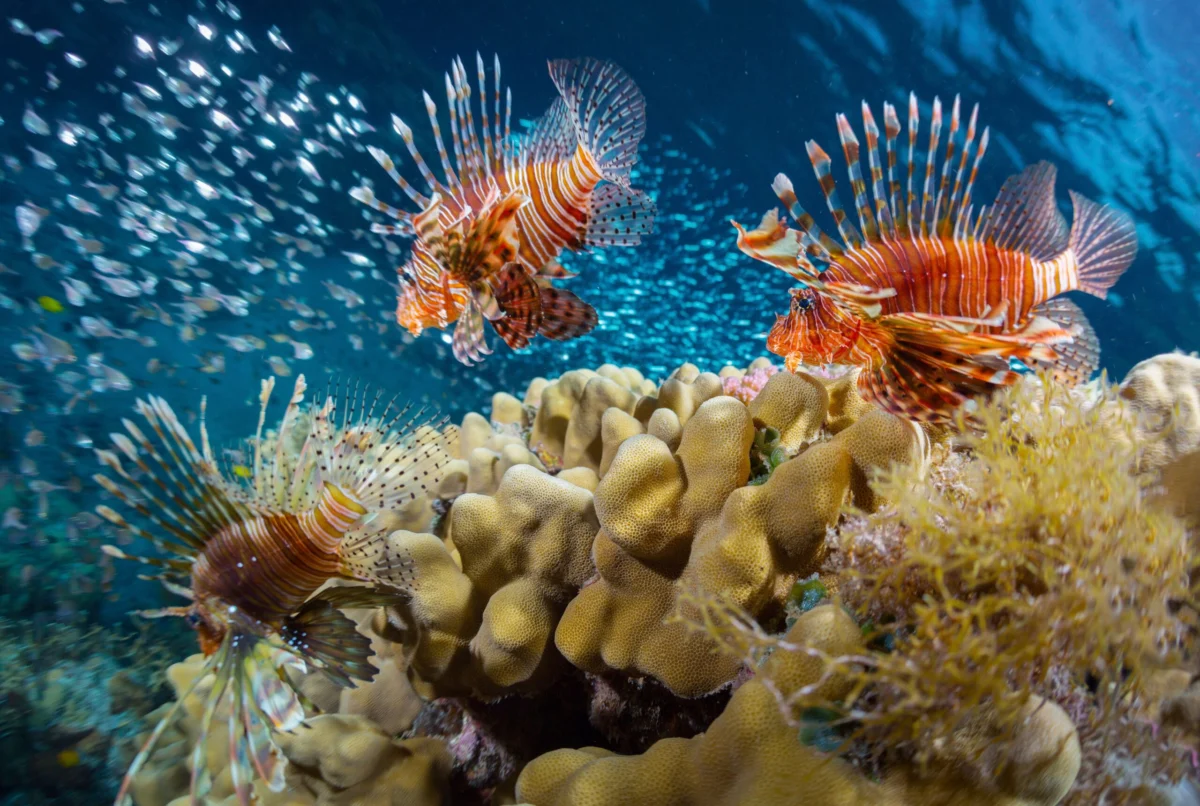
Beneath the shimmering, jade-colored surface of the Gulf of Mexico, off the coast of Destin, Florida, a silent invasion is unfolding. It is a slow-motion catastrophe that threatens the delicate equilibrium of one of the United States’ most vibrant marine ecosystems. The invader is the lionfish (Pterois volitans), a creature of striking, peacock-like beauty, armed with eighteen venomous spines and an insatiable, rapacious appetite.
Once an exotic fixture in home aquariums, the lionfish has transformed into the primary antagonist of the Florida coastline. With no natural predators in the Atlantic or the Gulf to check their population, these invasive fish are decimating native species and fundamentally altering the reef structures they occupy. However, in Destin, the narrative is shifting. Through a blend of competitive sport, environmental stewardship, and high-end gastronomy, the community has launched a counter-offensive. The weapon of choice? A spear in one hand, a fork in the other, and a concerted, city-wide commitment to eating the enemy into submission.
The Apex Invader: A Biological Time Bomb
The lionfish is a master of evolutionary biology. Native to the Indo-Pacific, where native predators and competitors keep their numbers in check, the lionfish was likely introduced to Florida waters in the mid-1980s by aquarium hobbyists releasing their pets into the wild. By 2010, they had successfully colonized the Gulf of Mexico.
Their biological advantages are overwhelming. An average female can spawn approximately 27,000 eggs every three to four days, leading to a reproductive cycle that produces millions of offspring annually. Because they possess specialized venomous spines, they are largely ignored by native grouper, snapper, and sharks, which have no innate behavioral recognition of the lionfish as prey.

The result is an apex predator with "haughty confidence." They consume more than 30 species of native Gulf fish, including economically vital stocks like red snapper, triggerfish, and grouper. Their hunting strategy is chillingly efficient: they can expand their stomachs to accommodate prey up to half their own body size and are capable of consuming up to 40 fish in a single hour. Research from the Bahamas has demonstrated that lionfish can reduce the recruitment of young native fish by as much as 79% in just five weeks, effectively starving the reef of its next generation.
The Emerald Coast Open: A Chronology of Conflict
Every May, the city of Destin transforms into the epicenter of the anti-lionfish movement through the Emerald Coast Open. What began in 2019 as a grassroots experiment has evolved into the world’s largest lionfish tournament.
The event is a logistical marvel. Over a single weekend, hundreds of divers descend upon the Gulf, armed with sling spears and specialized, puncture-proof "ZooKeeper" containment units. The tournament is not merely about the thrill of the hunt; it is a data-driven operation. At the docks, marine biologists and graduate students wait with clipboards and gloves, measuring, weighing, and cataloging every single fish brought in.
The scale of the removal is staggering. In the most recent iteration, 128 divers removed 15,018 lionfish during the two-day event, contributing to a total of over 20,752 for the season. Since the tournament’s inception, more than 125,000 of these invasive predators have been pulled from the local ecosystem. The tournament serves as a clearinghouse for information, with educational talks, cooking demonstrations, and outreach programs that help turn a grim ecological reality into a community festival.

Culinary Resilience: The "Eat Them to Beat Them" Strategy
The primary hurdle in curbing the lionfish population is their lack of commercial viability. They are not "trap-shy" like some fish, but because they are elusive and live in complex reef structures, they cannot be harvested using traditional nets or long-line fishing. They must be speared one by one. To make this labor-intensive process profitable, the market for lionfish must grow.
This is where the local culinary scene enters the fray. A common, persistent misconception is that lionfish are poisonous to eat. In reality, the venom is localized strictly to the spines; the meat itself is pristine, buttery, and exceptionally high-quality.
During the tournament, local restaurants compete in a "Restaurant Week" offshoot, turning the day’s catch into high-end cuisine. The versatility of the fish is striking. At Harbor Docks, a local institution, the "Reef Raider" sushi roll features raw lionfish topped with torched fillets, creating a flavor profile that evokes the delicate texture of monkfish or flounder.
At The Deck at Destin Brewery, the menu takes an "Invasive Experience" approach, serving citrus-cured lionfish bruschetta and bronzed scampi, proving that the fish is a blank canvas for chefs. Meanwhile, the perennial champion, La Paz, has secured its title for four consecutive years with Acapulco-style lionfish fajitas. The restaurants aren’t just selling a dish; they are selling a mission. By displaying educational materials and even theatrical performances—such as staff wearing wetsuits and carrying plush lionfish—they ensure that every patron leaves with an understanding of why the dish on their plate is an act of environmental heroism.

Official Perspectives and Scientific Impact
Alex Fogg, the natural resources chief for Destin-Fort Walton Beach tourism, was on the front lines as a graduate student when the invasion first took hold. He remembers diving on reefs where, at a single site, he could harvest 300 lionfish.
"For years, I said ‘lionfish are bad, bad, bad,’ but now we’ve turned them into a positive," Fogg says. "We’re encouraging people to eat them, to make money from them, and to have a lot of fun, while also helping the ecosystem."
The data supports this pragmatic optimism. Studies in the Atlantic have shown that concentrated efforts—like those seen in the Emerald Coast Open—can lead to a 52% reduction in lionfish density within a specific area, often resulting in a measurable increase in native fish survival rates. While Fogg acknowledges that total eradication is likely impossible given the sheer scale of the invasion, the tournament provides a crucial "reset" button for the reef, allowing native populations the breathing room they need to recover.
Implications: A Model for Future Conservation
The "eat them to beat them" model, while not a silver bullet, has become a template for invasive species management across the globe, from feral hogs in the South to nutria in the wetlands. In Destin, the strategy has achieved a rare trifecta: it provides ecological relief, boosts local tourism, and supports a nascent commercial fishery.

The economic implications are also promising. While most harvesters are currently hobbyists, local fishmongers like Sea Market are beginning to stock the fish, and divers are finding that selling their catch for $6 a pound helps offset the significant fuel and gear costs associated with tournament participation.
As the sun sets on the final day of the Emerald Coast Open, the atmosphere at the docks is one of triumph. Divers share stories of deep-water catches and "honey holes" filled with the striped predators. One diver, Wes Ratliff, gestures to a mountain of coolers packed with fish: "Your bucket’s so full, you can’t count them. We found some good groupings."
For the casual observer, it is a spectacle of sport. For the marine biologist, it is a necessary culling. And for the restaurant patron, it is a chance to participate in the restoration of the Gulf. In the end, the success of this initiative proves that when a community unites behind a common goal, even the most persistent of environmental threats can be managed—one bite at a time. The war for the reefs is far from over, but in Destin, the tide is finally beginning to turn.
 Sagoh
Sagoh
 Asro
Asro
