

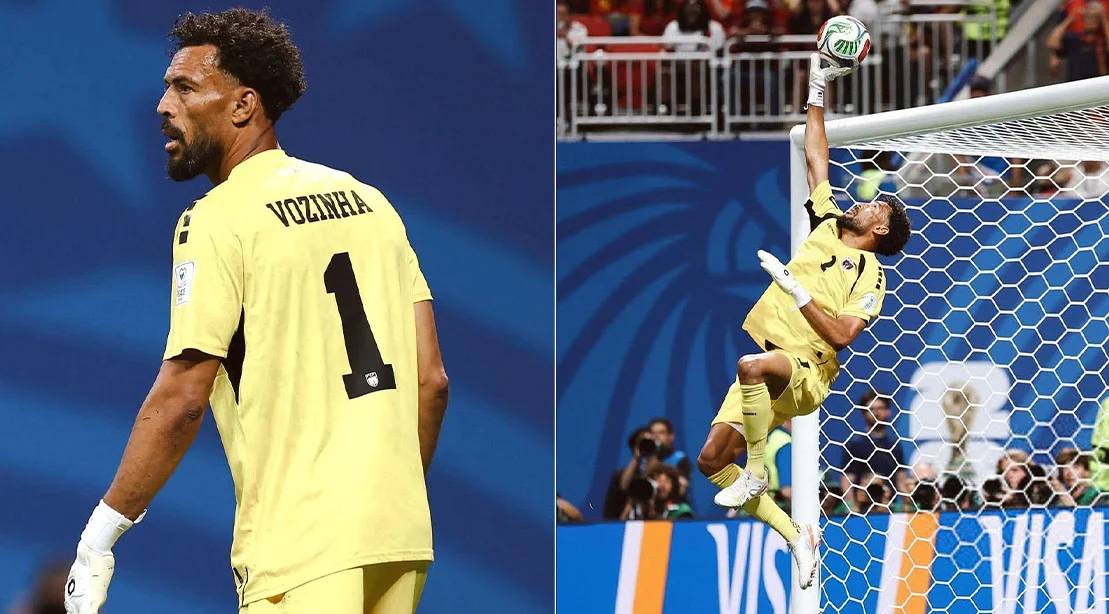
In the theater of global sports, where the narrative arc often favors the meteoric rise of teenage phenoms and the peak performance of players in their mid-twenties, a singular, defiance-filled performance has captured the world’s collective imagination. Josimar Dias, known to the world as "Vozinha," has emerged from the 2026 World Cup as more than just a goalkeeper; he has become a symbol of athletic longevity and human potential.
At 40 years of age, the Cape Verdean shot-stopper did not merely participate in the tournament’s opening round against heavyweights Spain—he neutralized them. With a record-breaking seven saves, Vozinha secured a historic 0-0 draw, earning Cape Verde its first-ever World Cup point and establishing himself as the oldest goalkeeper to post a shutout in the history of the competition.
The Main Facts: A Defiant Stand in Atlanta
The match in Atlanta was billed as a routine encounter for the Spanish juggernaut, a team brimming with world-class talent and pedigree. However, the script was dismantled by the 6-foot-2-inch frame of Dias. Throughout 90 minutes of relentless offensive pressure, the Spanish attack launched wave after wave of shots, testing the veteran from every conceivable angle.
Vozinha’s performance was not merely a matter of luck; it was a display of tactical positioning, feline reflexes, and psychological fortitude. By the final whistle, his seven saves had turned the tide of the game. For Cape Verde, a nation with a modest footballing history, the draw felt like a victory. For the global audience, the performance was a masterclass in proving that the decline often associated with the fourth decade of life does not apply to those who possess the right blend of experience and dedication.
Chronology of a Viral Phenomenon
The rise of Vozinha from a respected professional to a global icon is a testament to the power of digital media in the modern age. Before the whistle blew in Atlanta, Dias boasted a respectable following of 50,000 on Instagram—a figure reflective of a dedicated career played across various leagues in Angola, Moldova, Portugal, Cyprus, and Slovakia.
As the match progressed and the saves piled up, social media platforms began to light up. The realization that a 40-year-old goalkeeper was single-handedly holding back one of the world’s elite teams sparked a wildfire of engagement. By the time the game concluded, his follower count began a meteoric ascent that defied conventional logic. Within hours, the numbers climbed into the millions, eventually peaking at over 11.5 million followers.
This digital surge is not merely a byproduct of fame; it is a cultural reaction to the narrative of the "underdog." In a world where aging is often framed as a period of limitation, Vozinha’s performance offered a tangible, high-stakes example of sustained excellence. The internet, often a theater for the ephemeral, latched onto his story as an inspirational touchstone.
Understanding the Man Behind the Gloves
To understand the man behind the viral sensation, one must look past the statistics and into the history of Josimar Dias. The nickname "Vozinha," bestowed upon him by his grandparents during his childhood in Cape Verde, translates to "Little Granny." While the moniker implies a gentle, familial warmth, the man himself is a formidable presence on the pitch.
Dias adopted the name professionally early in his career to carve out a distinct identity. "I said, ‘I am not going to put Josimar II on the shirt,’" he recalled in an interview. "If everyone knew me as Vozinha in Cape Verde, that’s what I would be."
His journey to the 2026 World Cup stage was not a straight path of accolades and fame. It was a career built on grit, traversing the varied landscapes of international club football. His experience playing in Eastern Europe and across the Mediterranean provided him with the tactical versatility required to read the Spanish strikers. He is currently the second most-capped player in the history of the Cape Verde national team, a status earned through years of consistent, often unheralded, service to his country.
Supporting Data: Age and Elite Performance
The sports science community has long debated the "expiration date" of professional athletes. Traditionally, goalkeepers enjoy a longer shelf life than outfield players, yet reaching the pinnacle of the World Cup at 40 remains a statistical outlier.
Data from the 2026 tournament shows that the average age of starting goalkeepers remains in the late 20s. Vozinha’s performance serves as a data point for a growing movement in sports longevity. By maintaining his physical conditioning and relying on the "anticipatory intelligence" that only comes with two decades of professional experience, he effectively nullified the speed advantage of his younger opponents.
His seven-save tally against a high-possession team like Spain provides evidence that technical precision and mental discipline can bridge the gap created by the natural physical degradation associated with aging. The "Vozinha effect" is now being studied by analysts who look at how older players manage the physical demands of high-intensity tournament football through better recovery protocols and strategic positioning.
Official Responses and Emotional Resonance
The humility displayed by Dias following the match has only endeared him further to the global public. Upon reflecting on his performance via Instagram, he wrote: "Dream come true! Representing Cape Verde on the world football’s biggest stage is an indescribable honour. Speechless… just pride, gratitude, and responsibility."
The reaction from the Cape Verdean community and the footballing world at large has been one of overwhelming support. His teammates have lauded him not just as a goalkeeper, but as a leader who anchors the squad’s morale. Coaches and pundits have praised his composure, noting that during the most chaotic moments of the Spanish offensive, Vozinha remained the most composed man on the pitch.
Implications for the Future of the Sport
The implications of Vozinha’s performance extend far beyond the tournament in Atlanta. Firstly, it challenges the age-bias that often permeates talent acquisition in professional football. Scouts and club managers are now forced to re-evaluate the value of veteran experience. When a 40-year-old can hold the world’s best to a stalemate, the obsession with youth may find itself balanced by a renewed appreciation for "seasoned" talent.
Secondly, for the nation of Cape Verde, this moment is a catalyst. The draw against Spain is not just a statistical anomaly; it is a proof of concept. It signals that small nations, when equipped with disciplined leadership and individual brilliance, can compete on equal footing with footballing superpowers.
Finally, the story of Vozinha acts as a broader social message. In an era where many feel their "prime" years are fleeting, Dias has provided a refreshing counter-narrative. He has demonstrated that with persistence, the peak of one’s professional life can be moved, shifted, and redefined.
Looking Ahead: The Road to Uruguay
As the world turns its attention to the next round of fixtures, the pressure on Vozinha will undoubtedly intensify. His next challenge is a clash against Uruguay on June 21—a team known for its aggressive, high-scoring strikers. Whether or not he can replicate his performance remains to be seen, but the expectation has fundamentally changed. He is no longer an overlooked veteran; he is a marked man, a guardian whose legacy is already secured.
Regardless of the outcome of the upcoming matches, Josimar "Vozinha" Dias has already achieved the impossible. He has turned a single match into a legacy and transformed his name into a synonym for perseverance. As the tournament continues, the eyes of 11.5 million followers—and likely millions more—will be fixed on the Cape Verdean net, waiting to see if the "Little Granny" can continue to defy the passage of time.
In the final analysis, Vozinha’s journey reminds us that the spirit of competition is not bound by the chronological clock. It is bound by the will to stand tall, to hold the line, and to perform when the world is watching. Through his seven saves in Atlanta, he has taught us that while age may be a number, excellence is a choice—one that he continues to make every time he steps between the posts.
 Lina Hope
 rifanmuazin
 Laily UPN
