

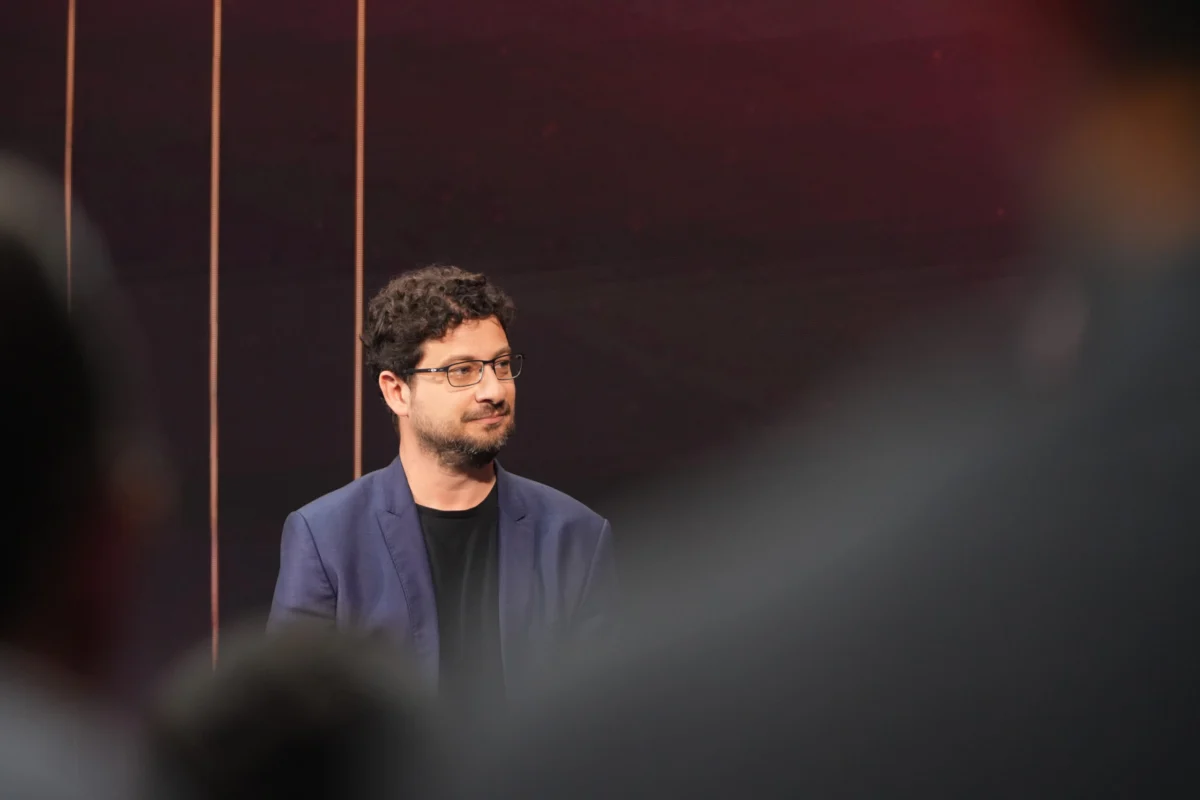
To the average user, Jean-Baptiste Kempf is the architect of a digital utility—the creator of the orange traffic-cone icon that has become synonymous with universal media playback. With over 6 billion downloads, VLC Media Player is one of the most successful pieces of open-source software in history. But for Kempf, the man who democratized video consumption, the true frontier isn’t on our desktops or smartphones; it is in the physical world.
Kempf is currently spearheading Kyber, a Paris-based startup building the "infrastructure layer" for the next generation of autonomous and remote-operated hardware. Having recently secured a $5 million funding round led by Lightspeed Venture Partners—a firm with a track record of identifying transformative AI plays like Anthropic and Mistral—Kyber is positioning itself to be the connective tissue for a world populated by millions of robots and drones.
The Core Mission: Bridging the Physical-Digital Divide
At its heart, Kyber is an SDK (Software Development Kit) designed to synchronize video, audio, sensor telemetry, and control inputs with near-zero latency. While the term "Physical AI" has become a buzzword in Silicon Valley, Kempf argues that the intelligence of a robot is irrelevant if the communication infrastructure between the machine, the controller, and the compute engine is sluggish.
"Physical AI is only as good as the underlying systems running it," noted the team at Lightspeed during the investment announcement. This realization is the cornerstone of Kyber’s value proposition. As Kempf explains, the platform is engineered for any scenario where the human operator, the compute power, and the physical action occur in disparate locations.
The name "Kyber," a nod to the energy-channeling crystals found in Star Wars lore, reflects the company’s singular obsession: speed. In the world of remote robotics, every millisecond of latency is a potential failure point. Whether a drone is navigating a disaster zone or a robotic arm is performing remote surgery, the lag between input and output must be imperceptible.
A Chronology of Innovation: From Shadow to Kyber
The genesis of Kyber can be traced back to Kempf’s tenure as the CTO of Shadow, the cloud-gaming platform. It was during this period that Kempf began to see the limitations of existing streaming protocols. Cloud gaming, much like robotics, requires ultra-low latency; a gamer who experiences a lag between pressing a button and seeing a reaction on screen has effectively lost the game.
Kempf realized that the techniques used to stream high-fidelity video to gaming consoles could be repurposed and optimized for the Internet of Things (IoT). While his team at Kyber leverages the deep video-streaming expertise inherent in the VLC DNA, they have significantly expanded their scope. They are not merely moving pixels; they are synchronizing the complex sensory data that allows a machine to "understand" its environment.
Since its inception, the company has grown to a 25-person team, headquartered in Paris with strategic satellite offices in San Francisco and Singapore. This global footprint is intentional, designed to support a customer base that is already spanning sectors as diverse as defense, telecommunications, and industrial robotics.
The Scaling Problem: Moving Beyond the "Niche"
For years, remote control and robotic management have been the domain of bespoke, proprietary solutions. Large enterprises in logistics or defense have spent millions developing custom stacks to manage small fleets—perhaps 2,000 or 3,000 units. However, Kempf argues that we are approaching an inflection point where the sheer volume of devices will render these custom, closed-source solutions obsolete.
"Imagine you need to manage millions of them," Kempf told TechCrunch. "That’s not the same thing."
This transition from thousands of units to millions introduces a critical requirement: observability. When humans are no longer the primary operators—when AI agents take over the management of entire networks—the ability to monitor, diagnose, and repair systems in real time becomes paramount. Kyber’s infrastructure is designed to provide this "god-view" of a fleet, ensuring that even when hardware is deployed in remote or hazardous environments, it remains under the watchful eye of the central management system.
Furthermore, Kyber solves the logistical nightmare of maintenance. Traditionally, a software bug in a fleet of robots would require a physical recall or manual intervention. Kyber’s architecture allows for seamless, remote software updates at scale, drastically reducing the Total Cost of Ownership (TCO) for companies investing in physical automation.
Supporting Data and Strategic Priorities
Kyber’s market strategy is segmented into three primary pillars, each representing a massive addressable market:
- Robotics: Providing the backbone for autonomous mobile robots (AMRs) used in warehousing and logistics.
- Drones: Enabling real-time control for surveillance, agricultural, and emergency response drone fleets.
- Remote IT Access: A high-demand sector where Kyber intends to challenge legacy giants like Citrix.
The decision to compete in the remote IT access space is particularly telling. While it lacks the "glamour" of humanoid robotics, the market is vast and the current solutions are often bloated and inefficient. Kempf’s ambition is to create the standard for remote access—a version that is robust, scalable, and accessible to everyone, rather than locked behind expensive enterprise-only silos.
The company’s commitment to open source remains central to its identity. By keeping the core project open, Kyber mirrors the development philosophy that made VLC a global standard. They monetize through a productized version for enterprise clients, supported by a team of Forward-Deployed Engineers (FDEs). These engineers work directly with clients to ensure custom, high-stakes deployments are successful, echoing the high-touch service models employed by firms like Palantir.
Implications: The Future of the Physical Web
The implications of Kyber’s technology extend far beyond corporate efficiency. As the world moves toward an era of ubiquitous robotics, the infrastructure governing these devices will effectively become a new "Physical Web."
If Kyber succeeds in becoming the standard layer for remote device management, it will hold a position of immense strategic importance. It will be the "plumbing" of the robotics age. For companies, this means lower barriers to entry for deploying complex hardware fleets. For the AI industry, it means that the brains of the next generation of robots will have a reliable, high-speed nervous system to inhabit.
However, this future is not without challenges. The centralization of control for millions of physical devices raises questions about security, data privacy, and the risks of a systemic "single point of failure." Kempf and his team appear acutely aware of these risks, positioning Kyber as a resilient, scalable solution that favors transparency through its open-source core.
Conclusion: A Legacy of Universal Utility
Jean-Baptiste Kempf’s career is defined by a commitment to creating tools that are fundamentally useful to everyone. With VLC, he helped organize the world’s digital media. With Kyber, he is attempting to organize the world’s physical machines.
By focusing on the unglamorous but essential problem of latency and synchronization, Kyber has positioned itself as an indispensable partner in the AI revolution. As the physical and digital worlds continue to collide, companies like Kyber will be the ones holding the map—and the keys—to the infrastructure that keeps the robots running.
In the coming years, as the streets begin to fill with the drones and autonomous vehicles that Kempf envisions, the orange traffic cone of VLC might find a successor in the logo of Kyber: a subtle, ubiquitous reminder that behind every great technological leap, there is a piece of foundational infrastructure that makes the impossible look easy.
 Asep Darmawan
 Siti Muinah
 Ali Ikhwan
