

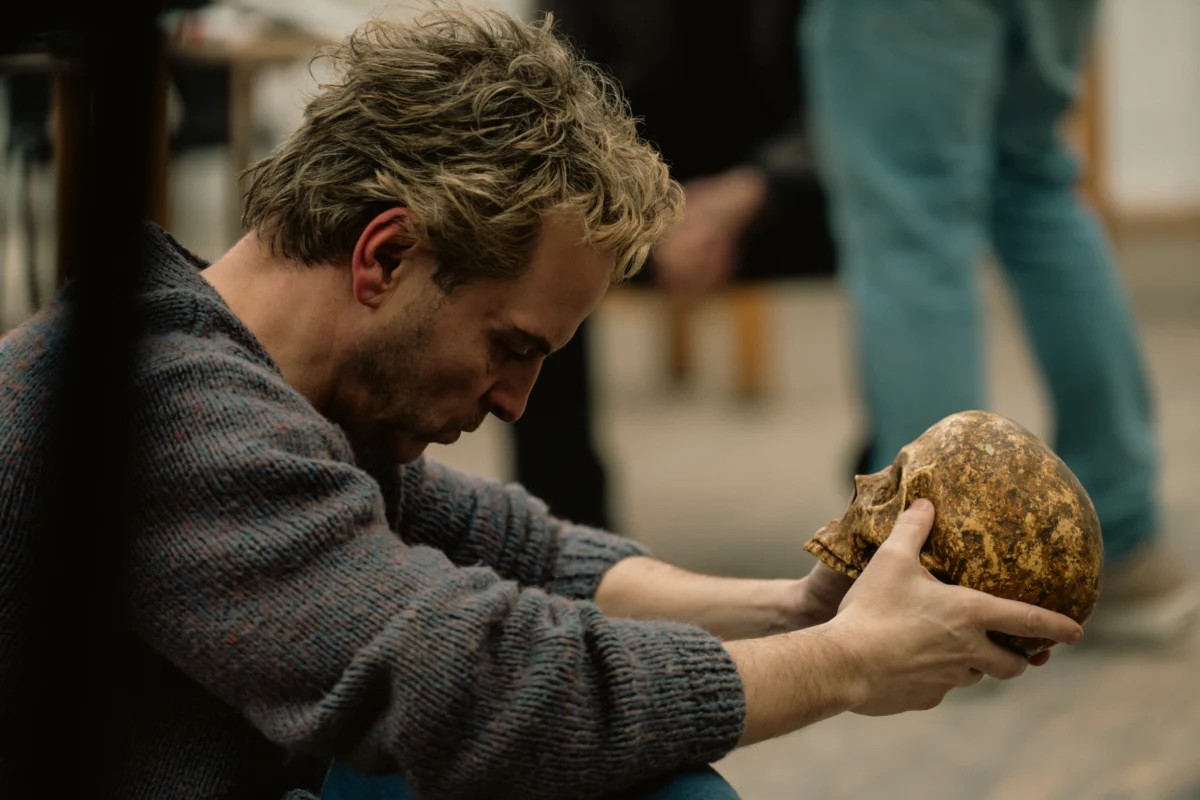
As one might expect from his riveting, transformative screen performances, Andrew Scott is an artist who refuses to be categorized. Whether playing the chillingly calculating Moriarty in Sherlock or the vulnerable, soul-searching "Hot Priest" in Fleabag, Scott has built a career defined by nuance and psychological depth.
This past Saturday, at the 51st Toronto International Film Festival (TIFF), the Irish actor peeled back the layers of his own creative process during an intimate, sold-out conversation at the Royal Alexandria Theater. The event centered on the Canadian premiere of Elsinore, a film that has already generated significant Oscar buzz following its rapturous reception at the Telluride Film Festival.
Main Facts: The Weight of Elsinore
In Elsinore, Scott takes on the role of Ian Charleson, the celebrated British stage actor whose life was tragically cut short. The film documents a pivotal, heart-wrenching moment in theater history: Charleson’s decision to step into the role of Hamlet during a 1980s production, replacing Daniel Day-Lewis.

What makes the performance—and the film itself—so profound is the context of Charleson’s reality. He was battling the final stages of AIDS while tackling perhaps the most demanding role in the Western canon. For Scott, the project was deeply personal, marking his first foray into film production. He assumed this dual role out of a profound, protective passion for Charleson’s legacy, fearing that a less intimate hand might dilute the complexity of his story.
"I felt a responsibility to get it right," Scott remarked during the TIFF panel. The film serves as a poignant meditation on the theater as a sanctuary, a "found family" that offers solidarity when the world feels indifferent or hostile.
Chronology: From Elocution Lessons to Global Stardom
Scott’s trajectory from a shy child in Dublin to an international icon is a study in quiet determination. His journey began not in a prestigious conservatory, but in the humble setting of speech and drama classes.

The Childhood Catalyst
Though his voice is now one of the most recognizable in modern cinema, Scott suffered from a significant lisp as a child. At age seven, his mother enrolled him in elocution lessons, which served as his accidental introduction to the performing arts.
"You were able to improvise in front of other kids and say poetry, do extracts," Scott recalled. "Something just happened to me when I was doing it, and I sort of fell in love with that. Acting amplified something that I thought was dormant. For that reason, I’ve always associated acting with playing." He noted that he never attended traditional drama school, instead relying on this early, innate sense of play—a methodology he maintains to this day.
The Sherlock Baptism by Fire
Many audiences first encountered Scott as the malevolent Jim Moriarty in the BBC’s Sherlock. While the role propelled him to global fame, it was a baptism by fire. Scott, who famously avoids the internet, learned the hard way about the volatility of public opinion.

"It was my first experience with public opinion," he explained. "Twitter was very popular at the time, and you could read it, and they said some mean s–t. Really terrible, awful s–t." The vitriol was so intense that Scott briefly feared he would be recast. However, the experience became a valuable lesson in emotional detachment. "You learn it doesn’t really matter. I did still work. I didn’t get recast. Everything turned out to be OK. You learn to give it less power."
The Fleabag Renaissance
The pivot from villainy to romantic lead came via his longtime collaborator, Phoebe Waller-Bridge. When she approached him for the second season of Fleabag, Scott found the catharsis he had been seeking.
"I was yearning to play someone that was nearer myself," he confessed. "I really love romantic comedy. I have a romantic nature and just to be able to express that in some way, it’s wonderful."

Supporting Data: Challenging the "Typecast" Trap
A significant portion of the conversation focused on the politics of casting and the public’s perception of queer actors. Having come out publicly years prior to Fleabag, Scott admitted to an underlying fear that he would be barred from playing straight, romantic leads.
He dismissed the notion that audiences are unable to suspend their disbelief when it comes to the sexuality of an actor. "People aren’t going to go, ‘Oh my god, the hot priest is gay,’" he said, citing his role in Fleabag as proof. "We don’t go to see Batman and go, ‘Oh my god, I can’t believe he’s not a bat!’ You willingly go to a theater to see a story."
This philosophy underpins his work in Elsinore as well. He believes that by leaning into the humanity of the character rather than the labels, an actor can transcend the limitations imposed by industry tropes.

Official Perspectives: The Elsinore Method
To portray Ian Charleson, Scott had to engage in a rare meta-acting exercise. He had already performed Hamlet on stage in London for 150 shows. Yet, for Elsinore, he had to "unlearn" his own performance to inhabit the specific, terminal mindset of Charleson.
"I had to learn all of the soliloquies again, and to try to learn them with what his thought process would’ve been," Scott explained.
The film explores the tension between quality of life and the duration of it. Charleson’s doctors had strongly advised against the physical and emotional strain of Hamlet, yet he proceeded, finding purpose in the work. Scott uses this as a mirror for his own life: "It doesn’t end well for any of us. That’s just the truth. So, why don’t you just pay attention to the things that make you really, really happy? Try to enjoy life."

He is careful to note, however, that the goal of the film is not to dwell on the tragedy of AIDS, but to highlight the agency and vigor of the man. "I wanted to take care to not fetishize his death but celebrate his life."
Future Implications: The Road Ahead
As the awards season cycle begins to heat up, the Elsinore project places Scott firmly in the conversation for major accolades. However, his ambitions remain rooted in the craft rather than the industry’s external validation.
A Musical Dream
When asked about his "bucket list" roles, Scott expressed a desire to enter the world of musical theater. "I’d love to do a musical," he said, though he added a note of characteristic humility regarding his vocal abilities. He envisions a role in the vein of Henry Higgins or Harold Hill—characters that rely on "act-singing" rather than pure vocal gymnastics, set within the grandeur of a classic, ensemble-heavy production.

The Shakespearean Bucket List
Scott’s affinity for the Bard remains as strong as ever. While Hamlet is often viewed as the summit of an actor’s career, Scott sees it as merely one stop on a longer journey. He expressed a keen interest in:
- Iago in Othello: A role that would allow him to tap back into the psychological complexity he mastered in Sherlock.
- Benedick in Much Ado About Nothing: A chance to fully embrace the romantic comedy genre he loves so dearly.
- The Richards (II and III): Exploring the historical weight and power dynamics of the royal houses.
Conclusion
Andrew Scott’s appearance at the 51st Toronto International Film Festival was more than just a promotional stop for Elsinore. It was a masterclass in the evolution of an artist. By stripping away the noise of social media, the anxiety of typecasting, and the fear of mortality, Scott has emerged as one of the most vital actors of his generation.
Whether he is reciting Shakespearean soliloquies or longing for the bright lights of a Broadway musical, Scott’s commitment remains unchanged: to find the truth in the play, and in doing so, to remind us all why we go to the theater in the first place. As he continues to navigate the complexities of his career, one thing is certain: he is only just beginning to reveal his true range.
 Ammar Sabilarrohman
 Siti Muinah
 Iffa Jayyana
