

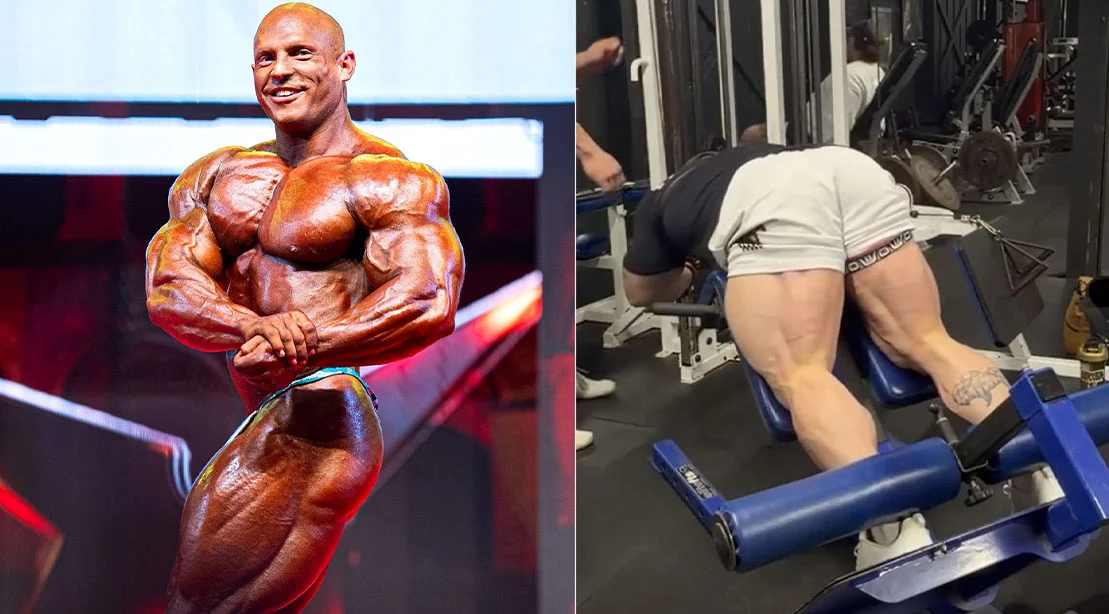
After a hard-fought, fifth-place finish at the 2025 Mr. Olympia, Martin "The Martian" Fitzwater is wasting no time in the pursuit of perfection. In the high-stakes world of professional bodybuilding, fifth place is both a triumph and a catalyst for change. Rather than resting on his laurels, Fitzwater has already secured his ticket to the 2026 Mr. Olympia in Las Vegas—a feat he achieved with an explosive, high-definition performance at the EVLS Prague Pro last October.
With his qualification secured, the focus for the coming year has shifted from mere survival to tactical refinement. Fitzwater is currently deep in the "off-season" grind, a period defined by heavy lifting, metabolic experimentation, and a relentless search for any mechanical advantage that might bridge the gap between himself and current champions like Derek Lunsford, Samson Dauda, and Hadi Choopan. His latest discovery? A specialized, cable-assisted variation of the Nordic curl that he claims has revolutionized his hamstring development.
The Evolution of the Hamstring: A Technical Shift
In the pursuit of the "perfect" physique, the hamstrings are often the difference-maker. They provide the thickness and separation required to distinguish an elite Olympia contender from the rest of the field. Traditionally, the Nordic curl has been a staple in strength and conditioning programs, often performed on the floor with a partner holding the athlete’s ankles.
However, Fitzwater, alongside fellow pro Brett Wilkin, has introduced a variation that pushes the limits of standard hypertrophy protocols. By utilizing a Roman chair (hyperextension bench) and a cable machine, Fitzwater has created a "Cable Nordic Curl" that removes the stability constraints of the floor-based version while adding the constant, progressive tension of a weight stack.
"Cable Nordic Curls? Romanian Chair Hamstring Curls? I don’t know what you call it, but this is a new favorite of Brett Wilkin and I’s," Fitzwater shared in a recent Instagram post with his 320,000 followers. For an athlete of his caliber, finding an exercise that provides both intensity and safety is the "holy grail" of training.
Chronology of a Contender: From Prague to Las Vegas
To understand why Fitzwater is experimenting with such novel movements, one must look at his recent competitive trajectory.
- October 2025: Fitzwater dominates the EVLS Prague Pro. His physique displays an unprecedented level of maturity and conditioning, solidifying his early qualification for the 2026 Mr. Olympia.
- November 2025: Following his qualification, Fitzwater assesses his performance at the 2025 Mr. Olympia. While a top-five finish is elite, he identifies "density" and "rear-chain sweep" as areas for growth.
- January 2026: Fitzwater begins incorporating the Cable Nordic Curl into his weekly leg-day rotation. He documents the setup, emphasizing that the move is not just a trend, but a technical evolution of his training philosophy.
- Present Day: As he looks toward the 2026 Las Vegas stage, Fitzwater continues to refine the movement, warning followers that while it is effective, it is "very heavy and humbling."
Supporting Data: The Anatomy of the Cable Nordic Curl
To appreciate why this movement is so potent, one must look at the biomechanics of the hamstring complex. The hamstrings are composed of three distinct muscles: the biceps femoris, the semimembranosus, and the semitendinosus.
The Biomechanical Advantage
Standard Nordic curls focus heavily on eccentric strength, forcing the hamstrings to act as stabilizers for the torso. By moving this movement to a Roman chair and attaching a cable belt, the athlete changes the vector of resistance.
- Isolation: By anchoring the ankles and driving the knees into the pads, the movement becomes purely knee-flexion based. This eliminates the involvement of the glutes and lower back, isolating the hamstrings entirely.
- Constant Tension: Unlike free weights, where gravity can provide "dead zones" at the top or bottom of a movement, the cable machine provides constant, unwavering tension throughout the entire range of motion.
- Safety Profile: Because the path of the exercise is fixed by the cable machine, the potential for erratic movement or joint strain is significantly reduced compared to free-weight variations like stiff-legged deadlifts, which can place extreme shear force on the lumbar spine.
Implementation: How to Perform the Martian’s Move
Fitzwater has been transparent about the setup, acknowledging that while it is complex, the results are worth the effort.
The Setup
- Equipment: A hyperextension/Roman chair and a standard pulley cable machine.
- The Attachment: Use a cable belt secured just under the armpits. The cable should be positioned in front of the body to create a forward-leaning pull.
- Positioning: Secure your ankles firmly. Push your knees into the pads with significant force. This is crucial—if the knees move, the tension is lost.
The Execution
- The Starting Position: Begin in a neutral, upright posture while kneeling on the bench.
- The Movement: Instead of hyperextending the back, pull your hips straight back and curl at the knee. "You want to keep your upper body in a straight line and try to keep movement out of your low back," Fitzwater advises.
- The Tempo: Control the descent. The eccentric portion of this lift is where the muscle fibers are most effectively micro-traumatized for growth.
"Start light," warns Fitzwater. "It’s very heavy and humbling."
Implications for the 2026 Mr. Olympia Stage
The implications of this training shift are significant. The Men’s Open division is currently dominated by massive, genetically gifted athletes who possess incredible mass. However, in the modern era of the Olympia, the winner is often decided by the smallest of margins—the detail in the glute-ham tie-in, the sweep of the lower lat, or the density of the rear leg.
By adopting this cable-based approach, Fitzwater is signaling that he is not satisfied with his current physique. He is actively seeking to improve his rear-chain density to compete with the likes of reigning champion Derek Lunsford. If he can add a fraction of an inch of hamstring depth through this specific isolation movement, he may well be the "dark horse" of the 2026 event.
Furthermore, the public nature of his training evolution highlights the "democratization" of pro-bodybuilding knowledge. In years past, top-tier training secrets were guarded behind closed gym doors. Today, athletes like Fitzwater are documenting their R&D (Research and Development) in real-time, inviting their fans to learn alongside them.
Conclusion: The Martian’s Philosophy
Martin Fitzwater’s approach to the Cable Nordic Curl is a microcosm of his larger career strategy. He is analytical, unafraid to experiment, and deeply focused on the mechanics of the sport. As the bodybuilding world turns its eyes toward Las Vegas for the 2026 Mr. Olympia, it is athletes like Fitzwater—who combine raw intensity with intelligent, targeted, and safe training modalities—who will define the next generation of the sport.
Whether this specific exercise will be the "secret weapon" that carries him to the Sandow trophy remains to be seen. However, one thing is certain: The Martian is not merely training for the next show; he is training to be a better version of himself than the one that took fifth place. For those looking to mirror his progress, the advice is simple: anchor your knees, engage your hamstrings, and never underestimate the power of a "humbling" set.
For more training tips and updates on Martin Fitzwater’s journey to the 2026 Olympia, follow him on Instagram here.
 Lina Hope
 rifanmuazin
 Laily UPN
