

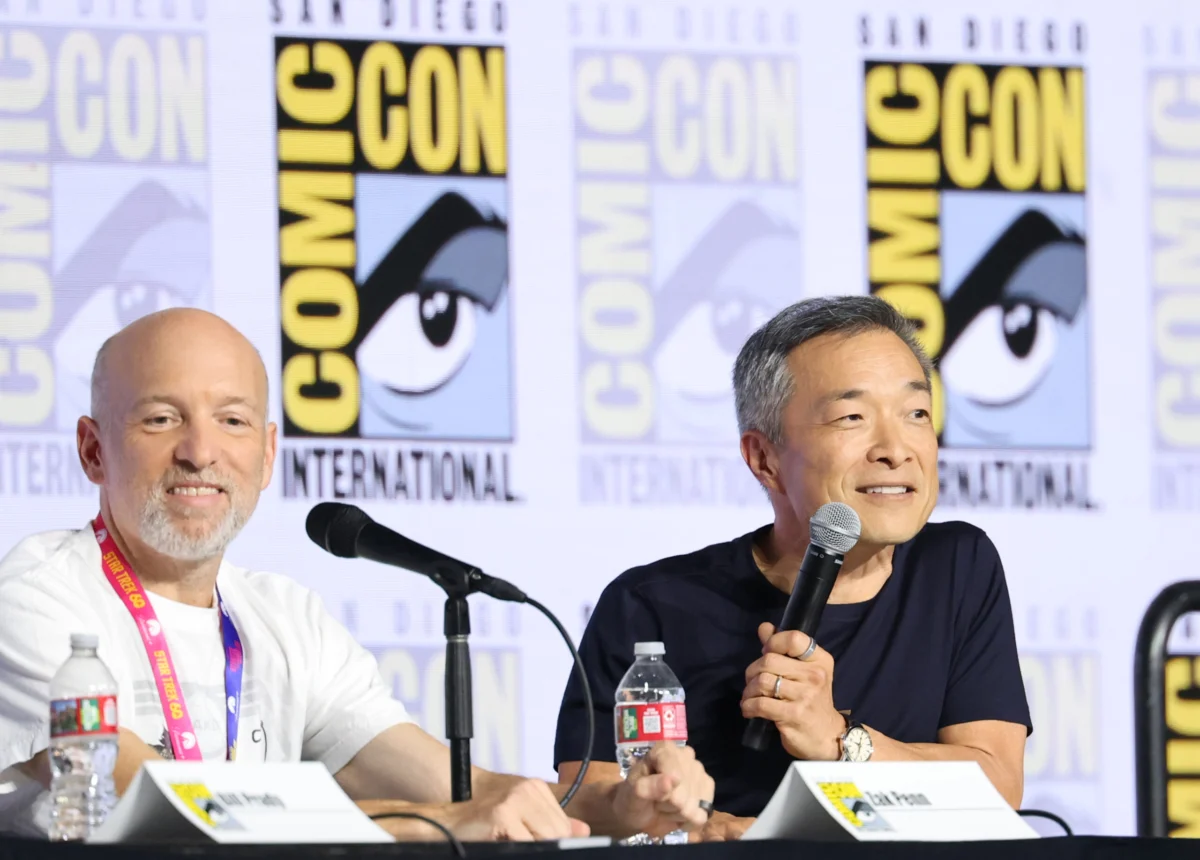
The hallowed grounds of Hall H at San Diego Comic-Con are no stranger to blockbuster revelations, yet Thursday’s panel for the highly anticipated The Big Bang Theory spinoff, Stuart Fails to Save the Universe, delivered a jolt of genuine surprise. As the lights dimmed following an exclusive screening of the pilot—which officially makes its debut on HBO Max today—the audience was treated to a high-profile guest appearance that underscored the massive scale of this new sci-fi comedy: DC Comics President and legendary illustrator Jim Lee.
Lee’s presence wasn’t just a ceremonial gesture; it served as a signal that this freshman series is not merely a nostalgia-fueled sitcom, but a bold, ambitious expansion of the Big Bang Theory universe. With the show’s creative architects—Chuck Lorre, Zak Penn, and Bill Prady—joining the cast on stage, the panel painted a picture of a show that bridges the gap between the grounded, observational humor of the original series and the high-concept, reality-bending possibilities of modern science fiction.
The Genesis of a Cosmic Crossover
The inclusion of DC Comics iconography was a foundational ambition for the production team. During the panel, moderated with characteristic wit by Felicia Day, Jim Lee revealed that his initial discussions with Chuck Lorre and the writing team were centered on a singular, audacious question: how to incorporate DC’s legendary roster into a narrative that remains true to the "nerd culture" roots of the franchise.
"They requested some DC characters to be involved in an episode, so we tried to make that happen," Lee explained, reflecting on his first meeting with the team. While he was careful to maintain a veil of secrecy regarding specific plot points, his enthusiasm was palpable. "It was just amazing that they were trying to do something that was true to our characters, but at the same time find comedy in it."

The DC President admitted that his first visit to the set was a transformative experience. Having expected a standard sitcom production, he was instead met with a scope that felt distinctly cinematic. "I was blown away," Lee noted. "It was completely not what I was expecting. Bill [Prady] and Chuck [Lorre] started talking about the overall arc of the 10 episodes, and I thought, ‘This is super ambitious.’"
Chronology: From Pasadena to the Multiverse
Stuart Fails to Save the Universe occupies a unique space in the Big Bang Theory chronology. Unlike its predecessors—Young Sheldon and Georgie & Mandy’s First Marriage, which served as historical prequels—this series moves the needle forward, focusing on the fan-favorite comic book shop owner, Stuart Bloom, played by Kevin Sussman.
The premise is a marked departure from the "will-they-won’t-they" or "growing-up" tropes of the parent shows. Stuart, a character defined by his perpetual bad luck and deep-seated obsession with pop culture, suddenly finds himself at the center of a multiversal crisis. Forced to repair the fabric of reality, he is joined by an eclectic crew of misfits: Denise (Lauren Lapkus), Bert (Brian Posehn), and the sharp-tongued Barry Kripke (John Ross Bowie).
As the panel revealed, the series structure mirrors the episodic nature of a comic book arc, with the "multiversal nightmare" providing a sandbox for the creators to play with alternate versions of established characters. Lee described the narrative as "nerds going through Gulliver’s Travels," a sentiment that suggests a show as much about the human condition as it is about cosmic threats.

The Artistic Fusion: A Meta-Narrative
One of the most compelling revelations of the panel was the extent of Jim Lee’s involvement beyond mere executive oversight. So inspired was the DC head by the show’s ambitious direction that he personally illustrated the cover art for the series’ exclusive comic book tie-in.
"I wanted to see Season 2 of this! But I wanted to do my part and bring these characters to life," Lee remarked. "It’s very meta to me."
This meta-narrative approach is clearly intentional. Chuck Lorre, the mastermind behind the Big Bang brand, noted that the primary creative goal was to "shoot it like a movie." The show aims to bridge the gap between the audience and the characters, presenting a science-fiction comedy that feels authentic to the very people who would have frequented Stuart’s comic book store in the original series. In essence, it is a show that the characters of The Big Bang Theory would likely watch and argue about over takeout.
Supporting Data and Production Insights
The production value of Stuart Fails to Save the Universe appears to be a significant step up from traditional multi-camera sitcoms. By leaning into the "multiverse" concept, the show utilizes a mix of practical sets and visual effects that move the series into the realm of high-concept genre fiction.

For Kevin Sussman, returning to the iconic Pasadena comic-book store set was an emotional experience. "Walking into the three-dimensional version of that shop was a fantasy, dreamlike experience," he told the crowd. However, the actor emphasized that the highlight was the camaraderie. "The best thing about it was just working with these guys again. I didn’t realize how much I missed them."
The panel also confirmed that the DC influence is not just a gimmick. While Mr. Freeze is confirmed to appear in the series’ trailer, Lee hinted that fans should prepare for surprising iterations of their favorite heroes. "Some of the DC characters they have in it, I think, are some of the best versions I’ve seen of those characters," Lee teased, setting a high bar for fan expectations.
Implications for the ‘Big Bang’ Franchise
The launch of this series carries significant weight for Warner Bros. and HBO Max. As the first official sequel in the Big Bang Theory franchise, it bears the burden of proving that the universe still has room for expansion after the success of the prequel series.
By pivoting from the sitcom format toward a genre-bending, multiversal adventure, the creators are attempting to future-proof the brand. If Stuart Fails to Save the Universe succeeds, it opens the door for a new era of Big Bang-adjacent content that focuses on the genre interests of the fans, rather than just the domestic lives of the characters.

The strategy is clear: leverage the deep bench of DC Comics, lean into the "nerd culture" that built the original show’s massive global audience, and provide a high-production-value spectacle that feels "at home" on a streaming service like Max.
The Path to the Finale
With the pilot streaming today, the momentum for the series is building rapidly. The panel served as a rallying cry for the existing fanbase to embrace this shift in tone. The series is slated to run for 10 episodes, culminating in a season finale on September 24.
As the panel concluded, the palpable energy in Hall H suggested that, despite the show’s title, Stuart may just succeed in saving the universe—or at the very least, saving the Big Bang Theory franchise from the stagnation that often plagues long-running sitcom legacies. For fans, the message is simple: keep an eye on the comic book store. The reality you know might just be about to change.
Whether it is the "best version" of DC characters or simply the funniest, one thing is certain: the stakes have never been higher for the guy who runs the store.
 Ammar Sabilarrohman
 Siti Muinah
 Iffa Jayyana
