

Even the most “magical” places on Earth are not immune to the cold, hard realities of crime. Beneath the meticulously manicured lawns of Walt Disney World and the soaring geosphere of Epcot, a shadowy underbelly exists—one fueled by obsession, black-market greed, and a fanatical devotion that occasionally crosses the line from appreciation to larceny.
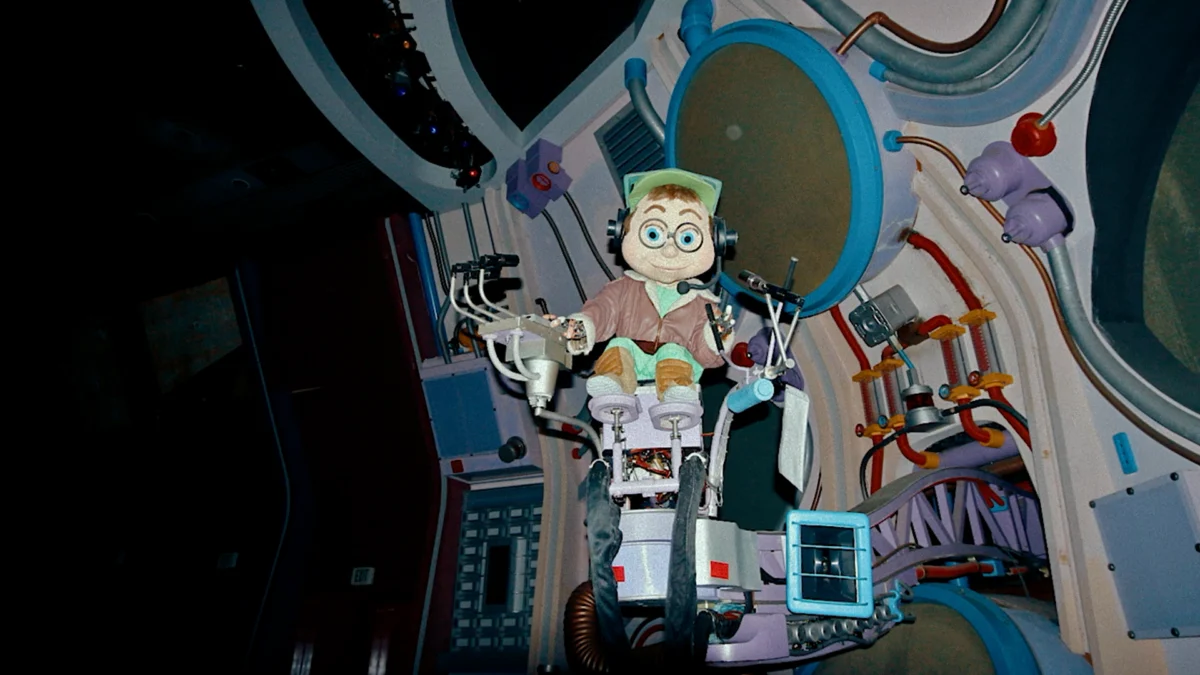
In 2018, the “Mouse House” faced an unprecedented security breach when one or more intruders bypassed the high-tech defenses of its flagship Florida resort under the cover of darkness. The target was not cash or proprietary technology, but something far more sentimental and bizarre: an animatronic character named Buzzy. A bespectacled, wide-eyed youth, Buzzy was the star of Cranium Command, a beloved, long-defunct theater show that once invited guests to explore the wonders of the human brain. When the dust settled, the animatronic had vanished, leaving behind an empty seat and a mystery that would haunt Disney enthusiasts for nearly a decade.
A Chronology of a Crime: From Defunct Attraction to Black Market Trophy
To understand the theft of Buzzy, one must understand the environment in which it occurred. Cranium Command had been shuttered since 2007, a victim of shifting corporate priorities that also claimed classic attractions like Body Wars and Goofy About Health. The Wonders of Life Pavilion, once a hub of educational entertainment, became a cavernous, forgotten relic—a “liminal space” that drew the attention of urban explorers.
The disappearance of Buzzy was not an isolated incident; it was the climax of a campaign of attrition. In the months leading up to the final heist, the character was slowly stripped of his dignity and his gear. His headset, his hat, and his jacket were systematically swiped, likely destined for the lucrative, underground market of illicit Disney memorabilia. Because the pavilion was decommissioned, it lacked the state-of-the-art security monitoring found in active rides, providing a window of opportunity for those who knew how to navigate the park’s blind spots.

The timeline of the investigation remains complex:
- 2007: Cranium Command closes to the public, marking the beginning of the pavilion’s transition into a forgotten, ghost-like state.
- 2018: A series of thefts occur, culminating in the total removal of the Buzzy animatronic from his post.
- 2019: Orlando authorities identify Patrick Spikes, a former Disney employee and content creator known as “BackDoorDisney,” as a person of interest.
- 2020: Spikes enters a plea deal, resulting in 10 years of probation, restitution, and a lifetime ban from all Disney properties.
- 2026: The documentary Stolen Kingdom, directed by Joshua Bailey, brings the case back into the public eye with new interviews and evidence.
The Suspect: Patrick Spikes and the “BackDoorDisney” Persona
The central figure in the mystery is undoubtedly Patrick Spikes. As the force behind the “BackDoorDisney” social media channels, Spikes had built a reputation for documenting the forbidden corners of Disney World. For years, he shared photos and videos of “behind the scenes” areas that were strictly off-limits to the public.
In Stolen Kingdom, director Joshua Bailey—himself a former urban explorer who knew Spikes—peels back the layers of this persona. The film features extensive interviews with Spikes, who remains tantalizingly vague about his culpability. While he never offers a full, formal confession, his behavior suggests a man who revels in the notoriety of the act.
“Ultimately, everything Patrick ever did was for attention,” Bailey notes. The documentary reveals that Spikes moved from petty theft—water bottles and FastPasses—to high-stakes trafficking of park artifacts. At one point, Spikes claims to have been offered $75,000 to liberate the original “Redhead” animatronic from Pirates of the Caribbean, a job he ultimately declined due to the extreme logistical risks.

Supporting Evidence: The Hat in the Room
The most damning piece of evidence in Stolen Kingdom is not a confession, but a visual “Easter egg.” During an interview filmed in 2021, the camera captures a hat sitting on a shelf behind Spikes—a piece of headwear that appears identical to the one stolen from Buzzy.
This discovery serves as a cinematic focal point, drawing comparisons to the ambiguous endings of The Usual Suspects or Michael Haneke’s Caché. When confronted with the visual evidence, Spikes offers a convoluted explanation, but the implication is clear: the items from the “stolen kingdom” are still circulating within private collections. The fact that the hat appears in the film, which was edited over four years, suggests that Spikes was aware of its presence and perhaps even intended to taunt investigators.
The Institutional Response: Silence and Denial
How does The Walt Disney Company respond to such a high-profile theft? According to director Joshua Bailey, the answer is a familiar one: “What film?”
Disney has historically employed a strategy of non-acknowledgment when it comes to unauthorized documentaries or “guerilla” filmmaking within its parks. This approach mirrors the company’s reaction to Randy Moore’s 2012 horror film Escape From Tomorrow, which was filmed in secret at Disney World. By refusing to sue or comment, Disney avoids giving these projects “extra oxygen,” effectively attempting to starve them of the controversy that could drive viewership.

Despite the embarrassment of having a flagship animatronic stolen by a former employee, the company has kept its internal security protocols regarding the theft largely under wraps, focusing instead on the legal banishment of the perpetrators.
Implications: The “Disney Adult” Crisis and the Ethics of Ownership
Stolen Kingdom is more than a true-crime documentary; it is a cultural critique of the modern “Disney Adult.” Bailey argues that the theft of Buzzy is a metaphor for a broader disconnect between the company and its most devoted fans.
“They feel that the metaphorical kingdom that was stolen from them was the Disney World IP,” Bailey explains. As Disney has shifted toward higher costs, overcrowding, and more restrictive policies, a segment of the fanbase has become radicalized. These individuals, feeling a sense of ownership over the attractions they grew up with, justify their actions as “reclaiming” history from a corporation that has allegedly lost its way.
This adversarial relationship has created a thriving black market where attraction manuals, props, and costumes are traded among elite collectors—some of whom, as the film hints, are prominent celebrities. The market is “sticky” and dangerous, yet it remains the primary driver for those who see themselves as custodians of a legacy that Disney has supposedly abandoned.

Conclusion: A Lingering Mystery
As Stolen Kingdom continues to reach audiences via VOD, the fate of Buzzy remains a haunting open question. Is the animatronic currently sitting in a private basement in Florida, or was he stripped for parts and sold to the highest bidder?
Director Joshua Bailey, while moving toward narrative filmmaking, keeps his files open. He teases a potential follow-up project titled “Disney Black Market,” suggesting that the Buzzy case is merely the tip of the iceberg. For now, the story serves as a cautionary tale: when the line between fandom and obsession blurs, the “most magical place on Earth” can quickly transform into a scene of the crime.
Whether Buzzy is ever recovered or remains a ghost in the machine, his absence remains a permanent scar on the history of Epcot—a reminder that even the most carefully constructed fantasies are vulnerable to the human desire to possess the unattainable.
 Ammar Sabilarrohman
 Siti Muinah
 Iffa Jayyana
