

As the global transition to renewable energy accelerates, the world is facing a paradoxical bottleneck: while capital for green infrastructure is abundant, the human labor required to install it is not. Countries and corporations are currently racing to deploy solar arrays and battery storage systems to meet aggressive climate goals and ensure energy sovereignty. However, this massive undertaking is being hampered by a chronic shortage of skilled manual labor.
Enter Gritt, a robotics startup that is betting on the marriage of advanced AI models and industrial hardware to solve one of the most pressing infrastructure challenges of our time. By enabling robots to operate in the chaotic, unstructured, and unpredictable environment of a construction site, the company aims to fundamentally change how civilization builds its future.
The Core Innovation: Intelligence for the "Dirty and Dangerous"
Historically, industrial robotics have been confined to the sterile, controlled environments of factory floors. In these settings, robots excel at repetitive tasks because the environment is unchanging. Construction sites, by contrast, are the antithesis of a factory: they are muddy, uneven, exposed to the elements, and constantly evolving.
Gritt, founded by Carnegie Mellon-trained roboticists Puneet Puri (CEO) and Vishal Dugar (CTO), was built on a singular thesis: if we want to scale construction, we need an intelligence capable of navigating the chaos of the outdoors.
Rather than reinventing the wheel by manufacturing proprietary robotic hardware, Gritt adopts an "asset-light" approach. The company integrates its proprietary AI software stack into off-the-shelf industrial hardware, such as robotic arms from Kawasaki and specialized skid-steer vehicles. This strategic choice allows Gritt to focus on what matters most: the "brain" of the machine. By deploying these systems, the startup is tackling the "3D" jobs of construction—tasks that are often described as dirty, dull, and dangerous.
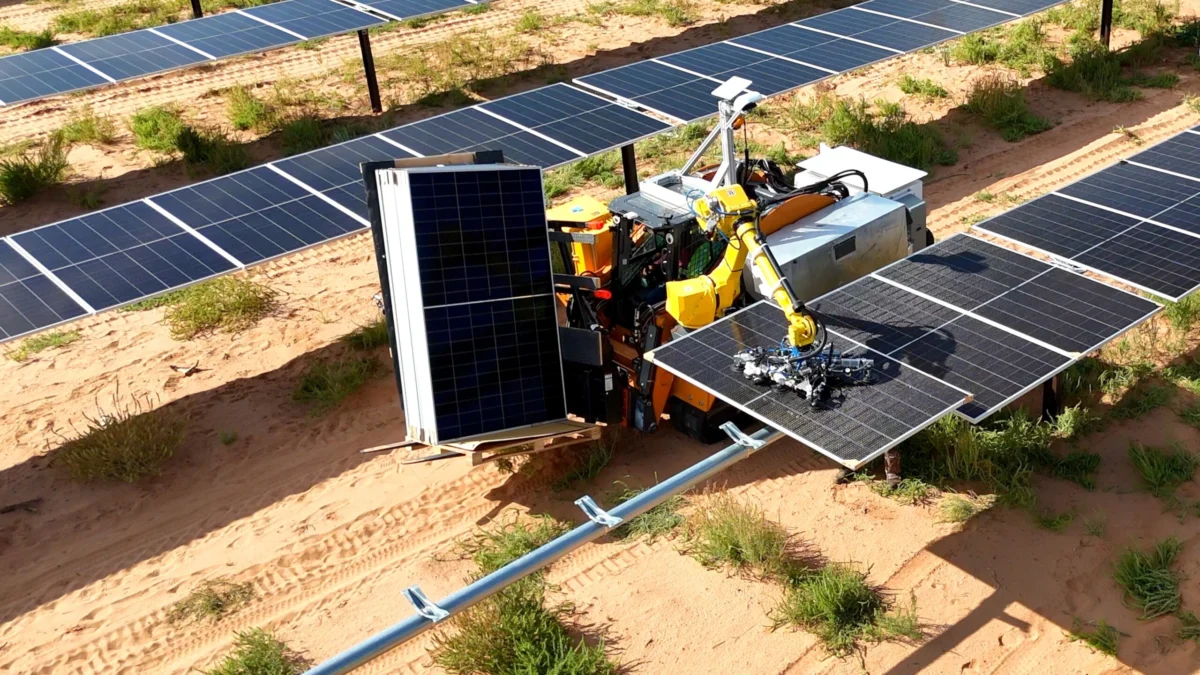
The first practical application of Gritt’s technology is the installation of solar panels. The system autonomously unloads heavy glass panels from transport pallets, transports them to the mounting structures, and positions them with sub-millimeter precision. This allows human workers to focus on the high-skill task of fastening the panels, rather than the back-breaking labor of lifting 100-pound components overhead in sweltering heat.
A Rapid Ascent: The Funding Chronology
Gritt’s journey from a research-driven concept to a market-ready player has been marked by significant investor confidence. The company recently announced it has exited stealth mode following a successful $26 million Series A funding round.
- Seed Stage: The company’s early potential was recognized by a diverse group of investors, including First Round Capital, Climactic, Congruent Ventures, and VSC Ventures. This initial capital allowed the founders to develop their core AI pipeline and prove the concept in early field tests.
- Series A Expansion: Led by Obvious Ventures, the $26 million Series A included participation from Union Square Ventures and Active Impact Investment. This injection of capital brings Gritt’s total funding to $34 million.
- The Milestone: The funding round arrives at a critical inflection point. With two systems already deployed in the field and active, the company is moving from the research phase to a commercial scaling phase. The roadmap for the next six months is aggressive: Gritt aims to have 48 of its systems fully operational across various job sites.
Andrew Beebe, the partner at Obvious Ventures who spearheaded the investment, highlighted the founders’ unique background as a primary driver for the firm’s involvement. "There are people who used to build rockets that went into space and had infinite budgets… and then there are people who know what it means to get into dirty, dull, and dangerous jobs and scale them like mad," Beebe noted. "These guys are in the second camp."
Data and Performance: Quantifying the Impact
The most compelling argument for Gritt’s technology is its demonstrated ability to improve job-site efficiency. According to data collected from the company’s active deployments, the impact on productivity is profound.
A standard, highly efficient eight-person crew typically manages the installation of roughly 800 solar panels per day. With the assistance of Gritt’s robotic systems, that same crew’s throughput increases to between 3,000 and 4,000 panels per day. This is a four-to-fivefold increase in speed, which could prove decisive in meeting the global demand for gigawatt-scale power installations.
Currently, the company has secured contracts to assist in the installation of 2.8 gigawatts of solar capacity over the next 18 months. Their customer base already includes three of the top 10 power construction companies in the United States, signaling that the industry is ready for the adoption of physical AI.
One anonymous customer—a project manager at a major solar firm—expressed enthusiasm for the system, specifically citing the benefits in remote locations. Attracting and retaining labor in remote, isolated sites is a perennial issue for construction managers. By automating the most taxing aspects of the work, companies can reduce the number of personnel required on-site, simultaneously mitigating the risk of injury associated with repetitive heavy lifting.
The Competitive Landscape: Hardware vs. Intelligence
Gritt is not operating in a vacuum. The race to automate solar installation has attracted several well-funded competitors, including Luminous Robotics, Cosmic, and China’s Trinabot.
However, there is a fundamental difference in strategy. While competitors are often building their own custom hardware from the ground up, Gritt’s decision to use off-the-shelf equipment provides a potential edge in scalability. By remaining hardware-agnostic, Gritt can theoretically pivot to the most cost-effective machinery available, avoiding the long lead times and high capital expenditures associated with designing and manufacturing bespoke robotic bodies. Whether this software-first approach allows Gritt to outpace hardware-heavy competitors will be a defining question in the coming years.
The Future: Beyond Solar Panels
The current solar application is merely the "beachhead" for Gritt’s broader vision. The founders are already working on expanding the system’s repertoire to include drilling, rack construction, and, eventually, complex tasks like tying rebar for concrete foundations.
The secret sauce behind this rapid expansion is the maturation of General-Purpose AI. Five years ago, training a robot to perform a single task was a laborious, multi-year process. Today, the underlying AI pipeline is becoming increasingly generalizable. Puri notes that training the system to stack cinder blocks took weeks of engineering, whereas a similar demo for rebar tying—using the same underlying logic—took only a single day.
The "Layer of Physical AI"
Beyond the physical manipulation of objects, Gritt envisions its robots serving as "site observers." Because the robots are equipped with an array of sensors and computer vision, they can function as a centralized intelligence layer for the entire construction site.
Imagine a scenario where a robot, while moving between tasks, detects an open trench just as a storm forecast is updated. The system could automatically alert project managers to cover the trench, preventing water damage to sensitive electrical components. It could also keep real-time tabs on inventory, flagging missing parts before they halt production.
"Gritt becomes now this layer of physical AI," says Puri. "It is doing this dextrous, labor-intensive task, plus it can help you take decisions on the site."
Implications for the Global Economy
The success of Gritt would signal a broader shift in the global labor market. If robots can successfully navigate the "unstructured" nature of the real world, the implications extend far beyond solar farms. We could see a reduction in the costs of building housing, bridges, and critical infrastructure, effectively lowering the barrier to entry for large-scale public works.
However, the rise of physical AI also prompts questions regarding the future of the construction workforce. While Gritt frames its technology as a tool to aid, rather than replace, human workers—focusing on reducing injury and burnout—the long-term impact on job roles remains a subject of ongoing debate.
For now, the focus remains on the immediate crisis: the climate-driven need for rapid, cost-effective infrastructure deployment. If Puri and Dugar can prove that their robots can handle the dust, the mud, and the complexity of the job site, they may have found the key to building a greener world—one autonomous installation at a time.
 Asep Darmawan
 Siti Muinah
 Ali Ikhwan
