

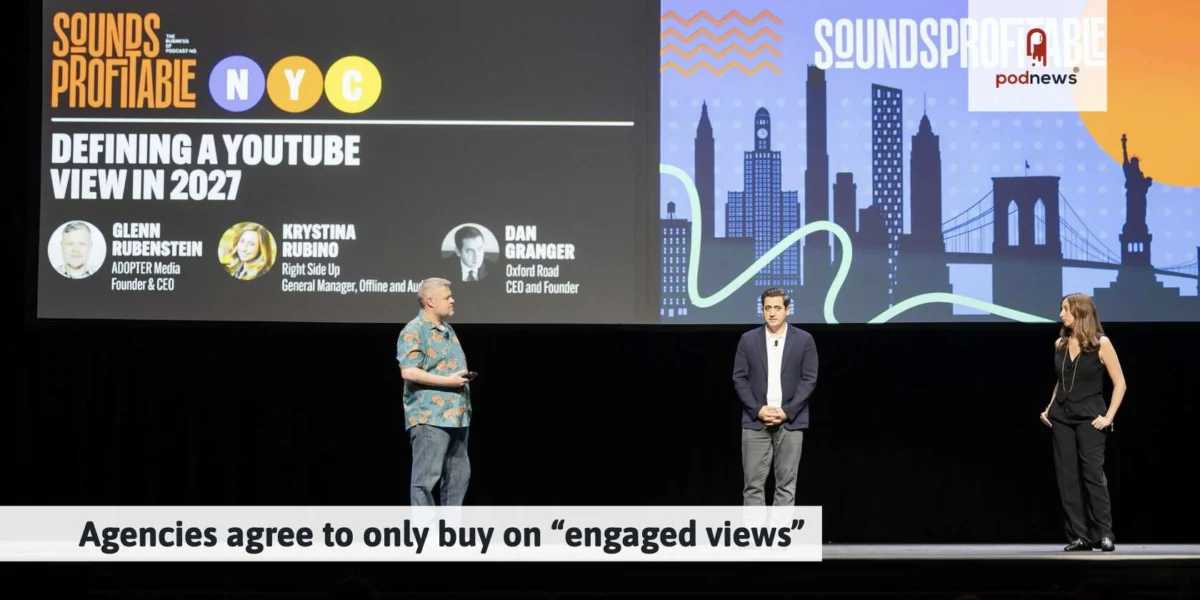
As the podcasting industry matures, the long-standing debate over "download-based metrics" versus "engaged audience insights" has reached a tipping point. As of September 2026, a significant shift is rippling through the media buying world: agencies are increasingly mandating that ad spend be tied exclusively to "engaged views." This evolution marks a departure from the "spray and pray" approach of counting raw downloads, moving toward a performance-based model that prioritizes actual listener attention.
Main Facts: The End of the "Download" Era
The fundamental shift in the industry centers on the reliability of the IAB Tech Lab’s measurement guidelines. While these standards provided a necessary baseline during the industry’s infancy, they have become increasingly decoupled from the reality of modern media consumption.

Agencies are no longer content with "served" impressions—a metric that, in the era of automatic background downloads and aggressive cache-clearing, often overstates actual listenership. Instead, major media buyers are demanding proof of "engaged views." This term generally refers to data verified by ad-insertion platforms confirming that the listener not only downloaded the file but stayed active through the ad break.
This pivot is not merely technical; it is economic. By tightening the criteria for what constitutes a "billable impression," agencies are effectively de-risking their investments, ensuring that their creative assets are reaching human ears rather than ghost-downloading scripts.

Chronology: The Road to Engagement-First Metrics
- 2023–2024 (The Awareness Phase): The industry began to grapple with the "download fraud" problem. Technical reports surfaced regarding how certain podcast hosting platforms inflated numbers through non-human bot traffic.
- 2025 (The Standardization Push): Industry leaders, spurred by organizations like Sounds Profitable, began advocating for a unified definition of "engaged listening." This period saw the rise of advanced pixel-based tracking and server-side verification.
- Early 2026 (The Agency Ultimatum): Major holding companies began drafting new internal mandates, requiring that at least 60% of their annual podcast budgets be allocated to inventory verified by third-party engagement trackers.
- September 2026 (The Current Pivot): The "engaged view" mandate becomes a standard industry requirement for top-tier ad campaigns, leaving legacy, unverified inventory to compete for lower-budget, non-performance-based spending.
Supporting Data: Parsing the Landscape
The current market environment, as of late September 2026, presents a bifurcated reality for podcasters. While top-tier shows continue to dominate, the metrics are becoming more granular.
According to latest industry data:

- Apple Podcasts (US): Remains the primary discovery engine, with shows like The Daily holding firm at the #1 spot. However, Apple’s proprietary metrics are being augmented by third-party attribution tools to confirm engagement.
- Spotify (US): The Joe Rogan Experience continues to lead the platform, showcasing the power of long-form, high-engagement content that agencies are willing to pay a premium for.
- Niche Growth: Categories such as "Automotive" (Ireland) and "Volleyball" (Australia) are seeing massive spikes in new entries, proving that hyper-niche content can generate high engagement rates even with lower total download volume.
The data suggests that while the "number of downloads" is still a vanity metric for creators, it has become nearly irrelevant for serious commercial entities. The "Highest New Entry" and "Biggest Gain" categories are now being filtered through engagement-per-episode metrics rather than simple volume.
Official Responses and Industry Sentiment
The shift toward engaged views has met with mixed reactions. Large podcast networks, which have already invested heavily in proprietary ad-tech stacks, view the move as a validation of their business models.

"We stopped selling ‘downloads’ three years ago," says a representative from a major ad-tech firm. "If you are buying a billboard, you don’t pay based on how many people might have walked past it; you pay for the gaze time. Podcasting is finally adopting the standard of every other digital medium."
Conversely, independent creators and smaller shows have expressed concerns. Many fear that the technical burden of implementing engagement tracking could create a barrier to entry. "It’s a ‘rich-get-richer’ scenario," notes an independent producer. "The big shows have the resources to integrate sophisticated tracking; the hobbyists and small-scale journalists are left trying to figure out how to satisfy agency algorithms."

New Content Trends: The Rise of Specialized Genres
As the industry pivots to engagement, the types of content finding success are shifting as well. Evidence of this can be found in the current week’s new releases:
- Horror as a Growth Engine: Inspired by the massive success of horror podcasts in Asian markets, BBC Studios has launched The Haunted Library. It is a clear bet on "always-on" engagement—horror content typically sees higher completion rates, making it an attractive prospect for performance-based ad buyers.
- Investigative Accountability: The Media Integrity Project’s launch of Humanity in Journalism highlights a hunger for "process-driven" content. By showing the audience how news is made, they are fostering a deeper, more loyal connection—a key driver for engagement metrics.
- Climate and Social Commentary: With the arrival of Climate Week NYC, shows like The Climate Denier’s Playbook are leveraging topical urgency to drive live engagement, including in-person events that bridge the gap between digital audio and physical presence.
Implications for the Future of Podcasting
The move to an "engaged views" economy will have three primary impacts on the future of the medium:

1. Consolidation of Ad-Tech
Expect a wave of mergers and acquisitions in the coming months. Hosting platforms that cannot offer transparent, agency-grade engagement data will likely be absorbed by larger, tech-heavy competitors. The days of "standalone" hosting services without built-in attribution are effectively over.
2. A Shift in Creative Strategy
Creators will increasingly focus on "retaining the listener" rather than just "attracting the click." This will likely lead to shorter, more high-impact intros and the placement of ads in more strategic, high-retention windows within the episode. Content that is "skippable" will be punished by the metrics, forcing a creative renaissance in ad-copy and placement.

3. The Human Element in Journalism
As seen with the launch of Humanity in Journalism and the long-running success of CONNESSIONI, listeners are seeking authenticity. The most successful podcasts of the next decade will be those that treat the listener as a participant in a conversation rather than a passive consumer of audio files.
4. The Globalized Content Market
The industry is becoming increasingly borderless. When a show like CONNESSIONI reaches a ten-year milestone, or an Indonesian-focused investigative series like World of Secrets gains global traction, it proves that "engagement" is a universal language. Agencies are no longer looking for "local" or "national" audiences; they are looking for "engaged" audiences, regardless of geography.

Conclusion
The transition to an engagement-focused model is the most significant maturation event in the history of podcasting. While the technical hurdles are non-trivial, the move brings the industry into parity with the broader digital advertising ecosystem.
For creators, the path forward is clear: focus on quality, prioritize listener retention, and embrace the data that proves your value. For advertisers, the era of paying for empty downloads is ending. In its place, a more transparent, performance-driven future is emerging—one where the quality of the conversation matters just as much as the quantity of the audience. As the industry continues to evolve, the "engaged view" will remain the gold standard by which the success of the medium is measured.
 Asep Darmawan
 Jia Lissa
 Neng Nana
