

Main Facts: A Surreal Collision of Science and Legacy
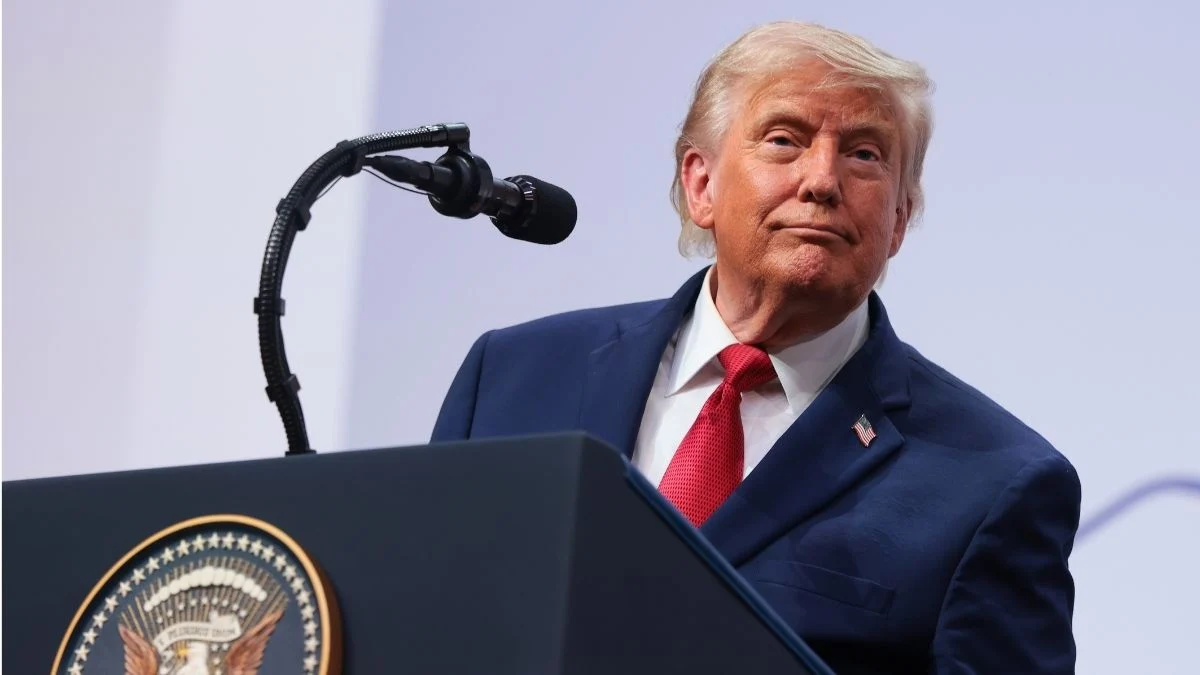
In a scene that underscored the increasingly unpredictable nature of Oval Office proceedings, President Donald Trump disrupted a formal signing ceremony for quantum technology executive orders with a series of tangents that left seasoned researchers and high-ranking officials visibly disoriented. The event, intended to bolster American dominance in the nascent field of quantum computing, saw the president pivot from the technical achievements of 2025 Nobel laureate Professor John Martinis to an idiosyncratic inquiry regarding the president’s late uncle, Dr. John Trump.
The encounter serves as a microcosm of the current administration’s unique approach to scientific discourse, where the rigid, data-driven world of quantum mechanics collided with the president’s persistent fixation on his family’s historical legacy. While the primary purpose of the gathering was to codify federal support for quantum research—an area of study critical to national security and global economic competitiveness—the atmosphere was abruptly recalibrated by the president’s personal anecdotes and grievances regarding the Nobel Committee.
Chronology of the Oval Office Exchange
The sequence of events began with the solemnity befitting a major technological policy announcement. Cabinet members, including Secretary of Defense Pete Hegseth, and leaders in the tech industry gathered to witness the signing of two executive orders aimed at accelerating the development of quantum-resilient systems.
The Nobel Comparison
As Professor John Martinis stood among the dignitaries, the President engaged him in a discussion regarding the timeline of his breakthrough research. Martinis, who shared the 2025 Nobel Prize in Physics for foundational work that laid the groundwork for modern quantum processors, explained that the core paper originated roughly four decades ago.
President Trump’s reaction was immediate and characteristic. After remarking that forty years was "pretty good," the president veered into a critique of the Nobel Committee. Expressing frustration over his own perceived lack of recognition, Trump lamented that he had been waiting for a Nobel Peace Prize, suggesting that the committee’s standards were unfairly applied to him. In a comment that drew swift attention from the assembled guests, he remarked, "They don’t think eight wars is enough," and asserted that, regarding his own diplomatic record, "nobody’s ever done one"—a reference to his belief that he had prevented large-scale conflicts during his tenure.
The "Uncle" Interrogation
Minutes after the discussion on war and international accolades, the President turned his attention back to Professor Martinis. With little context, the President asked, "Did you know of my uncle at all?"
The exchange was marked by a palpable sense of confusion. Martinis, visibly unsure if the query was a joke or a serious inquiry, looked to his right, seeking clarification from Defense Secretary Hegseth. Hegseth, recognizing the President’s intent, gestured toward Trump, confirming that the physicist was indeed the intended recipient of the question.
Martinis replied, "No, no," to which the President pressed, "You didn’t?" The professor offered a polite, "No, sorry," as laughter rippled through the room—a mix of nervous energy and amusement at the surreal nature of the dialogue. Martinis, a scholar of precision, attempted to ground the interaction in geography, noting that he had conducted his seminal research at UC Berkeley, whereas the President’s uncle had been a professor at MIT, an institution located on the opposite coast.
Supporting Data: The Legacy of John Trump
The figure at the center of the President’s curiosity is John Trump, a distinguished electrical engineer who served on the faculty at the Massachusetts Institute of Technology (MIT) from 1936 until his retirement in 1973. John Trump was a pioneer in high-voltage technology and particle accelerators, earning the National Medal of Science from President Ronald Reagan in 1983.
Field Discrepancies
While Donald Trump has frequently cited his uncle as a testament to the family’s intellectual pedigree, the assertion that John Trump’s work is synonymous with the quantum advancements of today requires nuance. John Trump’s expertise was primarily in electrical engineering, specifically high-voltage phenomena and their medical applications, such as radiation therapy for cancer patients. While his work in physics was significant, it sits in a different sub-discipline than the superconducting qubit research that earned John Martinis the 2025 Nobel Prize.
Historical Context
The timeline of the two men’s careers highlights the generational shift in physics. John Trump passed away in 1985—the very year Martinis and his colleagues co-authored the foundational paper that would eventually lead to the development of modern quantum circuits. The irony of the interaction lies in this temporal gap: while the President seeks to link his family name to the modern scientific elite, the actual researchers involved were often working in disparate fields or at different stages of scientific development.
Official Responses and Political Implications
The aftermath of the briefing has sparked debate regarding the prioritization of scientific expertise within the current administration. Critics argue that the interruption signifies a lack of focus on critical national security issues, while supporters contend that the President’s personal style reflects a desire to humanize technical briefings and bridge the gap between the executive branch and the scientific community.
The View from the Scientific Community
For many in the physics community, the exchange was viewed as a missed opportunity to discuss the looming "quantum race" with China. Experts in the field have warned that the United States is in a precarious position regarding the development of quantum decryption, which could render current encryption standards obsolete. By focusing on personal associations rather than the strategic implementation of the executive orders, the President provided an unconventional backdrop for a high-stakes policy shift.
Administrative Perspective
Insiders close to the administration suggest that the President’s habit of mentioning his uncle is a rhetorical device used to establish a baseline of "high-level intelligence" in his family tree, which he often uses to counter criticisms of his own policy decisions. By framing his family history within the context of Nobel-caliber science, the President attempts to position himself as a product of a sophisticated intellectual lineage.
Broader Implications: The Intersection of Policy and Personality
The Oval Office event serves as a case study in how modern governance is increasingly defined by the personality of the executive. When the leader of the free world occupies his time in a briefing on quantum mechanics by asking about a deceased relative, it ripples through the halls of academia and the corridors of power in Washington.
The Erosion of Protocol
The disruption highlights an erosion of traditional protocol. Formal science briefings, once strictly choreographed to highlight technical achievements and policy goals, are now subject to the same spontaneous, conversational style that defines the President’s rallies and media appearances. This shift has forced scientists and policy advisors to adopt a more flexible approach to their interactions with the President, often bracing for tangents that could range from the historical to the deeply personal.
Strategic Distraction or Authenticity?
Whether this behavior is a deliberate distraction from complex policy debates or a genuine reflection of the President’s thought process remains a subject of intense speculation. However, the result is the same: the technical substance of the executive orders—measures designed to ensure the US remains at the forefront of the quantum revolution—risks being overshadowed by the spectacle of the encounter itself.
As the administration continues to navigate the complexities of 21st-century technology, the "John Trump" inquiry stands as a reminder that in the current political climate, the personal legacy of the President remains as central to the administrative agenda as the science that governs the future of global computing. The challenge for the scientific community, therefore, is to maintain the integrity of their research while navigating a political landscape that prioritizes narrative and legacy over pure, empirical data.
Ultimately, the event highlights a fundamental disconnect: one side of the room is looking toward a future of quantum supremacy, while the other is looking backward at a family tree, attempting to anchor modern scientific achievement to the ghosts of the past.
 Neng Nana
 Azzam Bilal Chamdy
 Nana
Nana
