

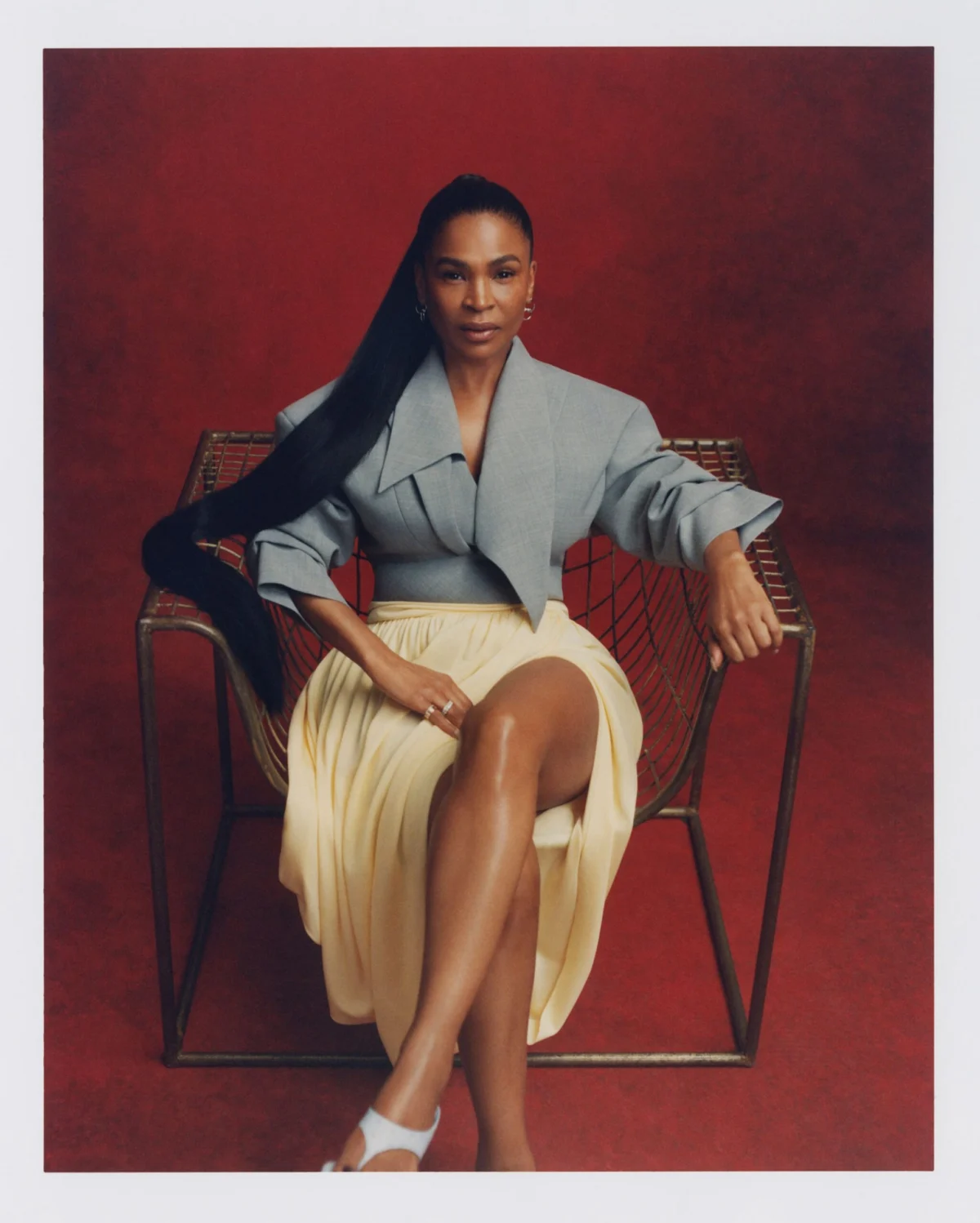
There is a specific, disorienting vertigo that accompanies exiting a darkened movie theater in the middle of a sun-drenched afternoon. The world outside feels jarringly saturated—too bright, too loud, and fundamentally detached from the carefully constructed reality one has just inhabited for two hours. You step onto the sidewalk, blinking against the glare, feeling as though the film is still clinging to your skin like a faint, persistent perfume.
It is in this state of post-cinematic transition that I meet Nia Long for an early lunch at the Chateau Marmont. I have just screened Michael, the highly anticipated Michael Jackson biopic arriving in April, in which Long portrays the family matriarch, Katherine Jackson. As Long arrives—effortlessly chic in an oversized blazer, wide-leg denim, and a Miu Miu baseball cap pulled low—a strange, doubling effect takes hold. Watching her move through the lobby, I see both the woman before me and the stoic, measured figure I witnessed on screen, their identities layered like two transparencies held up to the light.

The Art of the Load-Bearing Silence
In Michael, Long’s performance is a masterclass in economy. She plays Katherine Jackson with a studied, profound stillness. When we first encounter her, she is observing her sons during a rehearsal; the camera lingers on her face, capturing a depth of maternal love that requires no dialogue. In a film that features the blustering, high-stakes intensity of Colman Domingo as Joe Jackson and the uncanny physical transformation of Jaafar Jackson as the King of Pop, Long’s performance functions as the emotional anchor. She has mastered the art of making silence "load-bearing."
"There have been moments in my life where I’ve been required to be more graceful than I’ve ever had to be in the past," Long reflects, her tone shifting from casual warmth to intense introspection. "That requires a sense of really being able to dig deep into some sort of self-examination. What do I stand for? What’s important to me, ultimately, regardless of Hollywood, the noise? My children come before anything. And so, I think when you look at Michael’s journey, and you look at Katherine’s journey, the only way you thrive and survive is through a tremendous amount of grace. What I think I learned from her is that sometimes grace is really quiet."

A Career Defined by Cultural Permanence
Nia Long occupies a singular space in the American cultural consciousness. For generations, she has been the definitive embodiment of "90s Fine"—a descriptor that transcends mere aesthetics. To watch her as Nina in Love Jones, Jordan in The Best Man, or Lisa in The Fresh Prince of Bel-Air is to be transported to a specific era of Black cultural expression, one defined by a particular blend of poise, vulnerability, and sharp-witted autonomy.
When I ask how she navigates the weight of this nostalgia and the iconography that surrounds her, she remains characteristically grounded. "My commitment to work is not for accolades or attention, or even to be famous, quite honestly," she says, pausing to enjoy her salmon. "But I do think because of my commitment to truth and purpose, there is a thing—I don’t know what that thing is—that people see in my work. It makes them feel good. It makes them feel inspired. It makes them feel like they know me."

In an industry notoriously fickle, particularly toward Black actresses, Long’s longevity is an anomaly she does not take for granted. "There are highs and lows," she admits. "I’m having a great year, but I don’t know what’s happening next year."
Strategic Evolution: Behind and In Front of the Camera
Long’s approach to her craft has always been intentional. While she creates characters that resonate with raw truth, she is equally pragmatic about the business of Hollywood. "The only strategy I have in this game is my bank account," she says with a laugh. "Let’s strategize how we’re going to make money and create generational wealth. That is where I’m strategic."

As her eldest son moves into his 20s and her youngest, at 14, enters his own stage of independence, Long is shifting her focus toward producing and narrative control. She recently wrapped production on Don’t Ever Wonder, a romantic dramedy directed by Eugene Ashe. The film marks an onscreen reunion with her Love Jones co-star Larenz Tate, alongside an ensemble cast featuring Blair Underwood, Susan Kelechi Watson, and Algee Smith.
"This is not a continuation of Love Jones," she clarifies. "This is a continuation of love, and of what happens once you’ve had your kids, they’re off to college, and you’re empty nesters. There’s a lot of funny and there’s a lot of heartbreak, and I think it’s a really honest story."

The Anatomy of Resilience: Public Scrutiny and Private Healing
Our conversation inevitably drifts toward the intersection of the public and the private. In 2022, Long’s personal life became fodder for tabloid headlines following a high-profile cheating scandal involving her long-term partner. When we discuss the fallout, she is refreshingly direct.
"The amount of pouring into myself that I’ve done is strong and mighty and intentional," she says. "I’ve now identified the things that I need to work on and the things that I need to heal. But I have also identified what is intolerable."

Her gratitude for the public support she received is tempered by a clear-eyed understanding of the machinery of fame. "I’m proud of myself for giving so much grace. For being able to say people make mistakes and things happen. It’s life. When the stakes are high, the news is big. I can’t do anything about that, but I don’t have to protect my ego in any of this."
She offers advice for those navigating their own crises: "It’s not about another person’s behavior. It’s about your bottom line and the magnitude in which you’re committed to self-love. I don’t think it’s healthy to hold onto things because then you’re just walking around with this burdensome energy. You don’t have to respond to the noise with the undercurrent of your own trauma."

The Memoir: Excavating the Past
Currently, Long is channeling this self-reflection into her first memoir—a two-year project she describes as "one of the biggest, bravest, most challenging things" she has ever done. The book revisits her childhood, including a transformative period in Iowa City, where her mother attended university.
Raised in a close-knit, Black Brooklyn environment, the move to the Midwest forced her to grapple with identity in a space where she was often the only Black girl. "In writing this memoir, I realized the impact that experience had on my own view of beauty," she says. "I thought I was beautiful because my mother said it and my family said it, but the world told me something different. So, to now be a face for Estée Lauder, it’s kind of ironic, because I didn’t feel beautiful until Black Hollywood said I was beautiful."
.jpg)
Aging in the Public Eye
As she approaches 55, Long is rejecting the "Black don’t crack" narrative, which she views as a double-edged sword that often dismisses the physical reality of aging. "I’m 55. I’ve got hormonal stuff going. Your body shifts, changes. It’s a whole new body," she says.
She speaks of her mother—a woman who wore leg warmers in the summer simply because she wanted to—as a primary influence on her concept of freedom. "Being able to do what you want to do when you want to do it, because it serves your spirit, not what everyone else thinks you need to be or should be," she concludes. "You don’t have to have anyone else’s permission to do what you love. It doesn’t have to be on the big stage. It could be in your kitchen."
.jpg)
With that, she excuses herself. There is a pizza party waiting at home, and for Nia Long, the freedom to show up for her son—unfiltered, unburdened, and entirely on her own terms—is the greatest success of all.
 Asro
Asro
 Suro Senen
 Azzam Bilal Chamdy
