

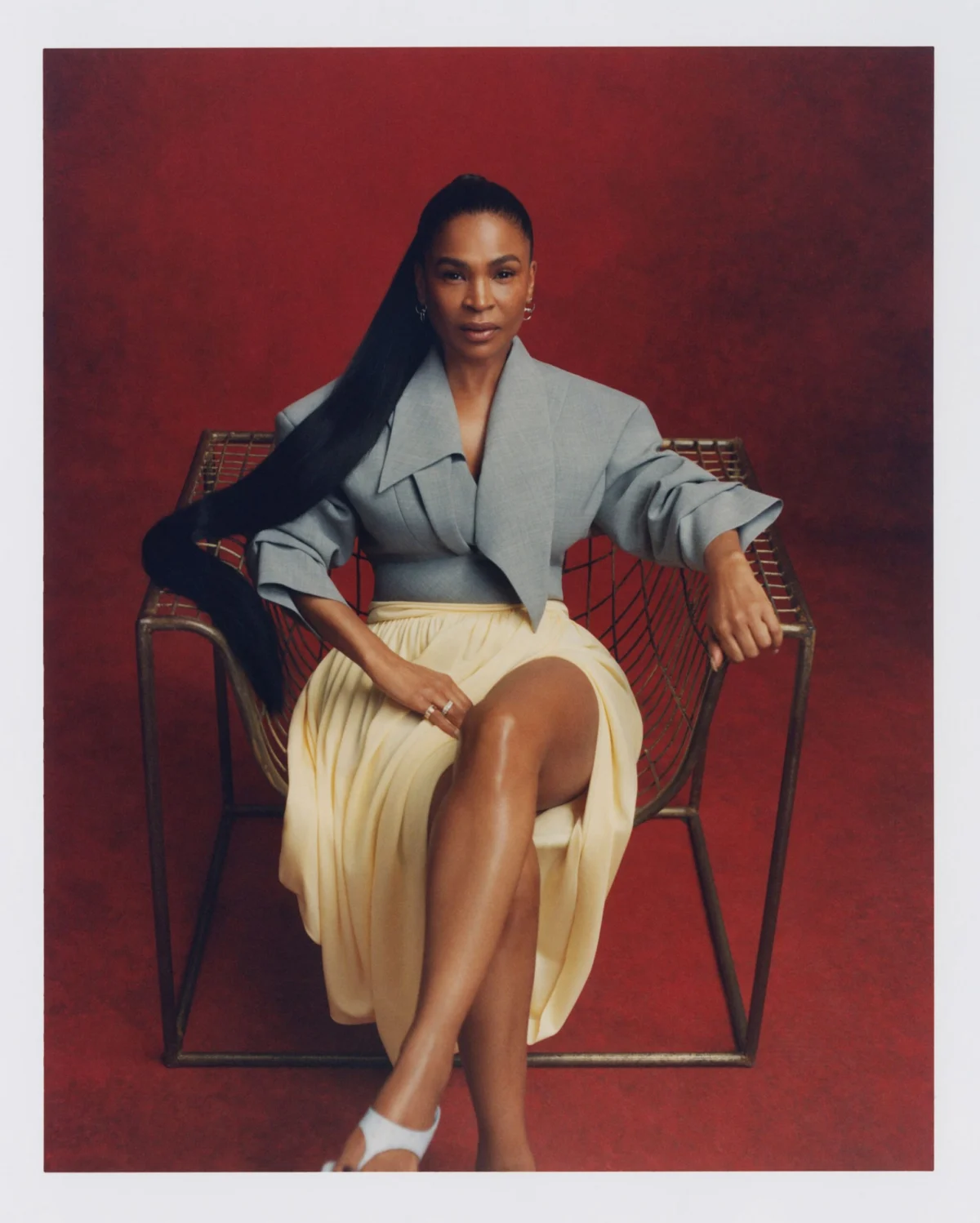
There is a peculiar, disorienting vertigo that accompanies the act of exiting a movie theater in the middle of a sun-drenched afternoon. The transition from the carefully curated, immersive reality of the screen to the jarring, unscripted noise of the real world is rarely seamless. For two hours, the audience lives within someone else’s vision; when the credits roll, one returns to the pavement, blinking, carrying the emotional residue of the film like a lingering scent.
It was in this state of transition that I met Nia Long at the iconic Chateau Marmont. Having just screened Michael—the highly anticipated, upcoming Michael Jackson biopic—a month ahead of its April release, my mind was still saturated with the film’s narrative. As Long arrived—effortlessly chic in an oversized blazer, wide-leg jeans, and a low-slung Miu Miu baseball cap—I was struck by a surreal doubling effect. The woman sitting before me and the woman I had just watched on screen, portraying the Jackson family matriarch Katherine Jackson, felt like two transparencies held up to the same light.
The Art of the Unspoken: Portraying Katherine Jackson
In Michael, Long delivers a performance defined by a masterclass in restraint. Her Katherine Jackson is not a woman of grandiloquent monologues; she is a woman of profound, heavy silence. In a film that features the boisterous, often volatile energy of Joe Jackson (played by Colman Domingo) and the eerie, transformative precision of Jaafar Jackson as his late uncle, Long’s performance serves as the film’s moral anchor.

Her approach to the role is one of "load-bearing" silence. When the frame holds on her face as she watches her children rehearse, she says nothing, yet she communicates everything. It is a performance that demands the audience pay attention to the stillness, a testament to her decades of experience in the craft. When asked about her preparation, Long repeatedly returns to a single, foundational concept: grace.
"There have been moments in my life where I’ve been required to be more graceful than I’ve ever had to be in the past," she reflects. "And that requires a sense of really being able to dig deep into some sort of self-examination. What do I stand for? What’s important to me, ultimately, regardless of Hollywood, the noise? Number one, for me personally, my children come before anything. When you look at Michael’s journey, and you look at Katherine’s journey, the only way you thrive and survive is through a tremendous amount of grace."
A Career Defined by Cultural Iconography
Nia Long occupies a singular space in the American cultural imagination. For a specific generation, she is the "platonic ideal" of 90s excellence—a descriptor that transcends mere physical beauty to encompass a specific aesthetic, a vibe, and a period of Black cultural history. From her breakout roles as Nina in Love Jones to Jordan in The Best Man and Lisa in The Fresh Prince of Bel-Air, Long is synonymous with an era of Black cinema that defined the nineties.

Yet, as she dines on salmon with a side of mustard, the "icon" fades into the human. When asked about the weight of that nostalgia, Long remains remarkably grounded. "My commitment to work is not for accolades or attention, or even to be famous, quite honestly," she explains. "But I do think because of my commitment to truth and purpose, there is a thing—and I don’t know what that thing is—that people see in my work. It makes them feel good. It makes them feel inspired. It makes them feel like they know me."
Navigating the Fickle Landscape of Hollywood
Longevity in Hollywood is rare; longevity for a Black actress in an industry prone to systemic fluctuations is nothing short of an achievement. Long does not take this for granted. "There are highs and lows," she admits. "I’m having a great year, but I don’t know what’s happening next year."
Her strategy is surprisingly pragmatic. "The only strategy I have in this game is my bank account," she says with a laugh. "Let’s strategize how we’re going to make money and create generational wealth. That is where I’m strategic." Once the business side is secured, she shifts her focus entirely to the integrity of the work. She is notoriously protective of her characters, ensuring that her hair, makeup, wardrobe, and dialogue represent a version of Blackness that feels "true" rather than a performative agenda imposed by others.

The Next Chapter: Empty Nesters and Second Acts
Now, with her eldest son in his twenties and her youngest son, 14, gaining independence, Long is entering a phase of professional and personal expansion. She is currently focused on producing and crafting stories that resonate with her current stage of life.
She recently wrapped production on Don’t Ever Wonder, a romantic dramedy filmed in New York. The project, directed by Eugene Ashe and featuring an ensemble cast including Larenz Tate, Blair Underwood, and Susan Kelechi Watson, explores the lives of people who find themselves in the "second act" of life.
"This is not a continuation of Love Jones," she clarifies. "This is a continuation of love, and of what happens once you’ve had your kids, they’re off to college, and you’re empty nesters. There’s a lot of funny and there’s a lot of heartbreak, and I think it’s a really honest story."

Radical Honesty and the Reclamation of Self
In 2022, Long found herself at the center of a public narrative when her 13-year relationship ended amidst a widely publicized cheating scandal. It was a moment that forced her to reconcile her private reality with the public’s protective gaze.
When we discuss the experience, she speaks with an unflinching clarity. "The amount of pouring into myself that I’ve done is strong and mighty and intentional," she says. "I’ve now identified the things that I need to work on and the things that I need to heal. But I have also identified what is intolerable."
Her advice on moving through betrayal is as practical as her approach to her career: "I’m proud of myself for giving so much grace. For being able to say people make mistakes and things happen. It’s life. When the stakes are high, the news is big. I can’t do anything about that, but I don’t have to protect my ego in any of this."

She advocates for a process of emotional release, suggesting that people write down their truths without the necessity of sending them. "It’s not about another person’s behavior," she notes. "It’s about your bottom line and the magnitude in which you’re committed to self-love. You don’t have to respond to the noise with the undercurrent of your own trauma."
Writing Her Own History: The Memoir
Currently, Long is channeling this wisdom into her first memoir, a project she describes as one of the "biggest, bravest, and most challenging" endeavors of her life. The book, two years in the making, serves as an exploration of her childhood, including the six years she spent in Iowa City while her mother pursued a degree.
Born in Brooklyn to a Trinidadian household, moving to the Midwest forced a young Long to confront the realities of race and beauty standards. "In writing this memoir, I realized the impact that experience had on my own view of beauty," she says. "And my own self-acceptance of being a pretty brown-skinned little girl growing up in Iowa. I thought I was beautiful because my mother said it and my family said it, but the world told me something different."

Her journey to becoming an ambassador for Estée Lauder is, she notes, a profound irony. "I didn’t feel beautiful until Black Hollywood said I was beautiful."
Aging in the Public Eye
The trope that "Black don’t crack" is often used as a hollow compliment, one that ignores the genuine pressures placed on Black women to maintain an ageless, static appearance. Long refuses to participate in this charade. "I’m 55," she says, matter-of-factly. "I’ve got hormonal stuff going. Your body shifts, changes. It’s a whole new body."
She finds freedom in balance—the ability to wear a couture gown on a press tour while simultaneously indulging in truffle parmesan fries. Her primary inheritance, she notes, was not beauty, but her father’s intellectual curiosity and her mother’s fierce self-possession.

The Ultimate Definition of Freedom
As our lunch concluded and Long prepared to head home to host a pizza party for her son and his friends, I asked her to define freedom at this stage of her life.
"Being able to do what you want to do when you want to do it, because it serves your spirit, not what everyone else thinks you need to be or should be," she replied. "You don’t have to have anyone else’s permission to do what you love. And it doesn’t have to be on the big stage. It could be in your kitchen. I know I have freedom right now to make a pizza. I’m going to do it."
It is this philosophy—that true power resides in the ability to curate one’s own reality, away from the noise and the expectations of the industry—that defines Nia Long today. She remains an icon, but she is an icon who has learned that the most important audience she will ever have is herself.
 Asro
Asro
 Suro Senen
