

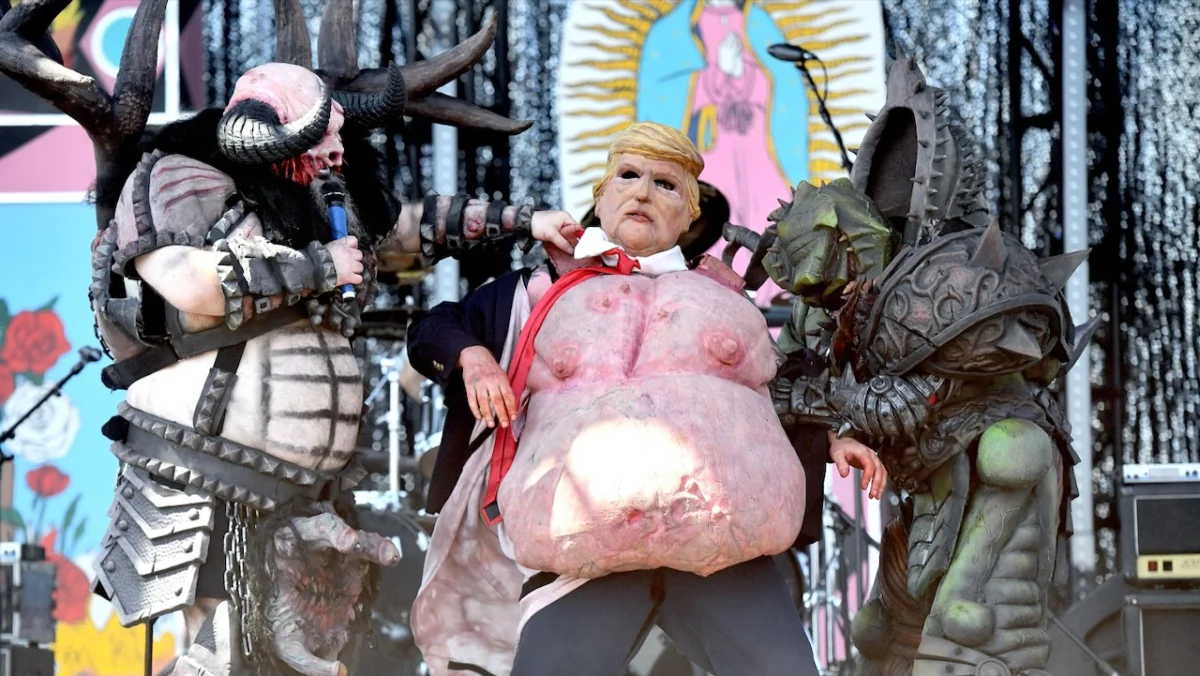
For four decades, the intergalactic warriors of GWAR have occupied a unique, albeit grotesque, niche in American pop culture. Known for their elaborate rubber monster suits, buckets of fake blood, and a stage show defined by the ritualistic, theatrical dismemberment of public figures, the band has long operated under the banner of "anything goes." From world leaders to pop icons, no one has been safe from the GWAR guillotine. However, in an era of heightened political polarization, the band’s signature brand of transgressive performance art has encountered a hurdle they never faced in the 1980s, 90s, or 2000s: the watchful eye of federal law enforcement.
In a recent candid interview with Rocking With Jam Man, Mike "Blothar the Berserker" Bishop revealed that for the first time in their storied history, the band was visited by the United States Secret Service. According to Bishop, the catalyst for this federal intervention was their routine, fictitious execution of Donald Trump.
A Legacy of Transgression: The GWAR Method
Since their inception in Richmond, Virginia, in 1984, GWAR has functioned as an absurdist mirror held up to the face of humanity. Their shows are not merely concerts; they are narrative-driven spectacles where the band—playing the roles of "Scumdogs of the Universe"—slaughter effigies of political and cultural figures.
Historically, this shtick was viewed as protected, albeit extreme, performance art. The band has "killed" presidents from both sides of the aisle, including Ronald Reagan, Bill Clinton, and Barack Obama. For decades, these acts were greeted with the occasional tabloid scandal or pearl-clutching from conservative watchdog groups, but the fundamental mechanics of the performance remained undisturbed.
"We [fictitiously] killed President Obama," Bishop noted during his interview. "We didn’t hear from the Secret Service. But you [fictitiously] kill Trump, and you better believe that there’s gonna be some shit going on. And that happened to us. It happened to us not too long ago."
Chronology of a Cultural Shift
The transition from "underground shock rock" to "federal inquiry" marks a distinct shift in the American cultural landscape. To understand why GWAR is suddenly in the crosshairs, one must examine the timeline of their public reception.
- 1984–2010: The Era of Provocation. GWAR operated as an established, if controversial, pillar of heavy metal. Their killings of public figures were largely treated as a form of "edgy" political cartooning. Even when controversy struck—such as their infamous depictions of Princess Diana or Laci Peterson—it was framed as a failure of taste rather than a threat to national security.
- 2016–2020: The Trump Presidency. With the rise of the MAGA movement, the band noticed a palpable change in how their audience and the public reacted to their political theater. Bishop argues that the vitriol shifted from general outrage to organized, politically charged harassment.
- 2025–2026: The Federal Intervention. The culmination of this tension resulted in the Secret Service visit. This marks a milestone where the "performance" was officially logged as a potential threat to the sitting President, a development that had no precedent in the band’s previous 40-year run.
The Mirage of "Anti-Wokeness"
A frequent talking point in contemporary political discourse is the idea that the current era—often championed as a rejection of "wokeness" and "cancel culture"—would usher in a golden age of unfettered, irreverent comedy. Bishop, however, finds this notion to be a farce.
"For years, GWAR would do whatever the fuck we wanted," Bishop explained. "We would kill politicians from both sides of the aisle… I mean, granted, when we killed Princess Diana, people got a little upset. But until Donald Trump got in office, that’s when people started getting extremely upset about politics in art."
Bishop posits that the band has not changed; the audience has. He suggests that the "politically correct" wing of the cultural spectrum, often accused of being the primary engine of censorship, was never the entity that brought the most heat to GWAR. Instead, the pressure has largely originated from the fervent supporter base of the former President.
"It’s not like feminists or the politically correct squad, they didn’t really come after GWAR," Bishop stated. "Who came after GWAR was fucking Trump fans."
Financial Pressure and Corporate Censorship
Beyond the physical presence of the Secret Service, Bishop highlights a more insidious form of pressure: financial and logistical gatekeeping. Large-scale touring in the modern era is heavily reliant on corporate entities like Live Nation. Bishop argues that these corporations are uniquely vulnerable to government pressure and public outcry, creating a ripple effect that limits artistic expression.
"What they have to do is make it hard for you to make money," Bishop said. "And that’s what they try to do. Especially a company like Live Nation… they are susceptible to pressure from the government. And when you upset them, they can lean on you, and that is fucking censorship, no matter what you call it."
This economic reality forces bands to navigate a landscape where their "transgressive" art must be weighed against the potential for venue cancellations, insurance hikes, and the loss of lucrative touring contracts. For a band like GWAR, whose entire business model is built upon being unpalatable, this creates an existential crisis.
Implications for Free Expression
The situation surrounding GWAR raises significant questions regarding the First Amendment and the nature of political satire in the 21st century. While the Secret Service is tasked with protecting the President, the line between investigating credible threats and chilling protected speech is notoriously thin.
Legal scholars often distinguish between "true threats"—statements where the speaker means to communicate a serious expression of an intent to commit an act of unlawful violence—and hyperbole. GWAR’s act, which involves alien monsters wielding prosthetic weaponry in a club setting, falls squarely into the realm of hyperbole. However, the mere act of a federal investigation can serve as a "soft" form of censorship, pressuring artists to self-censor to avoid the scrutiny of the state.
Furthermore, the band’s recent performance at the Washington, D.C. stop of the Warped Tour serves as a defiant rebuttal to these pressures. By once again disemboweling a Trump effigy, GWAR is signaling that they do not intend to retreat. The viral response to this performance—a mixture of fans defending the band’s history and outraged observers demanding accountability—underscores the deep divide in how the public perceives the role of the artist in political life.
Conclusion: The Scumdogs Persist
Despite the visits from the Secret Service, the corporate pressure, and the shifting tides of political sensitivity, GWAR remains committed to their core identity. Bishop’s reflections offer a sobering look at the state of free speech in America. He suggests that the "culture war" has not liberated artists, but rather has constrained them within a framework where political allegiance dictates what is considered "threatening" and what is considered "acceptable."
As GWAR continues to tour, their stage remains a space where the boundaries of the permissible are tested. Whether the federal government will continue to treat the "Scumdogs of the Universe" as a genuine security concern or eventually recognize the absurdity of the situation remains to be seen. For now, the band is sticking to their guns—and their fake blood—asserting that in a world that has lost its sense of humor, the most radical thing one can do is continue to tell the same, gory joke.
 Pevita Pearce
 Asro
Asro
 Lina Irawan
