

As of July 2026, the podcasting medium has officially solidified its status as a multi-billion-dollar juggernaut. According to the latest data released by Owl & Co, the global podcast economy is now valued at $9.2 billion. This figure, while staggering, represents a long-overdue accounting of the industry’s true financial footprint, which has historically been underestimated due to fragmented reporting and the exclusion of burgeoning revenue streams such as video and direct-to-consumer monetization.
Main Facts: Measuring the Uncountable
For years, the podcasting industry suffered from a "visibility gap." Analysts often focused solely on traditional advertising spend, neglecting the sophisticated ecosystems built around video-first podcasting, premium subscription tiers, and diversified creator-led revenue models.
The second edition of Owl & Co’s Global Podcast Economy Report aims to rectify this. By auditing five distinct revenue streams, the report provides a granular view of how money flows through the medium. It has become a vital resource for venture capitalists, media conglomerates, and independent creators alike, gaining recognition from major financial outlets like Bloomberg and Forbes.
The key takeaway is that the "long tail" of the industry is no longer just a collection of hobbyists; it is a structured, complex marketplace that demands professional-grade analysis. The report highlights that premium subscriber revenue and cross-platform video integration are the primary drivers of this $9.2 billion valuation, marking a departure from the ad-reliant models of the early 2020s.
Chronology: The Evolution of a Digital Medium
The journey to this $9.2 billion valuation has been anything but linear.
- 2020-2022 (The "Gold Rush" Era): The pandemic catalyzed a massive surge in both listenership and production. During this time, the industry saw heavy investment from major tech platforms, resulting in high-profile exclusive deals and aggressive M&A activity.
- 2023-2024 (The Correction): Following the initial boom, the industry faced a period of "right-sizing." Many companies struggled to prove the ROI of their massive investments. This led to a shift in focus from "growth at all costs" to "sustainable monetization."
- 2025 (The Pivot to Video): Podcasters began treating YouTube and other video platforms as primary distribution channels rather than secondary, leading to a significant increase in ad-load and sponsorship potential.
- 2026 (The Data Maturity Phase): The release of the current Owl & Co report signifies that the industry has finally matured enough to be accurately tracked. The industry is no longer guessing its value; it is calculating it with enterprise-grade precision.
Supporting Data: Understanding the Landscape
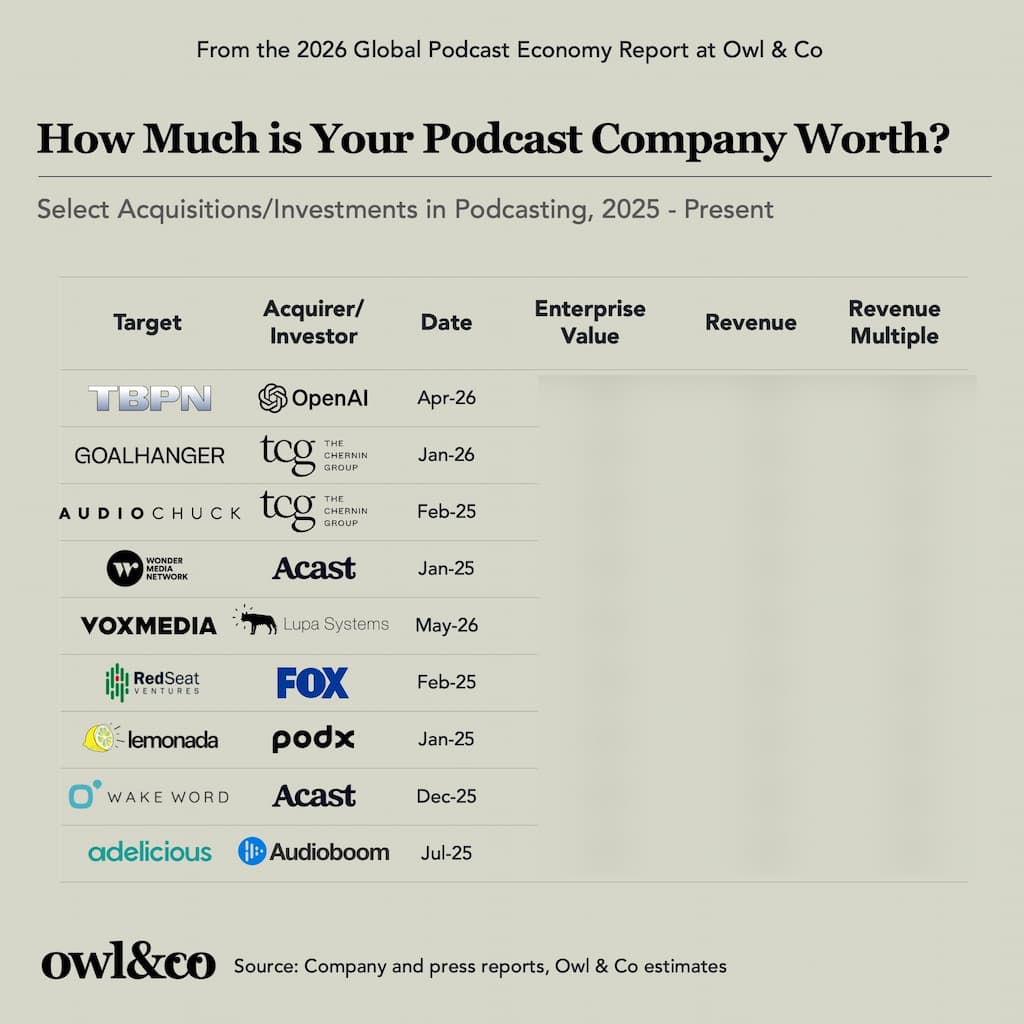
The Owl & Co report doesn’t just provide a headline figure; it breaks down the mechanics of the economy. It explores the 16-month trajectory of M&A activity, tracking not just the volume of deals, but the underlying revenue multiples that define them.

Why do some companies command higher enterprise valuations than others? The report suggests that the answer lies in "diversified IP." Podcasting companies that own their distribution, production, and ancillary revenue streams (such as merchandising or live events) are consistently trading at higher multiples than those reliant on third-party hosting or platform exclusivity.
Furthermore, current industry data confirms that consumer habits are shifting. The "Podcast News" cycle this week underscores this:

- Windows Weekly (Airwave/TWiT.tv): Discusses the broader implications of 4,800 layoffs at Microsoft, signaling potential instability in the gaming and hardware sectors—an example of how deep-dive audio journalism is capturing complex corporate narratives.
- The Sound Off Podcast: Featuring industry leaders like Justin Jackson (co-founder of Transistor), the show highlights the ongoing debate between open RSS distribution and walled-garden platforms.
- Podnews Weekly Review: Reports on the recent growth of independent players like Overcast, suggesting that despite the dominance of Spotify and Apple, there is still significant appetite for specialized, high-utility listening tools.
Official Responses and Industry Sentiment
Industry insiders view the $9.2 billion figure as a validation of the medium’s resilience. However, there is a clear divide in how different sectors are reacting to this data.
"The numbers confirm what we have known for some time," notes a lead analyst at Owl & Co. "The podcasting ecosystem is no longer a fringe media activity. It is a fundamental pillar of the digital media landscape, rivaling traditional radio and niche streaming television in terms of listener engagement and ad-spend efficiency."

Conversely, independent creators have expressed caution. While the total revenue in the industry is growing, there is a persistent concern that the majority of these gains are concentrated at the top. The "long tail," while more structured, still faces the constant pressure of platform algorithm changes and the rising cost of high-quality production.
Implications for the Future
The implications of a $9.2 billion market are profound.

1. The Professionalization of Content
As investment flows into the space, the "amateur-to-pro" transition continues. Shows that lack clear production standards or monetization strategies are being pushed out by high-fidelity, highly researched content. This is evidenced by the success of shows like Ernstfall, which utilizes wargaming simulations to explain complex geopolitical crises, and Mindy’s Comedy Archives, which treats oral history with a documentary-level of visual and audio care.
2. The Rise of "Niche-Scale"
We are seeing a move away from "one-size-fits-all" podcasts toward hyper-specialized content. Shows like Cry It Out Loud, which provides support for families navigating infant loss, prove that small, highly engaged audiences are often more valuable than massive, passive ones. This is the cornerstone of the current subscriber-driven model.

3. The Video-Audio Convergence
The distinction between "a podcast" and "a video series" is effectively dead. With platforms like YouTube integrating RSS feeds and podcast players incorporating video, the medium is moving toward a hybrid model. The $9.2 billion valuation is heavily reliant on this synthesis; advertising spend is now being allocated to "total media packages" that include audio-only, video-podcasts, and social media snippets.
4. Regulatory and Ethical Considerations
As the industry scales, so does the scrutiny. With high-stakes topics (like the potential of a NATO-Russia conflict being simulated in Ernstfall) appearing in the audio space, we can expect greater focus on misinformation, journalistic standards, and content moderation. The industry is reaching a point where it can no longer hide behind its "fringe" status when it comes to social responsibility.

Conclusion: What’s Next?
The $9.2 billion figure is not just a milestone; it is a starting point. As we move into the second half of 2026, the industry is poised for further consolidation. We can expect to see:
- Increased M&A activity as legacy media companies continue to acquire established podcast networks to fill their content pipelines.
- Advancements in AI-driven editing and discovery tools, which will lower the barrier to entry for high-quality production even further.
- Greater transparency in listener metrics, as the industry moves toward standardized, third-party audited data rather than proprietary platform numbers.
For stakeholders—whether you are a creator, an advertiser, or an investor—the message is clear: the era of speculative growth is over. The era of the "Global Podcast Economy" has arrived, and it is here to stay. Whether or not this $9.2 billion valuation can be sustained or expanded will depend entirely on how the industry manages its transition from a disruptive newcomer to a permanent, regulated, and highly profitable pillar of the modern media landscape.

As Podnews continues to track these developments, the focus will shift from "how big is the industry" to "how sustainable is the growth." The tools for success are available, but in a market worth nearly $10 billion, the cost of entry—and the cost of failure—has never been higher.
 Iffa Jayyana
 Sagoh
Sagoh
 Asep Darmawan
