

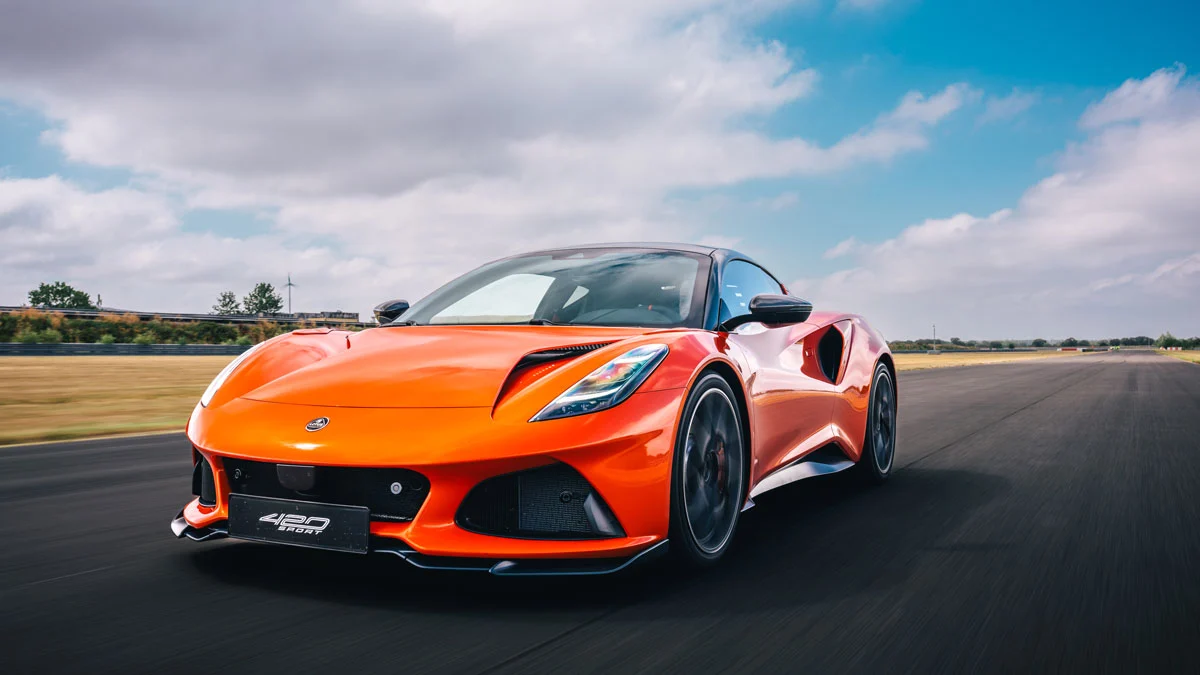
When Gavan Kershaw, the legendary chassis guru behind the world’s most precise-handling machines, describes the new Lotus Emira 420 Sport as "calm," the word feels like a misdirection. We are, after all, discussing the most potent iteration of the Emira lineage—a car that has been sharpened, lowered, lightened, and fed a steady diet of high-octane performance upgrades. By all conventional metrics of the modern hyper-segment, this vehicle should be a snarling, visceral assault on the senses. In an era where "sports car" often implies artificial weight and synthetic electronic intervention, one might expect a car with 414 horsepower to be a frantic, nervous energy machine.
Yet, after spending a day pushing the 420 Sport to its limits on the storied tarmac of Hethel and the unforgiving, undulating backroads of Norfolk, the descriptor "calm" begins to make perfect, intoxicating sense. It is not a lack of intensity; it is the absolute, unflappable composure of a machine that knows exactly what it is. In a market where stalwarts like the Porsche 718 Cayman and the Toyota GR Supra have ceased production, the Emira 420 Sport doesn’t just fill a void—it asserts a philosophy.

The Evolution of the Lotus Sport Pedigree
To understand the 420 Sport, one must look at the lineage from which it descends. The "Sport" moniker at Lotus is not a marketing vanity plate; it is a pedigree forged in the crucible of professional competition. The lineage traces back to the early 1990s, when the iconic Esprit was transformed into a track-devouring weapon for SCCA and IMSA racing. That era birthed the legendary Esprit Sport 300, a car that redefined the limits of what a road-legal Lotus could achieve.
The DNA of that era—lightweight construction, uncompromising aerodynamics, and a singular focus on driver feedback—has trickled down through the Elise and Exige, and now, it manifests in the Emira 420 Sport. It is worth remembering that Lotus Sport’s expertise extends beyond the asphalt; in 1992, the engineering team applied their mastery of carbon fiber to create the radical bicycle that carried Chris Boardman to Olympic gold. This intersection of high-end materials science and competitive ambition remains the bedrock of the brand today.

Technical Specifications and Performance Hardware
The Emira 420 Sport serves as the new flagship of the mid-engine range, successfully leapfrogging the existing Turbo SE and V6 SE variants. At its heart lies the formidable 2.0-liter turbocharged four-cylinder engine sourced from Mercedes-AMG. While some purists may scoff at the four-cylinder layout compared to the supercharged V6, the performance data tells a compelling story.
Producing 420 metric horsepower (414 hp), the engine is mated to an eight-speed dual-clutch transmission that has been calibrated with clinical precision. While the zero-to-62 mph sprint is clocked at a blistering 3.9 seconds—a tenth of a second faster than the Turbo SE—the true value of the 420 Sport is found in its track efficiency. Gavan Kershaw reports that the car can navigate the Hethel handling circuit in 1 minute 27 seconds, a staggering two seconds faster than its sibling.

The Lightweight Handling Pack: A Case Study in Engineering
The defining feature of this iteration is the optional Lightweight Handling Pack. Much like Porsche’s Weissach package, this suite of upgrades is intended for the true enthusiast. It includes:
- Multimatic Spool-Valve Dampers: Manually adjustable for compression and rebound, allowing owners to dial in the suspension for specific tracks.
- Mass Reduction: A carbon-fiber tailgate and a lithium-ion battery shave 55 pounds from the curb weight.
- Titanium Exhaust: A weight-saving system that emits a distinct, high-frequency mechanical symphony.
- Michelin Pilot Sport Cup 2 Tires: Bespoke rubber designed to maximize lateral grip and thermal stability during sustained track sessions.
Design: Where Form Follows Function
Russell Carr, the Lotus design director who cut his teeth on the original Esprit Sport 300, has once again managed to balance aesthetic drama with aerodynamic necessity. The 420 Sport is a study in "form and function working together."

The front fascia features expanded, mesh-filled air intakes and a deep, aggressive splitter designed to optimize cooling for the high-performance brakes. Of particular interest are the "Becker points"—the slash-cut vents atop the fenders. Named after long-time chief test driver Roger Becker, these functional peaks allow the driver to accurately gauge the car’s width, an invaluable tool when threading the needle on a narrow apex.
The silhouette is unmistakably mid-engined, enhanced by sculpted sills and larger side scoops that feed air directly into the AMG heart. At the rear, the louvered tailgate is a loving nod to the classic Turbo Esprit, while the more aggressive diffuser and optional bare carbon-fiber trim components ground the car visually. The introduction of the vivid "Tangelo Orange" paint scheme, reserved exclusively for the 420 Sport, ensures that the car commands attention, though for those who prefer the "sleeper" aesthetic, the Emira’s crisp lines remain just as effective in more muted tones.

Driving Dynamics: The Unflappable Poise
If there is one area where the Emira 420 Sport separates itself from the crowd, it is the steering. In an age of electric power steering, where manufacturers often struggle to replicate the tactile connection of a mechanical rack, Lotus has remained steadfast in its commitment to hydraulic assistance. The result is a steering feel that is nothing short of telepathic. It is neither heavy nor twitchy; it is simply clear. It communicates the texture of the road surface, the temperature of the tires, and the exact limit of adhesion with a fidelity that most modern supercars have long since abandoned.
On the road, the car is firm. You feel the ripples and the imperfections of the tarmac. Yet, the Multimatic dampers ensure that this feedback is never synonymous with discomfort. The suspension breathes with the road rather than fighting it. Kershaw’s mention of "turbulence" is key here—the feeling of being thrashed by a car is the antithesis of the Lotus experience. The 420 Sport feels as though it is gliding even when it is working at 90 percent of its capacity.

On the track, the composure is even more evident. In Sport mode, the stability control allows for a measured amount of slip, permitting the driver to rotate the car into a corner with the throttle. In Track mode, the system remains a safety net, but one that is remarkably permissive. It is a car that encourages the driver to be better, rather than a car that does the heavy lifting through over-eager electronic intervention.
Implications for the Sports Car Market
The Emira 420 Sport enters the market at a starting price of $122,900, with the fully kitted Lightweight Handling version reaching $135,990. This pricing structure places the Lotus in direct, and perhaps "perilous," competition with the base models of the Porsche 911.

For the general consumer, the argument for the 911 is obvious: it is a masterpiece of daily usability, comfort, and build quality. However, the Emira 420 Sport is not designed for the general consumer. It is designed for the driver who views the act of driving as a pursuit, not a commute. It is for the person who chooses the Cayman GT4 over the 911 Carrera because they crave the mid-engine balance and the singular focus of a purpose-built machine.
The market for such cars is indeed becoming "barren," as the author notes. As electrification takes hold and heavy, dual-motor all-wheel-drive systems become the standard for "performance," the Emira 420 Sport stands as a reminder of the virtues of simplicity, lightness, and hydraulic communication.

Final Verdict: Is It Worth It?
The Lotus Emira 420 Sport is not a car for everyone. It is not the most refined vehicle in its class, nor is it the most technologically advanced in terms of infotainment or automated driving aids. But it is, without question, the most "Lotus" car the company has produced in the modern era.
It effectively closes the gap between the promise of the Emira’s design and the reality of its performance. It is a car that asks for your attention and rewards you with a level of engagement that is becoming increasingly rare. Whether it is the visual impact of the carbon fiber aero, the mechanical feedback through the steering wheel, or the pure, unadulterated poise during a high-speed corner, the 420 Sport is a testament to the fact that when you prioritize the driver above all else, the result is something that transcends the sum of its parts.

Nobody will mistake a 911 for anything other than a 911, but the Emira 420 Sport is a conversation starter—an object of desire that commands respect from those who truly know what it takes to build a driver’s car. It is a bold, uncompromising, and deeply satisfying final act for the internal-combustion sports car as we know it. As the industry turns its gaze toward the future, the Emira 420 Sport ensures that the "Lotus way" will not be forgotten.
 Ali Ikhwan
 Laily UPN
 Raul Delapena Setiawan
