

Warning: This story contains major spoilers for Resident Evil. Proceed with caution.
Following the massive critical and commercial success of Weapons, visionary horror auteur Zach Cregger has returned to the multiplex with a project that is arguably his most ambitious and visceral undertaking yet. His latest feature, Resident Evil, is currently shattering box office records and drawing high praise for its uncompromising approach to one of gaming’s most storied franchises. Starring Austin Abrams as the ill-fated courier Bryan, the film strips away the excess of previous cinematic adaptations to deliver a pure, high-octane exercise in survival horror.
The Pitch: A Return to the Roots of Dread
For three decades, the Resident Evil franchise has defined the survival horror genre, evolving from a static-camera, puzzle-heavy experience into a sprawling multimedia juggernaut. Despite the series’ long cinematic history—spanning Paul W.S. Anderson’s long-running saga, the 2021 reboot Welcome to Raccoon City, and various television ventures—Cregger approached the project with a clean slate.
"I didn’t see any of the previous films," Cregger admitted during a recent press junket at San Diego Comic-Con. "I’m not interested in cinematic universes or legacy reboots. I’m interested in the feeling of being trapped."

Cregger’s pitch to Constantin Film was singular: he wanted to capture the "slow, creeping dread" of the original 1996 title and the resource-management anxiety of Resident Evil 4. He described a vision of a protagonist starting with nothing but a handgun, tasked with navigating a gauntlet where the world itself seems "hell-bent on destroying you."
"I told them, ‘What I see in the advertisements for the movies is not what I love about the games,’" Cregger explained. "I like the idea of one person moving from point A to point B, constantly feeling like they don’t have enough resources to survive. I wanted to make the movie I had yet to see. I wasn’t interested in adapting Leon S. Kennedy’s story better than the games—that’s a losing endeavor. I wanted to adapt the experience of playing."
The Chronology of a Nightmare
The film operates with a tight, claustrophobic narrative structure that echoes the real-time progression of a video game. The story begins with a seemingly mundane task: Bryan, a courier, is dispatched to deliver a medical package to Raccoon City General Hospital.
The inciting incident occurs just minutes into the film when Bryan accidentally strikes a pedestrian with his vehicle. This, according to Cregger, was the "first domino." From that moment, the film shifts gears into a relentless, high-intensity survival sequence.

The Gauntlet
- The Initial Encounter: Bryan is forced to confront the reality that the woman he struck is not a victim, but an infected "murder machine."
- Resource Acquisition: Much like a player navigating the early stages of a game, Bryan must scavenge. He secures a sidearm from a deceased officer and eventually upgrades to a shotgun at a remote farmhouse.
- The Environmental Puzzles: Cregger pays homage to the source material with iconic "Easter eggs," including the presence of safe-zone typewriters, first-aid sprays, and healing herbs.
- The Exposure: Upon reaching the city, Bryan learns the true stakes: he is carrying a serum capable of synthesizing an antidote. His new, desperate objective is to reach the top floor of the hospital.
The Practical Approach: A Dangerous Production
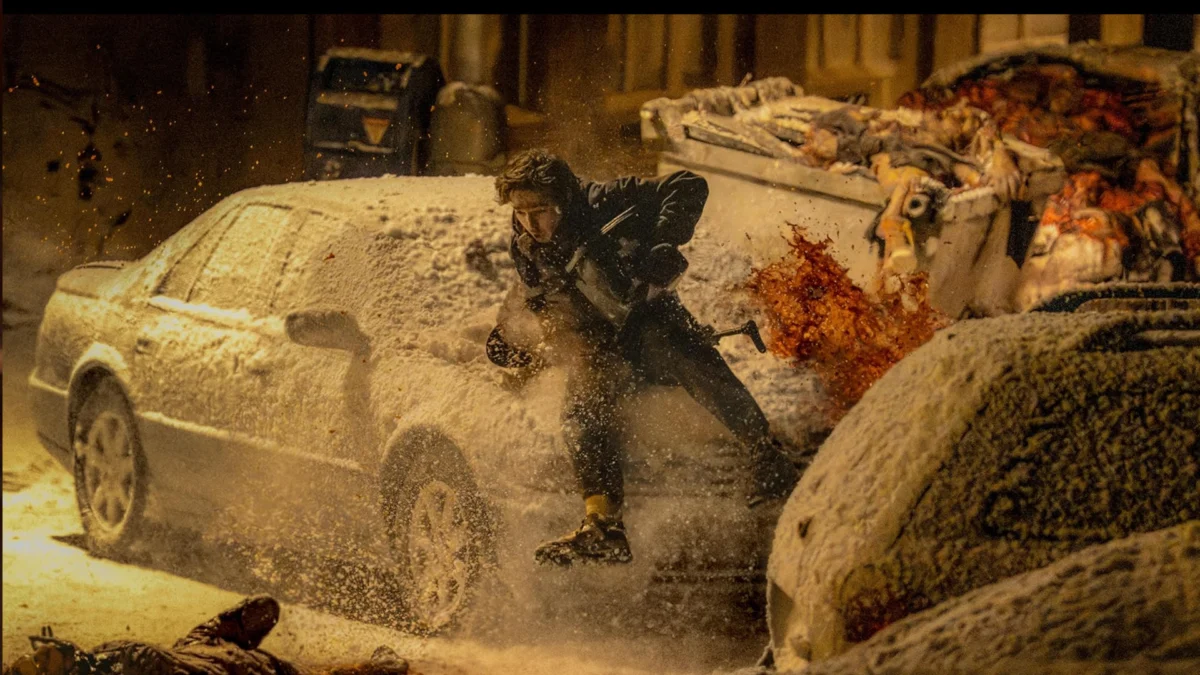
Perhaps the most discussed sequence in the film—and the one that pushed production to its physical limits—is the "Zombie Drop" sequence. Eschewing modern reliance on green screens, Cregger insisted on practical, high-risk stunts to maintain the visceral tangibility of the outbreak.
"I wanted to do as many practical detonations as possible," Cregger said. "We had a set of cranes, and we strung up 150-pound human sacks loaded with liquid blood. We dressed the street with snow to add texture, and we had a camera truck following Austin at high speed. If he had tripped, he would have been under the wheels."
The sequence, which features zombies plummeting from high-rise buildings and detonating upon impact, required days of intense rehearsal. In a move that highlights the unpredictability of practical effects, one of the "zombie" payloads dropped early, missing lead actor Austin Abrams by mere inches.
"If he’d been an inch to the right, he definitely would have died," Cregger noted. "But that footage is in the movie. You can’t replicate that kind of tension with digital effects. It was dangerous, it was exhausting, but it paid off."

Official Perspectives: The Director’s Vision
Cregger’s perspective on the film is that of a "rabid gamer." He views the project as a love letter to the series’ mechanics. By keeping the narrative "unrelenting," he successfully translated the feeling of the "Game Over" screen into a cinematic language.
The film’s ending serves as the ultimate subversion of traditional Hollywood tropes. After enduring a harrowing trek through the Raccoon City sewers and reaching the hospital lab, the audience expects a standard "save the day" finale. Instead, Cregger delivers a tragic twist: as the scientists prepare the antidote, Bryan begins his own transformation into a creature resembling the Nyx from the games.
The climax sees the protagonist—now a mutated Bio-Organic Weapon—devour the scientists. The syringe falls, shattering on the floor, as the National Guard arrives to eliminate the threat. It is a bleak, uncompromising conclusion that stays true to the high-stakes, "you never make it on the first life" ethos of the Resident Evil gaming experience.
Implications for the Horror Genre
The success of Resident Evil signals a shift in how major franchises are being handled by studios. By handing the keys to an auteur with a specific, singular vision rather than a committee of producers, Constantin Film has managed to create a product that satisfies both hardcore fans of the source material and general audiences looking for a high-quality horror film.

The film’s performance also highlights the growing appetite for "practical-first" filmmaking. In an era where audiences are increasingly fatigued by heavy CGI, Cregger’s emphasis on real-world physics and tangible danger has set a new benchmark for the genre.
Moreover, the film’s structure—treating the movie as an "unrelenting gauntlet"—may change how studios look at video game adaptations. Rather than trying to cram decades of lore into a two-hour runtime, future projects may opt to focus on the mechanics of the games, such as resource management, isolation, and environmental discovery, to capture the spirit of the source material.
Conclusion: A New Standard
Zach Cregger’s Resident Evil is more than just a box office success; it is a masterclass in tension and adaptation. By focusing on the player’s experience rather than the franchise’s convoluted history, Cregger has breathed new life into a series that many felt was heading toward irrelevance.
As the credits roll on the tragic, "Game Over" finale of the film, it is clear that Cregger’s mission statement—to make a story that feels like the experience of playing the games—has been fulfilled. Whether or not the studio plans to continue with a sequel remains to be seen, but for now, the industry has a new blueprint for how to respect the sanctity of the survival horror genre. Bryan may not have survived his mission, but in the annals of horror cinema, his journey will be remembered for a long time to come.
 Siti Muinah
 Iffa Jayyana
