

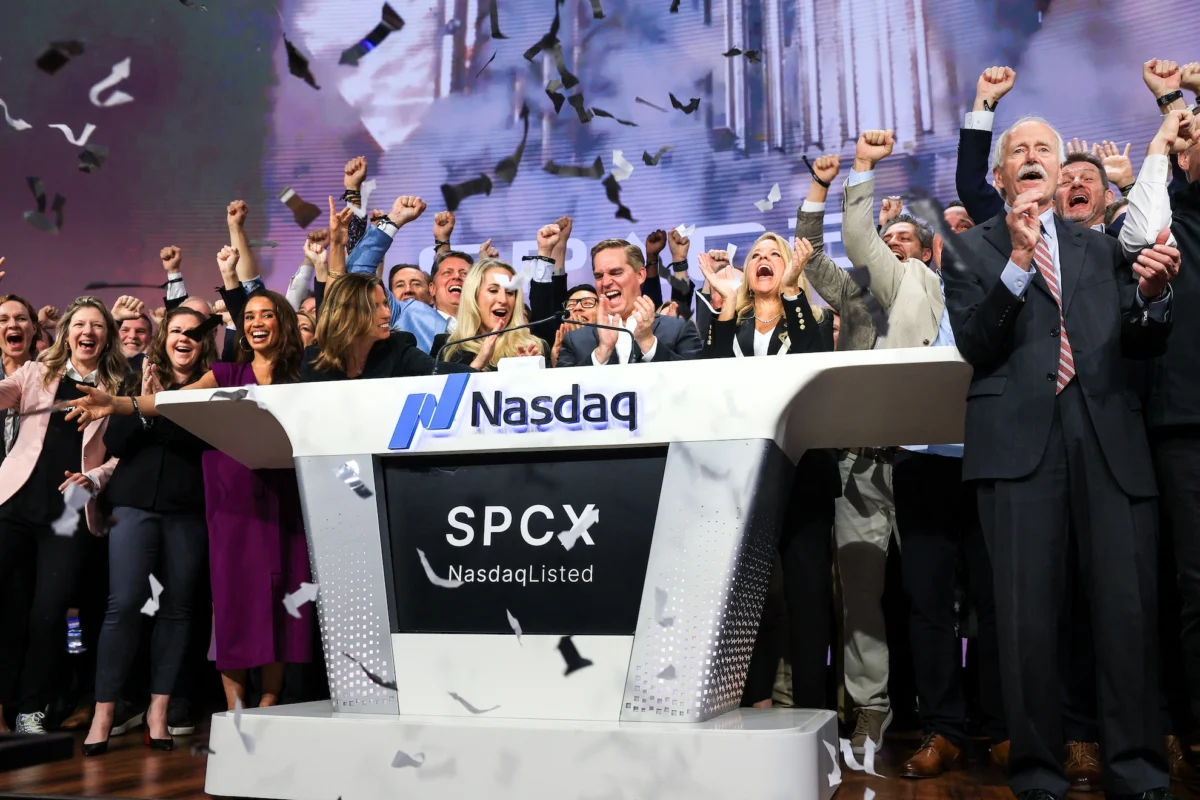
The global financial landscape underwent a seismic shift this week as SpaceX, the aerospace behemoth founded by Elon Musk, successfully completed what is now officially the largest initial public offering (IPO) in history. With shares priced at $135, the debut has not only reshaped the aerospace sector but has vaulted Musk into a category of his own, making him the world’s first-ever trillionaire.
However, the headline-grabbing nature of Musk’s personal wealth masks a much deeper, more complex transformation occurring within the public markets. As institutional and retail investors scramble to capture a piece of the AI-driven future, the "FAANG" era—defined by the dominance of Facebook, Amazon, Apple, Netflix, and Google—is being dismantled. In its place, a new acronym, "MANGOS" (Meta, Anthropic, NVIDIA, Google, OpenAI, and SpaceX), is emerging, signaling a fundamental pivot toward deeptech and artificial intelligence.
A Chronology of a Market-Defining Summer
The path to this moment was paved by months of speculation and behind-the-scenes maneuvering.
- May 2026: SpaceX files its formal IPO documents, surprising many by emphasizing its AI capabilities and infrastructure rather than just its space-faring ambitions. The filing sets off a chain reaction across Silicon Valley.
- Early June 2026: Anthropic and OpenAI, the two primary rivals in the generative AI space, file confidentially for their own IPOs. The race to be the next big public AI player intensifies.
- June 11, 2026: SpaceX officially prices its shares at $135, triggering massive market demand and confirming its status as the largest IPO in history.
- June 12, 2026: Following the market opening, Elon Musk’s net worth crosses the trillion-dollar threshold, a milestone previously considered impossible for an individual.
- Mid-June 2026: Secondary companies, such as Quantum Space, begin utilizing SPAC vehicles to "ride the wave" of investor sentiment created by SpaceX’s debut.
The "MANGOS" Paradigm: A Shift in Capital Allocation
The transition from FAANG to MANGOS represents more than just a change in ticker symbols; it marks a structural reorientation of where capital flows. For decades, the public markets were dominated by consumer-facing platforms and advertising giants. Today, the focus has shifted toward companies that provide the "picks and shovels" of the AI revolution.
On a recent episode of TechCrunch’s Equity podcast, the editorial team discussed how the influx of capital into AI labs and deeptech represents a departure from the "loss-leading" growth models of the past. Kirsten Korosec, a veteran observer of the tech industry, noted that the market is clearly prioritizing innovative, high-risk infrastructure over legacy social media or streaming models.
"We’ve got a bunch of AI labs in there, and that’s very different," Korosec explained. "Netflix gets booted out—a giant streaming service—and that is an interesting shift in terms of the vast amount of capital available in public markets, moving away from consumer social networks and toward, specifically, AI labs and other, more innovative deeptech."
The SpaceX Stress Test: Governance and Control
One of the most controversial aspects of the SpaceX IPO is the precedent it sets for corporate governance. By going public while maintaining a structure that allows for extreme, centralized control by a single individual, SpaceX is testing the limits of public market accountability.
Sean O’Kane, who has closely tracked the filing, points out that SpaceX appears to be blending the "move fast and break things" philosophy of early Google/Meta with the "scale at all costs" mentality of Amazon.
"We have SpaceX not only sucking up a huge chunk of the money that’s available on public markets, but also really stress testing the limits of what a public company can be and how much it can be controlled by one single person," O’Kane noted. Investors are currently watching to see if OpenAI and Anthropic will follow this "Musk-led" model of governance, or if they will attempt to present a more traditional, board-governed face to the public.
The Ripple Effect: Beyond the Billionaire Headlines
The market impact of the SpaceX IPO extends far beyond the share price. A profound "ripple effect" is currently being felt across industries as disparate as automotive and data storage.
Startups that previously struggled to attract venture capital are now positioning themselves as "orbital data center" providers or AI infrastructure facilitators, hoping to capitalize on the investor enthusiasm surrounding SpaceX’s business model. This has created a secondary gold rush, where even companies with no direct link to space are pivoting their business models to align with the "space-plus-AI" narrative.
This trend is not limited to startups. Legacy automotive giants, including Ford and General Motors, are aggressively pivoting their unused battery production capacities to serve as energy storage solutions for the massive, power-hungry data centers required by modern AI models. While these pivots have been met with temporary stock price surges, industry analysts warn that the "Tesla-fication" of legacy companies—the urge to model every business after Musk’s ventures—may be a risky gamble.
Competitive Pressures: The Race for the IPO Window
Perhaps the most palpable tension in the market is the race between OpenAI and Anthropic to reach the public markets. Analysts suggest that the window for massive, record-breaking AI IPOs may be finite. As valuation expectations soar, the fear that the "AI bubble" could deflate if earnings don’t keep pace is driving a sense of urgency.
"There’s very much a race between Anthropic and OpenAI," Korosec noted. "You’re even seeing OpenAI talk about slashing prices to capture market share. They are certainly going to be competing on the IPO calendar."
The concern among financial experts is that this rush to go public is a short-term strategy that may ignore the long-term viability of these companies. The pressure to deliver quarterly results to public shareholders, while simultaneously pouring billions into R&D and compute power, represents an unprecedented challenge for these AI labs.
Implications for the Future of Public Markets
As we look toward the remainder of the summer, the "hot IPO" trend shows no signs of cooling. However, the success of these companies will ultimately depend on their ability to transition from "AI hype" to "AI utility."
- Transparency vs. Control: The public will be watching closely to see if the SEC and other regulatory bodies allow companies to maintain such extreme founder control, or if institutional investors will eventually push back.
- Infrastructure Sustainability: The energy-intensive nature of the AI revolution is already forcing a convergence between tech, energy, and automotive sectors. The long-term success of MANGOS will depend on their ability to secure sustainable power.
- Market Saturation: With multiple AI-focused firms hitting the market simultaneously, the question remains whether the public markets can sustain such high valuations, or if a correction is inevitable.
In conclusion, the SpaceX IPO has served as the catalyst for a broader, deeper evolution in the global economy. Whether this transition to a MANGOS-dominated market is a durable shift or a temporary response to AI mania remains the defining question for investors, regulators, and tech observers alike. As O’Kane put it, this summer’s SEC filings are no longer just legal documents; they are the blueprint for the next century of corporate structure and economic activity.
For the CEOs of legacy industries watching from the sidelines, the advice is clear: attempting to mimic the specific strategies of Elon Musk is a fraught path. True success in this new landscape will likely belong to those who can differentiate themselves from the "SpaceX wave" rather than simply riding it.
 Asep Darmawan
 Siti Muinah
 Ali Ikhwan
