

In the waning months of the American Civil War, Frederick Douglass stood before the Massachusetts Anti-Slavery Society in Boston to address a nation teetering on the edge of a new, uncertain reality. As the conflict neared its conclusion, he offered a chilling prophecy regarding the future of the republic. “That enmity will not die out in a year,” he warned of the deep-seated racism and ideological division that fueled the rebellion. “It will not die out in an age.”
Over 160 years later, director Ava DuVernay posits that we are living squarely within the age Douglass predicted. Her latest documentary, 14th, arrives as a sweeping, maximalist examination of the constitutional amendment that redefined American citizenship, yet failed to secure the full promise of democracy. By tracing the arc of the Fourteenth Amendment—from its birth in the fires of Reconstruction to its current precarious state under the second Trump administration—DuVernay invites viewers to confront a sobering reality: history is not a static record of the past, but a living, breathing influence on the political paralysis of the present.
The Constitutional Crucible: A Historical Chronology
The Fourteenth Amendment stands as one of the most consequential documents in American jurisprudence. Ratified in 1868, it was designed to codify the rights of formerly enslaved people, establishing birthright citizenship and providing the "equal protection" clause that would eventually become the bedrock of modern civil rights litigation.
However, 14th makes a compelling case that the amendment’s brilliance was marred by a critical omission: the failure to explicitly protect the right to vote. Constitutional law expert and former head of the NAACP Legal Defense Fund, Sherrilyn Ifill, serves as the film’s moral and intellectual anchor. Throughout the documentary, Ifill returns to Douglass’s speech, "What the Black Man Wants," to remind audiences that by leaving voting rights vulnerable, the architects of Reconstruction inadvertently provided the legal loophole for future generations of white supremacists to dismantle the political power of Black Americans through Jim Crow laws and, more recently, modern voter-suppression tactics.
The film effectively argues that the values we associate with a multiracial democracy did not originate from the 1787 Constitution, but from the radical, transformative revolution that followed the Civil War. By highlighting the contributions of Chinese railroad workers and other marginalized groups who fought for their status under the Fourteenth Amendment, DuVernay expands the scope of the narrative, illustrating that citizenship was a hard-won victory that has been under sustained attack ever since.
Visualizing the Erosion of Rights
As a structural companion to DuVernay’s acclaimed 2016 documentary 13th, which focused on mass incarceration and the loophole of the Thirteenth Amendment, 14th adopts a similar, though more expansive, visual language. While 13th used the cold, industrial textures of prisons to ground its thesis, 14th seeks to reclaim the halls of intellectual power. Experts, historians, and activists—including Bryan Stevenson, Jelani Cobb, and Alexandria Ocasio-Cortez—are filmed in libraries, museums, and universities.

This setting is a deliberate stylistic choice; it insists on the value of expertise at a moment when objective truth and historical literacy are being actively undermined. The film utilizes a recurring motif: an animated five-pointed star representing the five sections of the amendment. As the documentary progresses, each point is gradually torn away, serving as a visceral metaphor for the legal and political erosion of the amendment’s protections over the last century and a half.
A Maximalist Approach to Modern Discourse
14th is an ambitious, sprawling odyssey. With over 50 interview subjects ranging from seasoned historians like Eric Foner and David Blight to contemporary political influencers and comedians, the film attempts to bridge the gap between academic rigor and modern, viral-ready discourse.
The inclusion of diverse voices—including conservative politicians like Jeff Flake alongside progressive figures like Stacey Abrams—reflects DuVernay’s desire to reach a hyper-polarized audience. Yet, this ambition occasionally works against the film’s pacing. The sheer density of the interview subjects creates a sense of "cognitive clutter," where the impact of profound, nuanced arguments is occasionally diluted by the inclusion of soundbites from social media influencers that feel transient in comparison to the gravity of the subject matter.
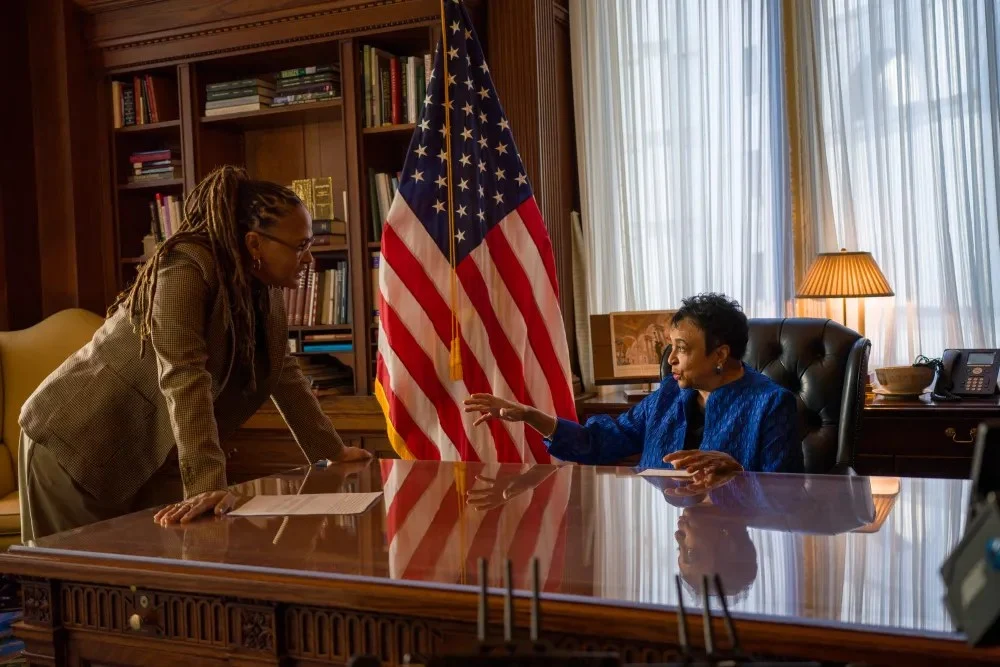
The documentary is at its most powerful when it moves away from the "talking head" format. A standout sequence featuring Devon Henry, the Black contractor who oversaw the removal of Confederate monuments in Richmond, Virginia, provides a rare moment of kinetic relief. Watching Henry move through the city, laboring to dismantle symbols of hate, offers a visual and emotional release that didactic explanations cannot match. Similarly, when Librarian of Congress Carla Hayden walks through the halls of her institution, the camera captures a sense of purpose and humanity that underscores the importance of institutional memory.
Implications: The Weight of the Present
The central question posed by 14th is not merely academic; it is existential. With the gutting of the Voting Rights Act and ongoing challenges to birthright citizenship, the documentary argues that we are standing at an inflection point comparable to 1865.
The film succeeds in its mission to make the past feel urgent. Through clever animation that brings archival photographs to life, DuVernay bridges the distance between the ordinary citizens of the Reconstruction era and those navigating today’s political landscape. We see that the struggle for equality is a continuum, and the "rank undergrowth of treason" that Douglass warned would pass from "sire to son" remains a potent force in American society.

However, the film’s relentless density risks inducing the very paralysis it seeks to cure. By the time the viewer reaches the two-hour mark, the sheer weight of historical trauma and political crises can become overwhelming. DuVernay, who has stated she did not want the film to "feel like medicine," achieves an energetic and accessible tone, yet the exhaustive nature of the project suggests that the subject matter might have been better served by an episodic structure, allowing each section of the amendment—and its corresponding modern crisis—the room to breathe.
Conclusion: An Invitation to Debate
Ultimately, 14th is a vital, if slightly overstuffed, contribution to the American political discourse. It serves as a necessary, high-stakes reminder that the American experiment is not a finished product but an ongoing, often messy negotiation.
Sherrilyn Ifill’s final plea is perhaps the film’s most enduring message: Americans have an obligation to debate in good faith what the next iteration of democracy should look like. The Fourteenth Amendment was revolutionary because it dared to imagine an America that had never existed before. By the end of the film, it is clear that the burden of realizing that vision rests not on the documents of the past, but on the actions of the present.
As Douglass predicted, the enmity has lasted an age. Whether that age concludes or continues depends entirely on how we choose to engage with the legacy of the revolution that defined our national identity.
Grade: B
14th premiered at the 2026 New York Film Festival. Netflix will release it in select theaters on Friday, November 27, followed by a global streaming debut on Friday, December 4.
 Iffa Jayyana
 Laily UPN
 Azzam Bilal Chamdy
