

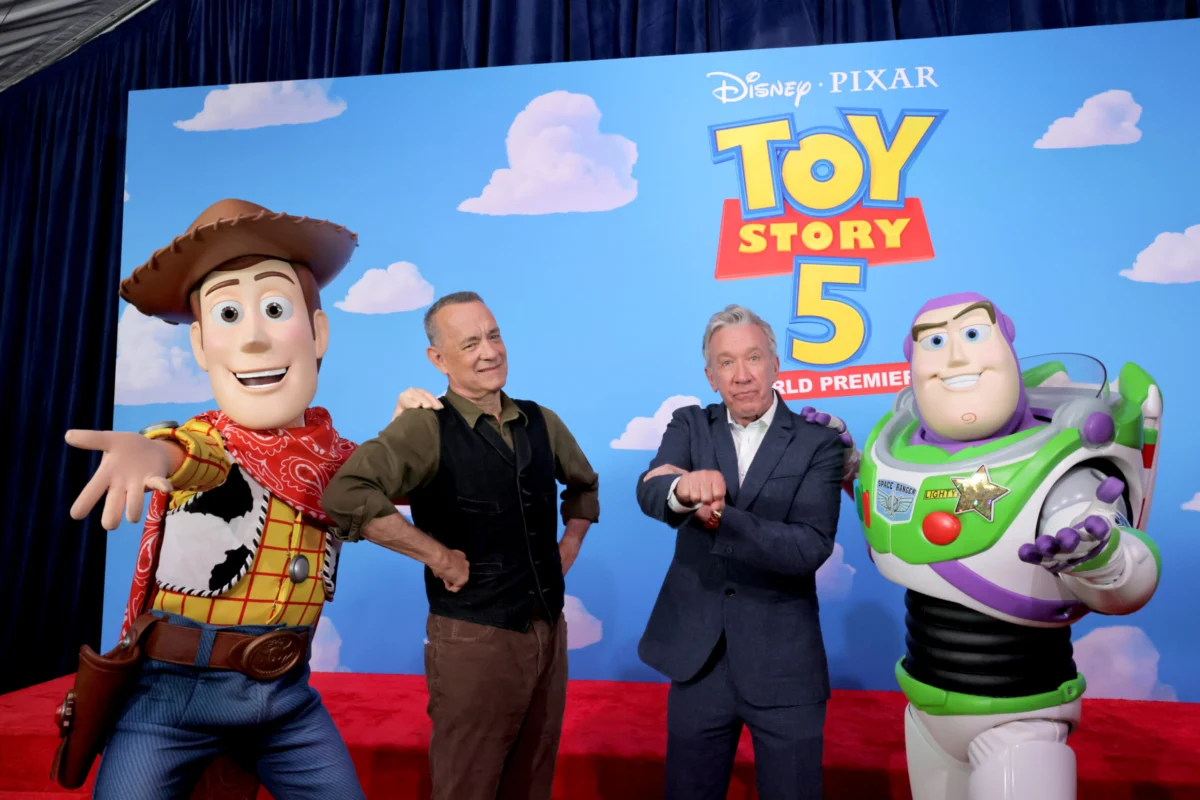
Thirty years after a plastic cowboy and a space ranger first captured the world’s imagination, the Toy Story franchise remains the crown jewel of Pixar Animation Studios. As production on the highly anticipated Toy Story 5 nears completion, franchise stalwarts Tom Hanks and Tim Allen have emerged from the recording booth to discuss the monumental challenge of returning to roles that defined their careers. The journey back to Andy’s world, however, was not without its hurdles—including a vocal crisis that nearly brought the production to a standstill.
The Pitch: A Story Worth Telling
When director Andrew Stanton—often referred to as the "grand old man of Pixar"—approached Tim Allen about reprising the role of Buzz Lightyear, the comedian was initially hesitant. For Allen, the decision to return was never about the paycheck; it was about the narrative integrity of a series that had already achieved a near-perfect conclusion in its previous installments.
"He wouldn’t do it for purely monetary reasons," Allen explained in a recent interview with Gold Derby. "He had a story in his mind. He said, ‘Just think of it as compressed time. Jessie’s in trouble. That’s what brought you two together.’"
This narrative hook—reuniting Woody and Buzz to save their friend—was the catalyst needed to bring the duo back. However, the scope of the film, which features a massive influx of new Buzz Lightyear models, presented a logistical challenge that even the veteran voice actors hadn’t anticipated.
A Vocal Crisis in the Booth
The return to the booth was a reality check for the actors. Early in the recording process, the atmosphere behind the soundproof glass turned uncharacteristically somber.
"He says, ‘Let’s just get a read,’" Allen recalled. "And it was real quiet behind the glass. And he goes, ‘Boy, Buzz sounds a little older now.’ Real long pause."

The implication was clear: the voice that had commanded the screen for three decades was showing the wear and tear of time. Allen, typically known for his quick wit, admitted to feeling genuinely vulnerable. "I got very uncomfortable. I said, ‘I’m not going to be able to do this. They don’t like my voice.’"
Pixar’s solution was both tactical and supportive. The studio connected Allen with a premier Broadway and opera-trained vocal coach based in New York City. The training, which focused on the mechanics of vocal longevity, proved transformative. "She said, at any age, you can’t go to a gym without stretching," Allen noted. "She told me how to move the voice up and down. She goes, ‘You don’t know this because you’re a comedian, not a singer.’"
While Allen underwent intensive training to recapture his character’s iconic timbre, Tom Hanks took a more characteristic, low-key approach to his return. When asked about his process for slipping back into the role of Woody, Hanks joked, "I just stubbed out my filterless Chesterfield in the ashtray and said, ‘Come on guys, we’ve got to get back to Andy’s room.’"
The Evolution of the Toy Universe
Toy Story 5 is set to explore the intersection of traditional play and modern technology. The film introduces a sophisticated, drone-like version of Buzz Lightyear, sparking a meta-conversation about whether toys are becoming an endangered species in the digital age.
"Tech is taking over in this film," the actors noted, discussing the contrast between passive digital consumption and active imaginative play.
"No one’s feelings have ever been hurt by playing with a toy, but everybody’s feelings can be hurt by being on screen and being engaged in the wider web," Hanks observed. "It’s the difference between engagement and fulfillment. That [digital] thing will engage you and take up your time and fill your day—you can disappear for three and a half, seven hours if you want. But playing with a toy will fulfill your imagination."

The introduction of an army of Buzz Lightyear drones creates a new, high-stakes dynamic. Allen admits the concept is brilliant, though he jokingly pointed out the logical flaws for the original character. "The Buzz that we know can’t be upgraded like that. But that drone thing—I went, ‘brilliant.’ Now I want one of those. Now every kid’s going to want that."
Critical Recognition and the "Voice Actor" Debate
The conversation inevitably turned to the lack of an Oscar category for voice acting—a point of contention in the animation industry. While Tim Allen holds an Annie Award for his performance, the Academy has yet to recognize pure voice acting with its own category.
Hanks, who holds two Academy Awards for Best Actor, offered a nuanced take on the issue. "I think they have enough categories already," he said. "But the truth is—a voice actor can win Best Actor. The judgment should be: any performance that moved you."
Hanks pointed to actors like Andy Serkis, whose work in motion capture often bridges the gap between traditional and digital performance. "If they [voters] are moved, that means they are moved by a human being’s performance. That’s all the requirement."
Surprise Cameos and Global Marketing
In a shift from the secret-heavy development of previous films, the production team has leaned into high-profile cross-promotional strategies. The cast revealed they were kept in the dark regarding some of the project’s most high-profile contributors, including a track by Taylor Swift and the inclusion of recording artist Bad Bunny.
"We had no idea," Hanks admitted. "They don’t include us. We didn’t even find out that Bad Bunny is in this thing until they mentioned it during one of the recordings. ‘By the way, the pizza with the sunglasses—that’s Bad Bunny.’ It is? Holy cow. Don’t keep that a secret."

The inclusion of global icons underscores the studio’s intent to position Toy Story 5 not just as a sequel, but as a major cultural event.
Implications: A Lasting Legacy
As the franchise moves forward, the core of the story remains rooted in the relationship between the toys and their children. Despite the addition of new characters and complex technological themes, the actors believe the emotional weight of the series is what keeps audiences coming back.
Reflecting on the most powerful moments in the series, such as the toys reaching for each other in the incinerator scene, the actors emphasized that the most profound moments in Toy Story are often those without dialogue.
"The most powerful moments in the Toy Story universe are without dialogue," Hanks said. "They come from moments like when we were all about to be incinerated… They grabbed each other. They reached out."
For Allen, the brilliance of the franchise lies in its ability to strip away the artifice of the toys and show the human-like vulnerability beneath. "My favorite was when Buzz found out in Sid’s attic that he wasn’t a real space ranger, and he just dropped," Allen recalled. "I thought, ‘That’s brilliant,’ and I was kind of pissed [that it wasn’t a dialogue-driven moment]."
As the release date approaches, the consensus from the two leads is clear: Toy Story 5 is an attempt to honor the legacy of the previous films while pushing the boundaries of what animation can express. For Hanks and Allen, the journey is far from over—it is simply evolving. Whether it’s through the addition of drone-enhanced characters or the integration of a modern soundtrack, the goal remains the same: to remind audiences that, at its heart, the magic of the Toy Story universe is found in the simple, fulfilling act of play.
 Ammar Sabilarrohman
 Siti Muinah
 Iffa Jayyana
