

By Global Music Desk
Published: October 2026
Main Facts
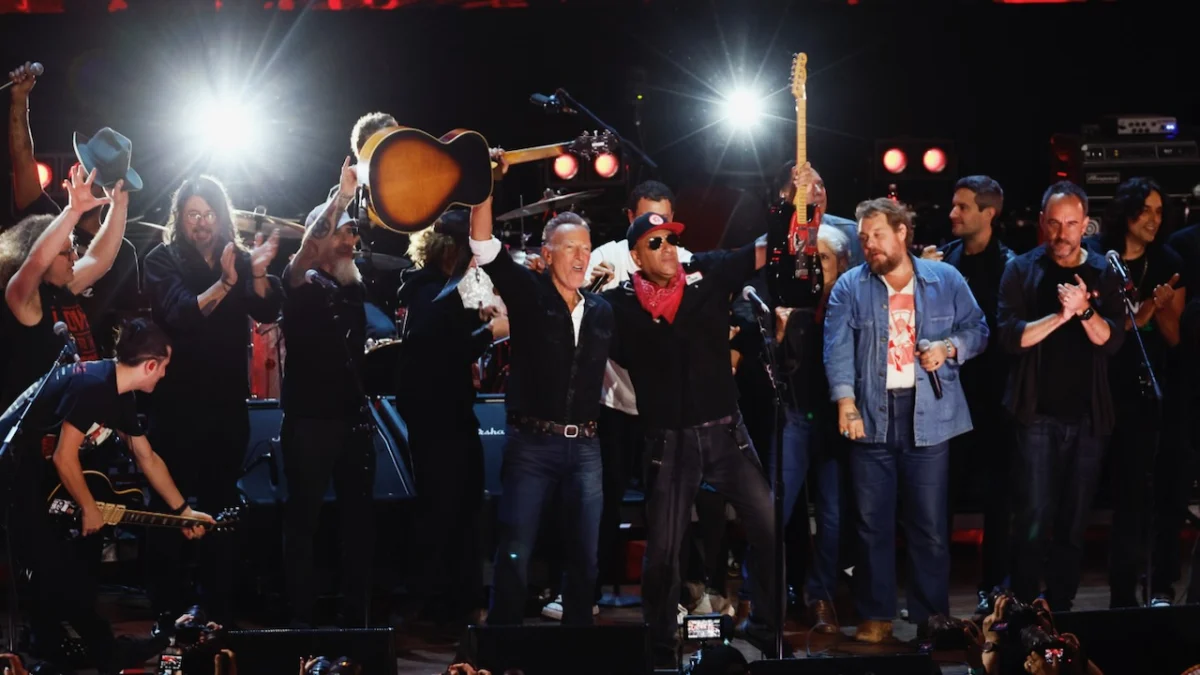
In a landmark convergence of rock royalty, social activism, and generational talent, the inaugural Power to the People Festival concluded on Saturday night with an unforgettable, star-studded finale. Spearheaded by rock icon Bruce Springsteen and guitar innovator Tom Morello, the closing set transcended a standard concert experience, transforming into a historic rallying cry for solidarity, resistance, and unity through music.
The festival—designed from its inception to celebrate the intersection of protest, human rights, and the unifying power of live performance—drew tens of thousands of passionate fans. Yet, it was the closing hours on Saturday that cemented the event into the cultural lexicon. The night featured a sprawling, rotating cast of music industry legends, including folk pioneer Joan Baez, modern troubadours Dave Matthews and Nathaniel Rateliff, and rock powerhouse Dave Grohl.
Together, this collective of artists bridged decades of musical history, moving seamlessly from intimate acoustic protest anthems to roaring, stadium-shaking rock-and-roll manifestos. The setlist was a masterclass in curation, honoring the architects of political songcraft while injecting modern urgency into timeless classics. By the time the final notes of John Lennon’s "Power to the People" reverberated through the night air, the festival had firmly established itself not merely as a successful new addition to the global live music calendar, but as a defining cultural moment of the decade.
Chronology of an Historic Evening
The unfolding of Saturday night’s grand finale was meticulously paced, building organically from a solitary, haunting reflection into an explosive, communal celebration involving every major artist on the bill.
Act I: The Solo Reflection and Folk Heritage
The evening’s climax began quietly. Eschewing a bombastic entrance, Bruce Springsteen walked onto the darkened stage alone, armed only with his acoustic guitar and harmonica. The atmosphere shifted instantly as he launched into "Streets of Minneapolis," a powerful, contemporary protest song he penned as a poignant tribute to Renée Good and Alex Pretti. The raw emotion in Springsteen’s delivery set a solemn, reflective tone for what was to come.
Moments later, the mood elevated as Springsteen welcomed folk royalty Joan Baez to the stage. The pairing of Springsteen’s gritty rasp and Baez’s crystalline, historic soprano breathed new life into Bob Dylan’s timeless anthem "Chimes of Freedom." It was a generational passing of the torch that visibly moved the audience, capturing the very essence of protest music’s enduring lineage.
Act II: Electric Aggression and Political Fire
As the momentum built, Tom Morello joined Springsteen on stage, injecting a jolt of fierce, politically charged alternative rock into the proceedings. Armed with his signature eclectic guitar stylings and the revolutionary ethos that defined Rage Against the Machine and Audioslave, Morello traded musical blows with Springsteen.
The duo tore through a blistering rendition of The Clash’s anti-establishment classic "Clampdown," followed by a spellbinding, deeply evocative performance of "The Ghost of Tom Joad." Morello’s distinct, siren-like guitar solos paired with Springsteen’s narrative lyricism created a sonic landscape that felt both timely and timeless.
Act III: The Ensemble Expands
With the crowd whipped into a frenzy, the revolving door of guest artists swung wide open. Singer-songwriter Dave Matthews and soul-rock powerhouse Nathaniel Rateliff stepped up to the microphones, adding their distinct vocal textures to a roaring cover of Creedence Clearwater Revival’s Vietnam-era masterpiece, "Fortunate Son." The synergy between Springsteen, Morello, Matthews, and Rateliff showcased the broad church of American roots and rock music, united under a single banner of social consciousness.
Just when the audience assumed the lineup was complete, Foo Fighters frontman and rock icon Dave Grohl stormed the stage. Grohl, known for his unmatched high-octane energy, propelled the ensemble into a visceral, sweat-drenched cover of Neil Young’s "Rockin’ in the Free World." The performance was a masterclass in collective catharsis, with guitars wailing and thousands of voices singing in unison.
Act IV: The Grand Finale
For the ultimate crescendo, all of the day’s performers gathered shoulder-to-shoulder under the stage lights for a two-song acoustic and electric denouement. First came Woody Guthrie’s unofficial American anthem, "This Land Is Your Land"—a poignant reminder of the nation’s democratic promise and the struggles required to protect it.
The night finally culminated in a soaring, transcendent rendition of John Lennon’s "Power to the People." As the entire all-star cast chanted the titular refrain alongside a euphoric, sea-of-lights audience, the inaugural Power to the People Festival drew to a triumphant, history-making close.
Supporting Data and Context
To understand the weight of Saturday night’s performance, one must look at the statistical and cultural footprint of the artists involved, as well as the unique framework of the Power to the People Festival.
- Combined Legacies: The artists gracing the stage during the final set represent a combined total of over a dozen Grammy Awards, multiple Rock and Roll Hall of Fame inductions, and a collective career span exceeding six decades of active music-making and political advocacy.
- The Anthems: The setlist traversed the historical milestones of protest music. Woody Guthrie penned "This Land Is Your Land" in 1940 as a critical response to Irving Berlin’s "God Bless America." Bob Dylan wrote "Chimes of Freedom" in 1964 at the height of the civil rights movement. John Lennon released "Power to the People" in 1971 as a direct anthem for the counterculture movement. By placing these songs alongside contemporary tracks like Springsteen’s "Streets of Minneapolis," the festival effectively mapped the historical evolution of social dissent.
- Festival Demographics: Organizers reported that the inaugural Power to the People Festival achieved a sell-out status within hours of tickets going on sale, drawing attendees from all 50 U.S. states and over 20 international countries, signaling a massive, pent-up global demand for culturally conscious, large-scale live music events.
Official Responses and Artist Statements
While formal post-festival press releases from the event’s executive production teams are still rolling out, select artists and backstage insiders have shared their reflections on the historic gathering through social media and brief statements.
Tom Morello took to social media shortly after leaving the stage, capturing the raw sentiment of the collaboration:
"Music has always been the ultimate weapon of truth and the greatest builder of bridges. Sharing the stage tonight with Bruce, Joan, Dave, Nathaniel, Dave, and every single soul in that crowd proved that the power truly belongs to the people. We didn’t just play songs; we built a community."
Cultural critics and music industry insiders have also weighed in overwhelmingly praising the event. Renowned musicologist and journalist Sarah Jenkins noted in a preliminary review:
"What Springsteen and Morello achieved on Saturday night was nothing short of miraculous. In an era where live music is often commodified into sterile, highly polished spectacle, the Power to the People Festival reminded us of rock music’s gritty, dangerous, and profoundly unifying soul. It wasn’t just a concert—it was a revival."
Festival organizers released a brief joint statement thanking the attendees, crew, and artists:
"We launched the Power to the People Festival with a simple dream: to create a space where art and activism meet without compromise. The response has humbled us beyond words. Saturday night proved that when you bring the right artists and the right message together, the resonance can change the world—or at least change the room for the better."
Implications for the Music Industry and Social Activism
The resounding success of the inaugural Power to the People Festival—and its unforgettable, star-studded conclusion—carries significant implications for both the contemporary music industry and the broader landscape of cultural activism.
1. The Revival of the Protest Album and Festival
For much of the 21st century, mainstream popular music has often trended toward escapism, prioritizing commercial streaming optimization over socio-political commentary. However, the unprecedented ticket demand and cultural impact of the Power to the People Festival signal a major shift. Event promoters and record executives are taking note: audiences are hungry for music with a conscience. This success is expected to pave the way for a resurgence of politically and socially engaged themed festivals, proving that conscience and commercial viability are not mutually exclusive.
2. Generational Bridging in Live Performance
One of the most remarkable elements of Saturday night’s jam session was the seamless integration of veteran icons (like Joan Baez and Bruce Springsteen) with modern rock heavyweights (like Dave Grohl and Nathaniel Rateliff). This cross-generational collaboration proves that the lineage of protest and roots music remains unbroken. Industry analysts predict this event will inspire more multi-generational touring packages and collaborative studio projects, bridging the gap between legacy acts and contemporary alternative artists.
3. Music as a Catalyst for Civic Engagement
Beyond the melodies and guitar solos, the festival actively partnered with grassroots human rights and voter registration organizations, integrating civic action into the fabric of the live music experience. By closing the festival with anthems like "This Land Is Your Land" and "Power to the People," the artists effectively weaponized their platform to encourage voter turnout, community organizing, and social empathy. As the global sociopolitical landscape navigates complex challenges, Saturday night’s grand finale serves as a powerful reminder that music remains one of humanity’s most effective tools for inspiring hope, demanding justice, and standing united in the face of adversity.
 Suro Senen
 Nana Wu
 Sagoh
Sagoh
