

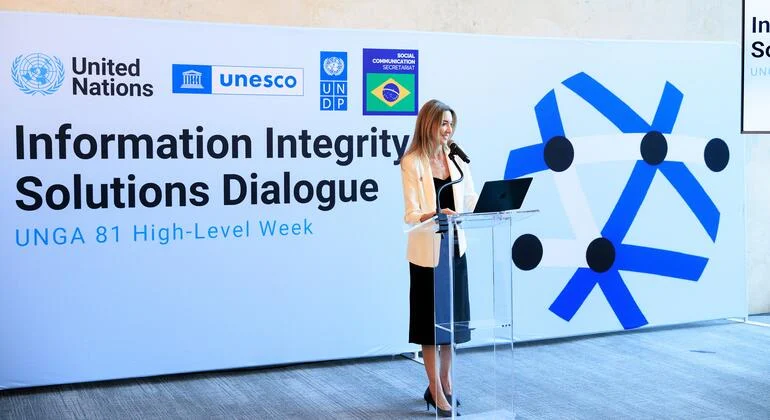
NEW YORK — As the world navigates a rapidly shifting digital landscape, the United Nations has sounded an urgent alarm: the integrity of the global information ecosystem is under siege. During the high-level week of the 81st session of the General Assembly, policymakers, civil society leaders, and technology experts converged at UN Headquarters for the Information Integrity Solutions Dialogue, a pivotal forum aimed at transforming abstract principles into tangible defenses against misinformation, algorithmic bias, and the unchecked proliferation of harmful content.
Co-hosted by Brazil, the UN Secretariat, the UN Development Programme (UNDP), and UNESCO, the dialogue served as a clarifier for the international community. It marked a transition from the diagnostic phase of acknowledging the “information crisis” to the implementation phase of the UN’s Global Principles for Information Integrity and the Global Digital Compact.
The Anatomy of the Global Information Crisis
The core challenge, as defined by the UN, is the erosion of “information integrity”—the capacity for citizens to access reliable, accurate information necessary to make informed decisions and participate in democratic life.
Melissa Fleming, the UN Under-Secretary-General for Global Communications, set a somber tone for the proceedings, noting that the architecture of modern discourse is fundamentally broken. “Today, a handful of companies still dominate and shape our global information architecture,” Fleming stated. “Their priorities remain the same: engagement, profit. Always placed above the public interest.”
This profit-driven model has left the primary guardians of truth—journalists, scientists, and human rights defenders—dangerously under-resourced. According to the dialogue’s participants, the rapid, often unregulated deployment of artificial intelligence (AI) has exacerbated these risks, turning the digital space into a minefield where the line between reality and synthetic fabrication is increasingly blurred.
Chronology of a Digital Pivot: From Principles to Policy
The dialogue was not a standalone event but the latest in a series of strategic maneuvers by the UN to reclaim the digital commons.
- September 2024: The UN launches the Global Principles for Information Integrity, establishing a normative framework for how states and corporations should treat the digital sphere.
- Early 2025: Initial discussions regarding the Global Digital Compact begin, aiming to harmonize technological innovation with human rights.
- September 2026 (High-Level Week, UNGA81): The Information Integrity Solutions Dialogue is convened, shifting the focus toward specific, actionable regional and national projects.
- September 22, 2026: Secretary-General António Guterres opens the General Debate, demanding “reliable guardrails” for AI to prevent the degradation of truth in public discourse.
- Concurrent with UNGA81: The Coalition for Children’s Rights and Protection in the Age of Artificial Intelligence launches a comprehensive roadmap for safety-by-design standards to protect minors from AI-enabled threats.
Supporting Data and Evidence-Based Solutions
While the risks are global, the UN’s approach is increasingly localized. A central theme of the dialogue was the Global Initiative for Information Integrity on Climate Change, which serves as a prototype for cross-border cooperation. By prioritizing the Global South, the initiative addresses the specific vulnerabilities of developing nations that often bear the brunt of climate-related disinformation campaigns.
Participants highlighted several key pillars for building a more resilient information environment:
- Platform Accountability: Moving beyond self-regulation, there is a push to engage advertisers to stop the “inadvertent funding” of harmful content. By drying up the revenue streams for hate speech and misinformation, the UN hopes to alter the economic incentives that currently reward toxic engagement.
- Human-Centric Literacy: As AI becomes more sophisticated, the focus on “information literacy” is expanding. The dialogue emphasized that technical solutions alone are insufficient; community outreach and direct, human-to-human engagement are essential to rebuilding the foundational trust required for societal cohesion.
- Cross-Sectoral Collaboration: Solutions must span from electoral integrity to child safety. The roadmap launched by the Coalition for Children’s Rights, for instance, focuses on "age assurance" and "AI literacy," providing a model that could be replicated in the protection of human rights defenders.
Official Responses: Reclaiming the Digital Public Square
The diplomatic consensus emerging from the 81st General Assembly is clear: the era of "move fast and break things" in the technology sector is incompatible with the survival of democratic discourse.
Secretary-General António Guterres has been vocal about the need for a multi-stakeholder approach. "We need to involve governments, businesses, scientists, civil society, and academia," Guterres noted. The UN’s proposed Global Information Integrity Exchange (GIIEx) represents the most concrete response to this need. Designed as a repository for tools, research, and policy, GIIEx will function as a central hub where practitioners can share what works in real-time, effectively scaling success stories from one continent to another.
The private sector, while under scrutiny, was also invited into the fold. The dialogue highlighted that if tech companies refuse to adopt human-rights-responsible advertising standards, they risk not only regulatory crackdowns but also the total collapse of the user trust that their business models rely upon.
Implications: The Path Toward COP31 and Beyond
The urgency of these discussions is underscored by the looming international calendar. With COP31 on the horizon, the UN is treating information integrity as a prerequisite for climate action. Without accurate, trusted information, international agreements on climate goals are effectively neutralized by denialism and bad-faith actors.
The implications for international relations are profound:
- A New Geopolitical Frontier: The proposal for a pan-African UN-African Union conference on information integrity signals that the Global South is not waiting for Silicon Valley to solve these problems. Instead, regional blocks are beginning to assert their own sovereignty over their information ecosystems.
- Institutionalizing Defense: By establishing “Centres of Excellence for Information Integrity,” the UN is essentially creating a permanent diplomatic and technical infrastructure to monitor threats. This is a shift from reactive crisis management to proactive risk mitigation.
- The Regulatory Future: The alignment between the Global Digital Compact and specific sectoral protections—like those for children—suggests that global governance is moving toward a “safety-by-design” mandate. Companies that fail to incorporate these protections into their development cycles may face a future where they are increasingly excluded from global markets.
Conclusion: The Long Road to Recovery
As the Information Integrity Solutions Dialogue concluded, the overarching sentiment was one of cautious resolve. The “crisis” is no longer a theoretical concern—it is a lived reality for journalists under fire, communities divided by AI-generated polarization, and children navigating an increasingly predatory digital space.
“The solutions we have are as wide-ranging as the threats we face,” Melissa Fleming concluded. “From climate to health, to democratic governance. From prevention to response. Together, we’re pursuing those solutions.”
The success of these efforts will depend on whether the UN can sustain the momentum generated during UNGA81. The path forward requires more than just high-level rhetoric; it demands consistent investment in local information defenders, a rigorous overhaul of the advertising models that fuel digital toxicity, and the creation of a global, interdisciplinary network—the GIIEx—that can out-pace the evolution of the threats it seeks to combat.
In the final assessment, the information integrity movement is an attempt to rewrite the social contract of the 21st century. It is a recognition that in a world where information is the primary resource of the modern era, the integrity of that information is not merely a policy goal—it is a fundamental human right. As the world looks toward COP31 and the future of the Internet Governance Forum, the message from the UN is clear: the battle for the truth is not yet lost, but it must be fought with unprecedented coordination and collective courage.
 Reynand Wu
 Raul Delapena Setiawan
 Pevita Pearce
