

SANTA BARBARA — Long before asphalt and concrete became the default skin of modern civilization, humanity maintained a vastly different relationship with the earth. Over the past century, however, sprawling suburbs, towering overpasses, and relentless urban sprawl transformed natural landscapes into hyper-efficient transit corridors designed for commuting, logistics, and resource delivery. Yet, for four decades, California-based artist, landscape designer, and educator Bonnie Ora Sherk (1945–2021) waged a creative, persistent campaign against the foundational assumptions of urban life.
Operating as a cultural trickster and a proactive spoiler in the machinery of everyday routine, Sherk continually proposed radical new models for social relations and ecological coexistence. Today, her legacy is the subject of a vital, meticulously curated retrospective titled Life Frames since 1970 at the University of California, Santa Barbara’s Museum of Art, Design, and Architecture. Featuring a wealth of archival drawings, posters, photographs, and moving images, the exhibition underscores how Sherk’s boundary-pushing interventions—ranging from quiet, contemplative performances to high-impact public environmental activations—remain profoundly relevant to contemporary discussions about urban planning, ecology, and human psychology.
Main Facts: The Retrospective and Sherk’s Artistic Blueprint
Life Frames since 1970 serves as both a historical survey and a timely reminder of art’s capacity to disrupt normalized behaviors. While the exhibition is relatively modest in scale, relying heavily on documentary evidence such as photographs, preparatory sketches, and video transfers, its impact is outsized.
Sherk’s work was rarely confined to traditional gallery spaces. Instead, her canvas was the civic sphere: the street corners, the concrete medians, the municipal parks, and even the city zoo. Trained under influential Fluxus artists Robert Watts and Mel Henderson, Sherk synthesized a post-Dadaist performance sensibility with a deeply practical, visionary rethinking of human priorities. She sought to jolt everyday citizens out of their autopilot states, fostering mindful, unexpected encounters between humans, animals, and the built environment.
The exhibition highlights several foundational projects from her expansive career:
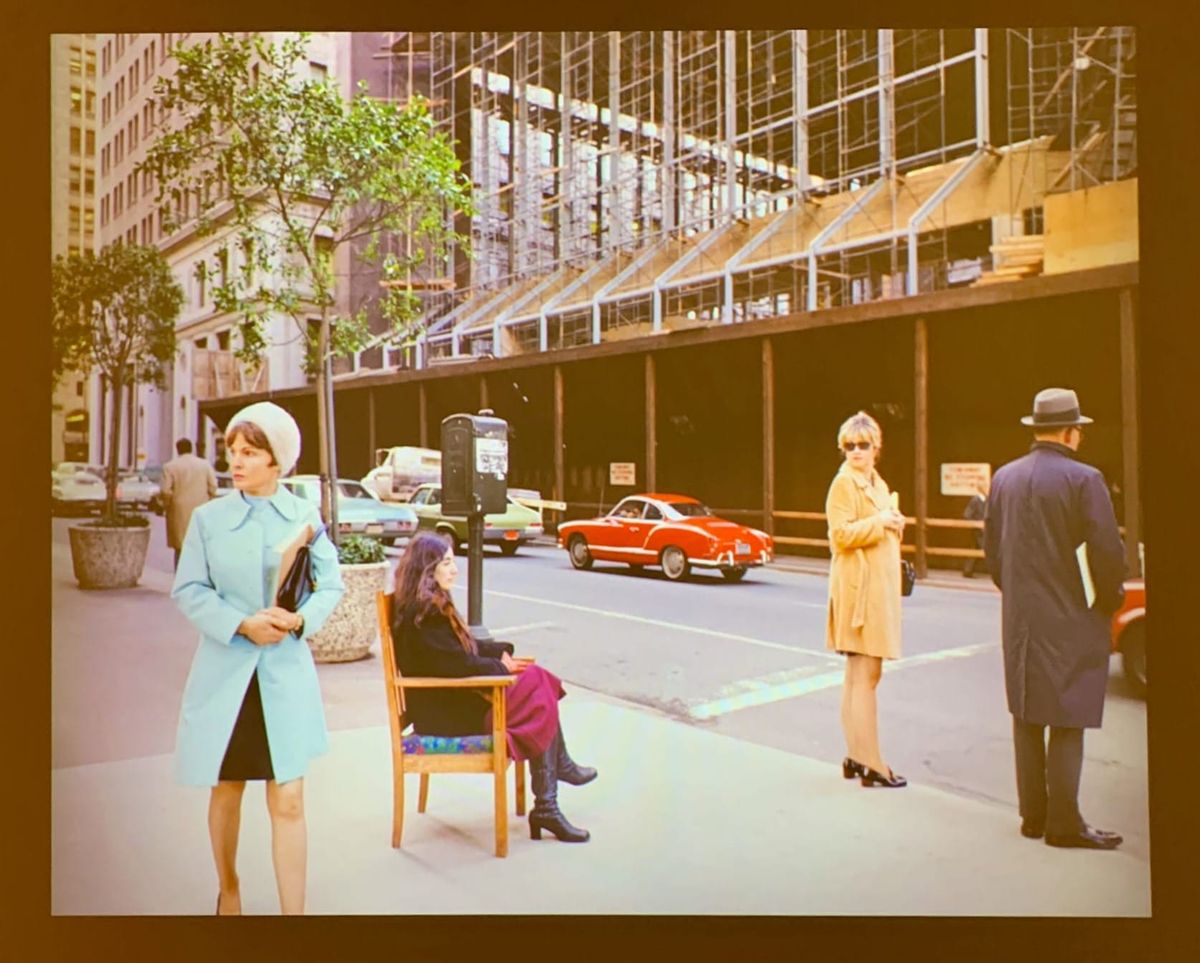
- "Sitting Still" (1970): A series of performances staged in mundane outdoor locations across San Francisco, where Sherk placed herself in ordinary armchairs amidst the chaos of daily urban traffic and pedestrian life.
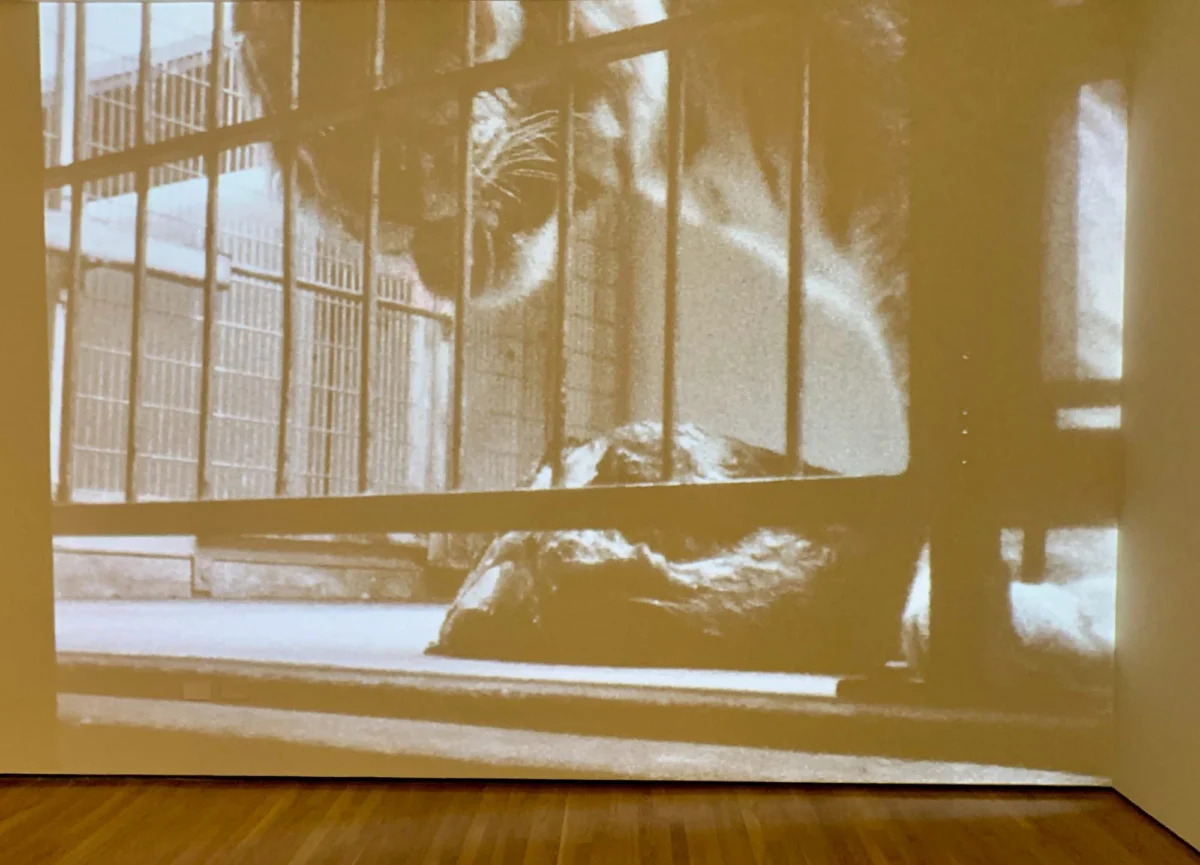
- "Public Lunch" (1971): A provocative performance piece executed at the San Francisco Zoo, where Sherk locked herself inside a cage in the Lion House directly adjacent to a enclosure of big cats, prompting startled reactions from zoogoers.
- Environmental and Educational Initiatives: Later works that expanded into large-scale landscape architecture, community farming, and ecological frameworks aimed at healing fractured urban ecosystems.
Chronology: From Fluxus Provocateur to Environmental Pioneer
The Formative Years and the Fluxus Influence (Late 1960s–1970)
Bonnie Ora Sherk emerged onto the West Coast art scene during a period of immense social upheaval, artistic experimentation, and radical questioning of institutional authority. After completing her studies with avant-garde figures like Robert Watts and Mel Henderson, Sherk quickly absorbed the core tenets of the Fluxus movement—which emphasized the artistic process over finished objects, humor, anti-commercialism, and the blending of art into daily life.
However, Sherk distinctively pivoted these concepts toward environmental and sociological critique. She recognized that the modern city was an artificial construct that systematically alienated humans from the natural world and from one another. Her early works were designed to puncture this urban bubble.
The Urban Interventions: Sitting Still and Public Lunch (1970–1971)
In 1970, Sherk launched Sitting Still, a deceptively simple yet resonant performance series. Armed with an ordinary household armchair, she positioned herself in various unremarkable, high-traffic outdoor locations throughout San Francisco—busy intersections, concrete plazas, and industrial fringes. As captured in large-scale Kodachrome photographs now featured in the UCSB retrospective, Sherk sat motionless, reading or simply observing, while the frantic pace of modern life swirled around her. The project exposed the absurdity of the urban rush, turning the passive commuter into a spectator of stillness.
A year later, Sherk executed one of her most notorious and intellectually layered works: Public Lunch (1971). Documented in the exhibition via a black-and-white film transferred to video, the performance took place at the San Francisco Zoo’s Lion House. Sherk positioned herself inside a wired enclosure adjacent to a cage housing live lions and leopards. As weekend visitors streamed through the facility to gawk at the caged beasts, they were met with the uncanny sight of a human woman sharing the spatial logic of captivity. Visitors watched, bewildered, as the big cats and the artist paced, napped, and were eventually fed.
Public Lunch brilliantly interrogated the dynamics of the gaze, institutional power, and the arbitrary lines drawn between "civilized" humanity and "wild" nature. By placing herself on the exhibition side of the bars, Sherk forced viewers to confront the voyeuristic nature of urban entertainment and the ways modern infrastructure cages both animal instincts and human imagination.
Evolution into Landscape Architecture and Community Activism (1970s–2021)
As her career progressed, Sherk realized that temporary performance art, while effective at sparking critical thought, needed to be paired with permanent, structural solutions to urban alienation. This realization led her to transition from a "cultural trickster" to a proactive landscape architect, educator, and environmental activist.
She began reclaiming neglected urban spaces—most notably transforming a barren, garbage-strewn patch of land beneath a freeway interchange in San Francisco into the "Life Frame" / "Rainbow Sign" and eventually the renowned Crossroads Community (The Farm). These projects combined agriculture, art, performance, and education, proving that communities could actively heal their built environments and forge sustainable relationships with the earth. Sherk continued this interdisciplinary work until her passing in 2021, leaving behind a robust theoretical framework known as "A Life Frame."
Supporting Data and Archival Insights
Because many of Sherk’s seminal works were ephemeral performances rather than permanent objects, the curators at UCSB’s Museum of Art, Design, and Architecture faced a unique challenge in mounting Life Frames since 1970. The exhibition relies heavily on archival materials to reconstruct the weight and texture of Sherk’s interventions:
- Visual Documentation: Large-scale projections of Kodachrome slides from Sitting Still preserve the vivid, hyper-real color palette of early 1970s urban America, contrasting the dull grays of asphalt with the striking posture of the artist.
- Moving Image Archives: Digital transfers of 16mm and video recordings capture the kinetic energy of Public Lunch, allowing contemporary audiences to observe the subtle behavioral mirroring between Sherk and the caged felines.
- Ephemera and Epistolary Records: Architectural drawings, handwritten notes, project proposals, and promotional posters from her later community farm initiatives offer insight into the rigorous planning and administrative tenacity required to execute visionary ecological art.
While the aesthetic experience of viewing documentation can occasionally feel detached from the visceral, real-time shock of the original performances, the sheer volume and intellectual coherence of the archive provide a compelling testament to Sherk’s visionary scope.
Official Responses and Curatorial Perspectives
Art historians, critics, and institutional leaders have increasingly recognized the prophetic nature of Sherk’s work, particularly as contemporary cities grapple with climate change, ecological degradation, and social fragmentation.
In framing the exhibition, curators and critics have emphasized that Sherk was not merely making art for aesthetic appreciation; she was performing a form of urban acupuncture. By inserting foreign elements—an armchair in traffic, a human in a zoo cage, an organic farm under a concrete overpass—she stimulated stagnant systems and prompted viewers to question the inevitability of their environments.

Brian Karl, writing in Hyperallergic, notes that Sherk’s status as a "proactive spoiler" allowed her to short-circuit the mindless efficiency demanded by modern capitalism and municipal planning. "Through her creative projects, Sherk consistently proposed new models of social relations," Karl observes, highlighting how her early performative investigations laid the groundwork for her subsequent, decades-long commitment to ecological landscape design.
Institutional voices at UCSB have similarly stressed that Life Frames since 1970 serves as a critical educational tool for a new generation of artists, architects, and urban planners. In an era dominated by smart cities, digital isolation, and escalating climate anxieties, Sherk’s hands-on, community-centered approach offers a roadmap for reclaiming the civic commons.
Implications: Why Bonnie Ora Sherk Matters Today
The resonance of Life Frames since 1970 extends far beyond the historical retrospective of a singular West Coast artist. Sherk’s body of work raises fundamental questions about the trajectory of modern urban development and the responsibilities of artists operating within the public sphere.
1. The Re-Enchantment of Public Space
In contemporary cities, public spaces are increasingly privatized, commercialized, or heavily surveilled, leaving little room for spontaneous human interaction or contemplation. Sherk’s Sitting Still reminds us of the revolutionary power of simply pausing within the machine. By refusing to participate in the endless rush of productivity, the artist reclaims public space as a site of psychological freedom.
2. Deconstructing Human-Animal Boundaries
As ecological crises accelerate and biodiversity plummets, works like Public Lunch feel remarkably prescient. Sherk’s blurring of the line between the observer and the caged animal challenges anthropocentric worldviews. She forces us to ask: Who is truly caged by the modern urban infrastructure—the lion pacing in the concrete enclosure, or the commuter trapped in endless cycles of asphalt and traffic?
3. Art as Infrastructure
Sherk’s seamless transition from performance art to landscape architecture and community farming challenges the traditional boundary between fine art and utilitarian urban planning. She demonstrated that artists can—and should—act as primary architects of social infrastructure. Her "Life Frames" concept posits that art can provide the structural framework through which communities organize, nourish themselves, and heal their environments.
Ultimately, Bonnie Ora Sherk’s retrospective in Santa Barbara is more than a retrospective glance at 1970s counterculture; it is a urgent, enduring challenge to the concrete grids we inhabit. Her legacy invites us to look up from our daily commutes, question the asphalt beneath our feet, and imagine a world where cities are designed not just for transit and commerce, but for life, mindfulness, and deep ecological harmony.
 Raul Delapena Setiawan
 Evan Lee Salim
 Jia Lissa
