

LOS ANGELES — In the sun-drenched landscape of 1960s Southern California, where the prevailing artistic vernacular often leaned toward sleek surfaces, automotive finishes, and monumental light installations, a quieter, yet radically ambitious revolution was taking shape inside a printmaking workshop on Melrose Avenue.
Founded in 1966 by Sydney B. Felsen and Stanley Grinstein, Gemini G.E.L. (Graphic Editions Limited) quickly evolved from an experimental atelier into an international powerhouse. Over the last six decades, it has served as a crucible where the world’s most celebrated artists could step away from their signature practices, drop their guards, and venture far outside their comfort zones.
To mark its monumental 60th anniversary, the legendary institution has organized a landmark retrospective. Titled (Almost) Every Year: Sixty Years of Printmaking at Gemini G.E.L. and guest-curated by Susan Dackerman and Helen Molesworth, the exhibition mines the workshop’s vast archives. Rather than merely presenting a chronological victory lap, the curators have constructed a nuanced narrative around dialogue, risk, and cross-pollination. The show demonstrates how Gemini functioned not just as a production facility, but as a dynamic intellectual salon where modern masters could tinker with materials, challenge the boundaries of print, and redefine the very definition of editioned art.
Main Facts: A Sanctuary for Experimentation
At its core, Gemini G.E.L. was built on a premise of radical collaboration. Felsen and Grinstein did not view their workshop as a commercial press that merely translated an artist’s preexisting sketches into ink on paper. Instead, they fostered a symbiotic partnership between master printers and visionary artists, encouraging a freewheeling exchange of ideas that frequently subverted traditional printmaking standards.
The exhibition underscores this ethos through direct juxtapositions of works created decades apart. Visitors can observe how different artists tackled shared conceptual preoccupations:
- Frank Stella and Ellsworth Kelly exploring the psychological weight of pure color and geometric shape;
- Robert Rauschenberg and Jasper Johns incorporating the poetry of found-object imagery;
- Susan Rothenberg and Richard Serra weaponizing the color black, pushing it to its absolute light-absorbing extremes; and
- Toba Khedoori, Julie Mehretu, and Analia Saban deconstructing complex linear matrices.
Yet, some of the most compelling artifacts in the retrospective are anomalies—moments where artists famous for one specific style abruptly pivoted. For instance, minimalist sculptors Joel Shapiro and Richard Tuttle, typically celebrated for their austere, understated three-dimensional constructions, completely upended expectations here. In their Gemini screenprints, they embraced exuberant, polychromatic palettes and dizzyingly complex geometric configurations, proving that printmaking could unlock entirely new emotional registers in an artist’s oeuvre.
Chronology: Six Decades of Artistic Evolution
The institutional trajectory of Gemini G.E.L. mirrors the broader shifts in modern and contemporary art history over the past half-century. The exhibition’s rigorous timeline maps this evolution across distinct cultural eras.
The Inaugural Era (Late 1960s)
Gemini opened its doors with an immediate, high-impact roster. The workshop successfully lured East Coast heavyweights—including Josef Albers, Man Ray, Robert Rauschenberg, Jasper Johns, Claes Oldenburg, Frank Stella, and Ellsworth Kelly—out to the West Coast. Simultaneously, Felsen and Grinstein deeply engaged with Los Angeles’s burgeoning home-grown avant-garde, collaborating with David Hockney, Ed Ruscha, Ron Davis, and Bruce Nauman.
The Institutional Expansion (1970s–1980s)
During its second and third decades, the workshop solidified its reputation as a technical innovator, embracing materials far beyond traditional paper, from industrial plastics to heavy metals. It was also during this period that Gemini began dismantling the gender imbalances historically inherent in the blue-chip art world.
The Shift Toward Gender Parity (1980s–Present)
The entry of Dorothea Rockburne and Vija Celmins in the 1980s marked a pivotal turning point. They were swiftly followed by luminaries such as Susan Rothenberg and Elizabeth Murray. Curators Dackerman and Molesworth noted in recent gallery talks that today, Gemini’s contemporary artist roster stands out for its robust gender equality—a deliberate structural evolution rather than a retroactive afterthought.

Supporting Data: Defying the Boundaries of the Print
What separates Gemini G.E.L. from standard commercial lithography or screenprinting studios is its relentless defiance of what constitutes a "print." The workshop’s master artisans routinely pushed technical envelopes, forcing materials to behave in ways they were never intended to.
Several seminal works in the exhibition highlight this material audacity:
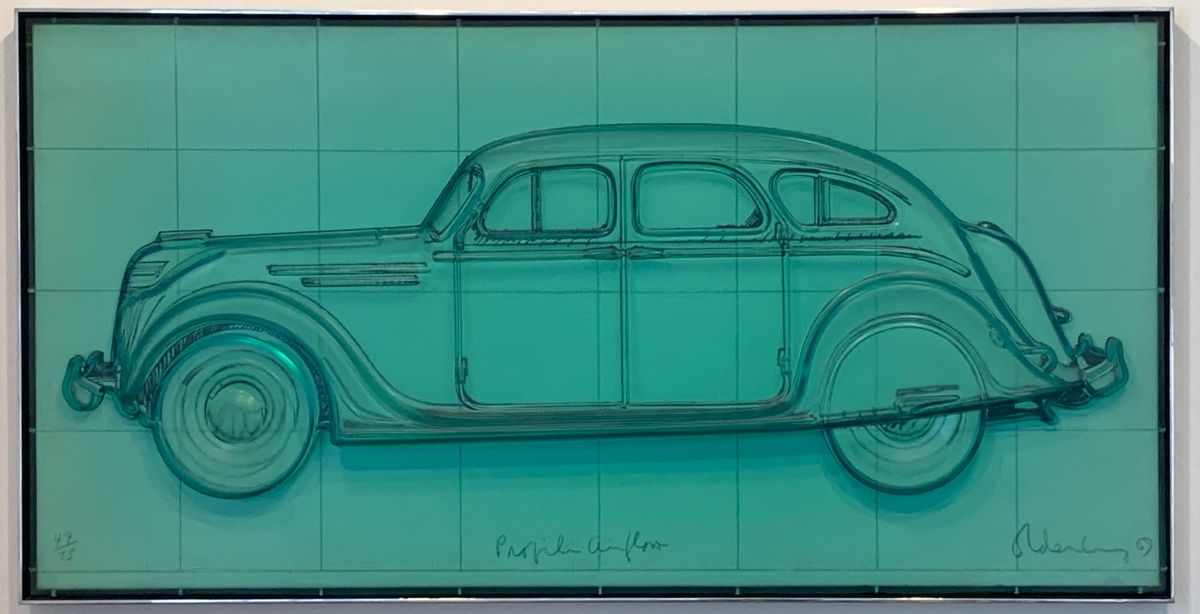
- Claes Oldenburg’s Profile Airflow (1969): Evolving directly out of the Southern California "Finish Fetish" art movement of the era—which celebrated high-gloss automotive lacquers and molded resins—Oldenburg molded polyurethane to replicate the profile of an automobile in heavy relief over a two-color lithograph. It sits somewhere between sculpture, relief, and print.
- Jasper Johns’s Lead Reliefs (Early 1970s): In a brilliant subversion of fragility, Johns printed images of delicate lightbulbs and other everyday items directly onto sheets of lead. By pressing soft metal into durable matrices, he transformed ephemeral, fragile objects into heavy, permanent historical monuments.
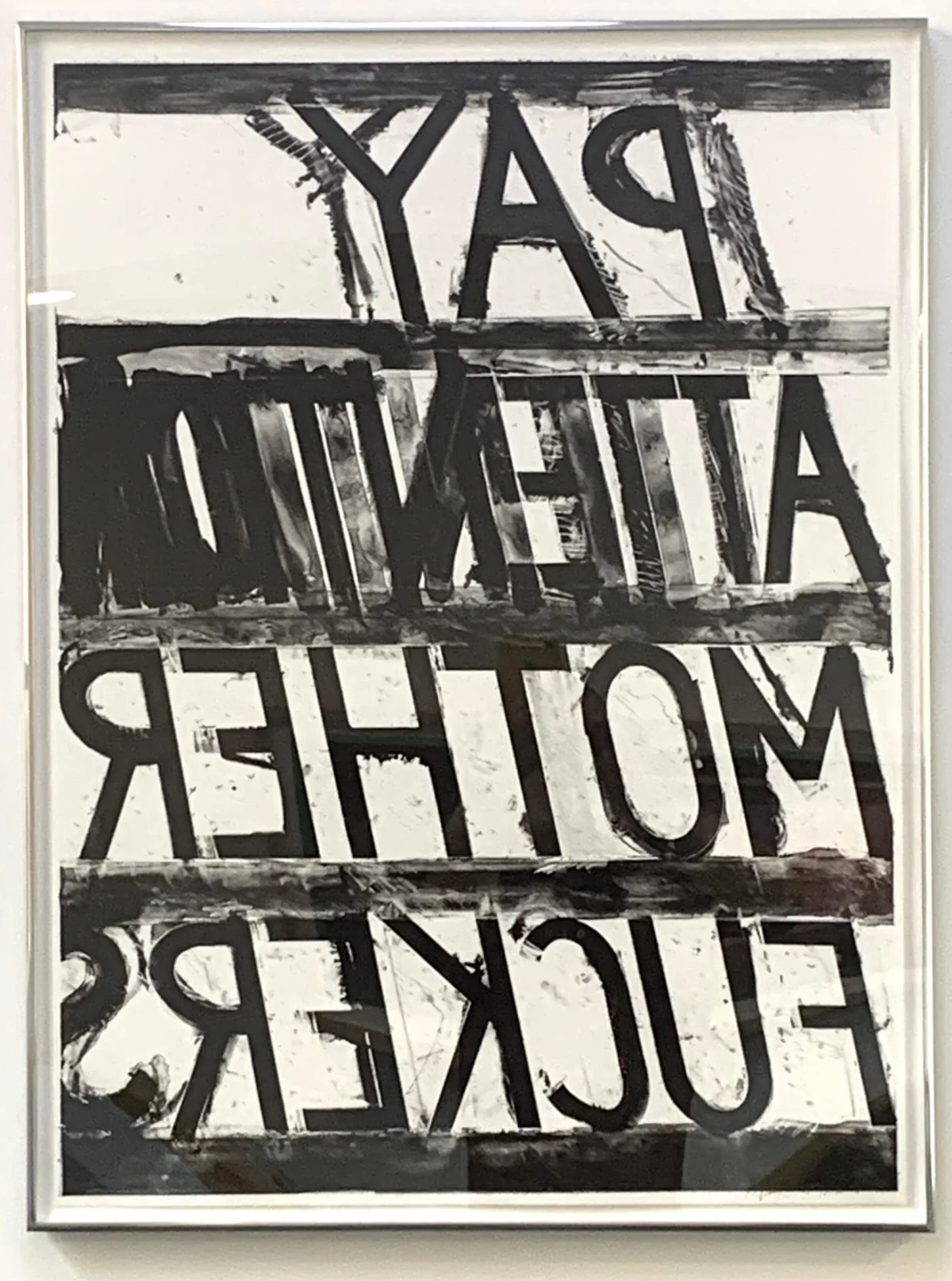
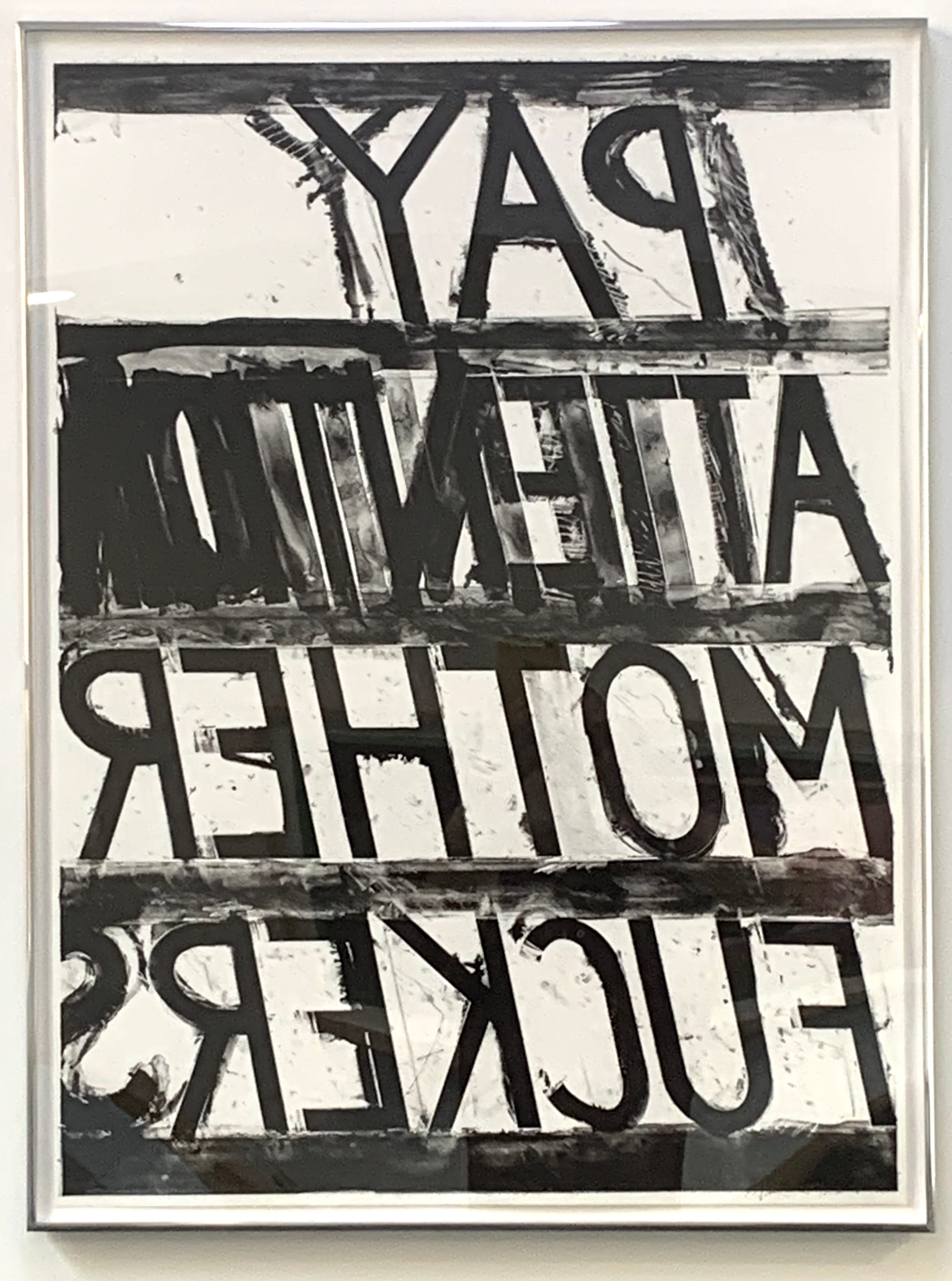
- Bruce Nauman’s Pay Attention (1973): A striking one-color lithograph that acts as both a visual command and a psychological mirror, urging the viewer to interrogate their relationship to the artwork itself.
- Edward and Nancy Kienholz’s The Econo-Can (1977): Pushing conventions to their breaking point, the Kienholzes took ordinary gasoline containers and refashioned them using a Fresnel lens system to resemble vintage television sets, bridging environmental critique with sculptural assemblage.
- Allen Ruppersberg’s Great Speckled Bird (2013): A monumental multi-colored screenprint executed on a 20-foot-long perforated player-piano roll, later divided into four distinct sections. Titled after a traditional Southern gospel hymn famously recorded by Johnny Cash, the piece is a nostalgic meditation on classic Americana. Its imagery is composed of handwritten reproductions of lyrics from age-old songs, meticulously drafted by Ruppersberg on vintage motel stationery.
Official Responses: Curatorial Insights and Institutional Legacy
Speaking on the overarching vision of the 60th-anniversary exhibition, guest curators Susan Dackerman and Helen Molesworth emphasized that the true archive of Gemini G.E.L. is not merely a collection of rare paper editions, but a living testament to intellectual risk-taking.
"The workshop was never just about producing editions; it was about creating a conceptual pressure cooker," the curators noted during their opening gallery walkthrough. By bringing artists from disparate geographical and ideological backgrounds into the same Los Angeles facility, Felsen and Grinstein engineered an environment where creative vulnerability was prized above all else.
Art historians and critics have long lauded Gemini for maintaining rigorous standards of craftsmanship without ever falling into sterile academicism. The institutional response to [Almost) Every Year has been overwhelmingly positive, casting the retrospective not as a dusty historical archive, but as an active prompt for contemporary discourse.
Implications: The Enduring Relevance of the Studio Model
As Gemini G.E.L. steps past its diamond jubilee, the implications of its 60-year experiment resonate deeply within the modern art ecosystem. In an era increasingly dominated by digital media, rapid virtual fabrication, and hyper-commercialized blue-chip galleries, the physical workshop model championed by Felsen and Grinstein feels both radical and essential.
Gemini proves that physical collaboration—the messy, tactile friction between an artist’s concept and a master printer’s technical wizardry—remains irreplaceable. By compelling artists to step out of their comfort zones, the studio has consistently generated breakthroughs that trickle back into those artists’ primary practices in painting, sculpture, and installation.
Ultimately, sixty years after its founding, Gemini G.E.L. continues to issue the same quiet, uncompromising command found in Bruce Nauman’s iconic lithograph: Pay Attention. For artists and collectors alike, the workshop remains a vital reminder that the most profound artistic discoveries happen precisely at the edge of the unknown.
 Evan Lee Salim
 Suro Senen
 Jia Lissa
