

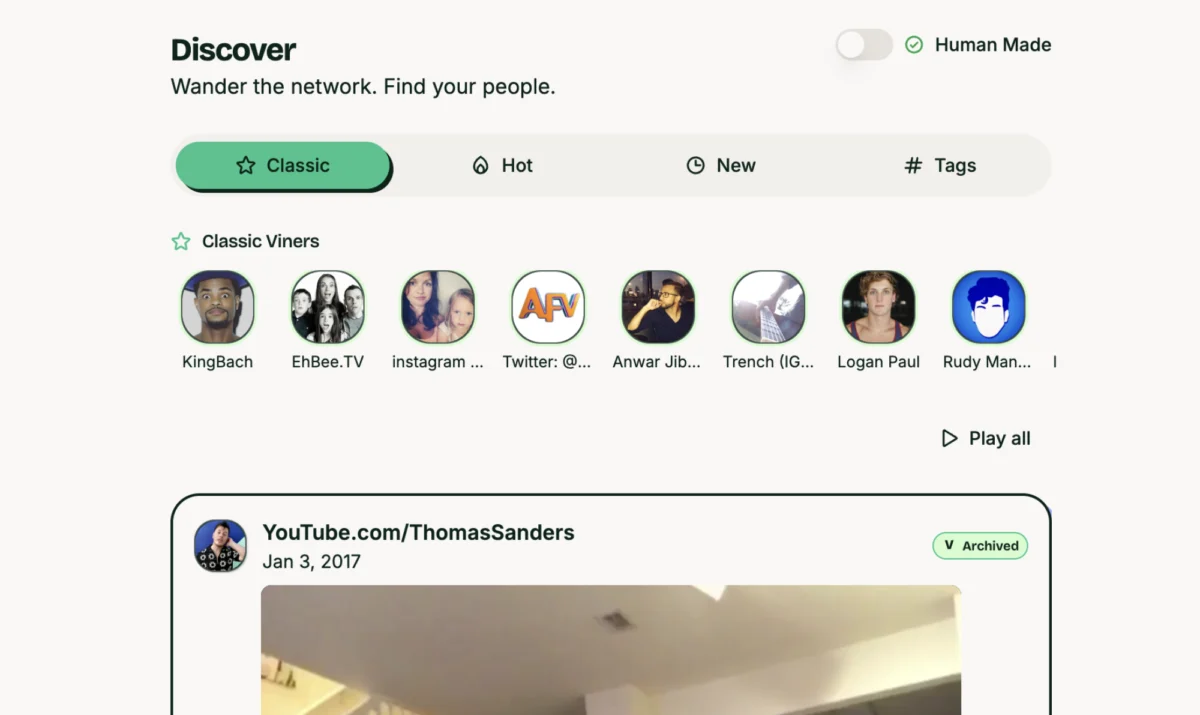
It is a sentence that would have sounded like a fever dream just a few years ago: Vine is back. In the landscape of 2026, where the digital ecosystem is increasingly dominated by synthetic media, infinite algorithmic feeds, and the blurring lines between reality and generative artifice, the return of a platform synonymous with six-second bursts of human creativity feels less like a corporate reboot and more like a cultural intervention.
Rebranded as "Divine," the platform has emerged from the digital grave to stake a claim in a social media market that has grown bloated and unrecognizable since the original Vine was shuttered in 2017. Perhaps the most poetic—and polarizing—aspect of this relaunch is its benefactor: Jack Dorsey, the former Twitter CEO whose tenure saw the original execution of Vine, is the very man funding its resurrection.
The Main Facts: What is Divine?
Divine is not merely a nostalgia project; it is a direct ideological challenge to the status quo of modern social media. The platform serves two distinct purposes. First, it functions as a comprehensive digital archive, housing over 500,000 videos from the original Vine library, allowing a new generation to experience the cultural touchstones that defined the early 2010s internet. Second, it acts as a functional, modern short-form video app designed specifically to facilitate a "human-first" experience.
The core differentiator of Divine, and its most aggressive policy shift, is its self-proclaimed status as a "freedom from AI slop" zone. In an era where deepfakes, synthetic influencers, and LLM-generated video content are polluting social feeds, Divine has implemented a strict gatekeeping mechanism. To ensure that content remains authentic, users must either record their videos directly within the Divine interface or subject their uploads to a rigorous human-verification protocol. This verification tool is powered by the Guardian Project, a nonprofit organization dedicated to digital security and privacy, ensuring that the content reaching the feed is the product of human effort, not machine-generated output.
A Chronology of the Vine Saga
To understand the weight of Divine’s arrival, one must look back at the trajectory of its predecessor.
- 2013: The Birth of the Loop. Vine launched with a simple, restrictive premise: six-second, looping videos. It became an instant cultural phenomenon, fostering a new class of internet celebrities—names like Logan Paul, King Bach, and Zach King became household names.
- 2016: The Death Knell. Twitter, struggling to monetize the platform and facing stiff competition from Instagram’s burgeoning video features, announced it would shutter the Vine app.
- 2017: The Final Fade. Vine officially ceased operations. While a web archive remained, the creative community dispersed to YouTube, Instagram, and eventually, TikTok.
- 2022-2024: The Speculation Phase. As social media sentiment shifted toward the "Enshittification" model—where platforms prioritize advertiser needs and AI-driven engagement over user experience—figures like Elon Musk publicly mused about bringing Vine back to compete with TikTok.
- 2025: The Test Run. Evan Henshaw-Plath, a former Twitter engineer and long-time open-source advocate (known online as "Rabble"), began testing a project to preserve the Vine archive. With funding from Dorsey’s nonprofit "and Other Stuff," the project transitioned from a library into a functional social network.
- 2026: The Official Launch. Divine arrives on the Apple App Store and Google Play Store, attempting to reconcile the past of short-form video with the complex digital anxieties of the present.
Supporting Data: The Landscape of Modern Consumption
Divine enters a market that is fundamentally hostile to its minimalist, human-centric design. The current landscape is a battle for "brainrot" engagement, where the dominant platforms have become massive, automated juggernauts.
- The TikTok Hegemony: TikTok, which essentially inherited the DNA of Vine, currently commands a massive share of the attention economy, utilizing complex AI-driven recommendation engines that are designed to keep users in a state of perpetual consumption.
- The Scale of Reels and Shorts: Instagram Reels and YouTube Shorts have scaled to unprecedented levels. YouTube Shorts alone reports over 200 billion daily views, a metric that dwarfs the peak of the original Vine, which sat at roughly 100 million monthly active users.
- The AI Proliferation: Recent industry reports indicate that by the end of 2026, synthetic content—ranging from AI-enhanced aesthetics to fully generated influencer clips—will account for nearly 30% of all short-form video content on major legacy platforms.
Against this backdrop, Divine’s proposition is mathematically daring. It is not trying to compete on the volume of content or the sophistication of an algorithm. Instead, it is betting on the "Human Premium"—the idea that, as the internet becomes flooded with synthetic content, audiences will increasingly crave the authentic, the flawed, and the human-made.
Official Responses and Strategic Philosophy
The leadership behind Divine has been remarkably transparent about the platform’s shortcomings and the mistakes of its predecessor. In a statement provided to The Guardian, Jack Dorsey addressed the irony of his role in the platform’s history, noting that the "death" of Vine was a failure of corporate vision.
"The core principle of this relaunch," Dorsey stated, "is that creators must own their content and their followers." This is a significant pivot from the traditional social media model, where platforms exert total control over the relationship between the creator and the audience. Divine is built on the premise that users should be able to build their own revenue streams without being beholden to the whims of an opaque algorithm or a platform’s shifting advertising policies.

Evan Henshaw-Plath, speaking during the 2025 testing phase, underscored this mission. "The goal was to recapture an era of social media built around real people," he told TechCrunch. "We want to give users control over their algorithms, or the ability to opt out of them entirely. We want to return to an internet that feels like a conversation rather than a broadcast."
The Implications: A New Era for Social Media?
The arrival of Divine signals a deeper shift in the tech industry: the "Post-Algorithmic" movement. For years, the industry mantra was "scale at any cost." Now, a small but influential group of engineers and investors are arguing that the next great growth market is not larger scale, but higher trust.
1. The Death of the "Slop" Feed
By mandating human verification, Divine is creating a digital "gated community." While this will inevitably limit the platform’s growth speed compared to a platform like TikTok, it also insulates it from the decay that typically occurs when a site becomes overrun by bot-generated spam. If successful, Divine could become a premium space for artists, comedians, and creators who are tired of being buried under algorithmic noise.
2. Creator Sovereignty
The move to ensure creators own their followers is a direct response to the "platform risk" that has plagued creators for a decade. When a creator builds an audience on Instagram or YouTube, they are essentially renting space. If the algorithm changes, their career can disappear overnight. By prioritizing portable follower lists and direct revenue paths, Divine is aligning itself with the "Creator Economy" movement that favors decentralization.
3. The Irony of the Reboot
There is an undeniable irony in Jack Dorsey—the man who helped shepherd the era of mass-media social platforms—now funding a project that seeks to dismantle them. However, it reflects a broader trend among Silicon Valley veterans who have begun to view the platforms they built with a sense of regret. The "Divine" experiment is effectively an attempt to atone for the transformation of social media from a connection tool into a consumption tool.
4. The Challenges Ahead
Despite the idealism, the hurdles are massive. Divine is competing against companies with billions of dollars in R&D budgets. Can a platform that intentionally limits the reach of its content through human verification survive the pressures of a venture-backed environment? Will the audience that grew up on the hyper-speed consumption habits of TikTok find the "six-second, human-only" experience satisfying, or will it feel like a step backward?
Conclusion: The Final Loop
Divine is a bold, perhaps even foolhardy, proposition. In a 2026 digital environment that favors the massive, the machine-made, and the algorithmically optimized, a platform that celebrates the small, the manual, and the human is an outlier.
Whether Divine becomes a long-term home for the next generation of creative talent or serves merely as a high-concept museum for the "good old days" of the internet remains to be seen. However, its existence proves one thing: the internet is beginning to tire of its own synthetic reflection. Sometimes, in order to figure out where we are going, we have to go back to the beginning—and look at the six-second loop that started it all.
 Nana Wu
 Neng Nana
 Reynand Wu
