

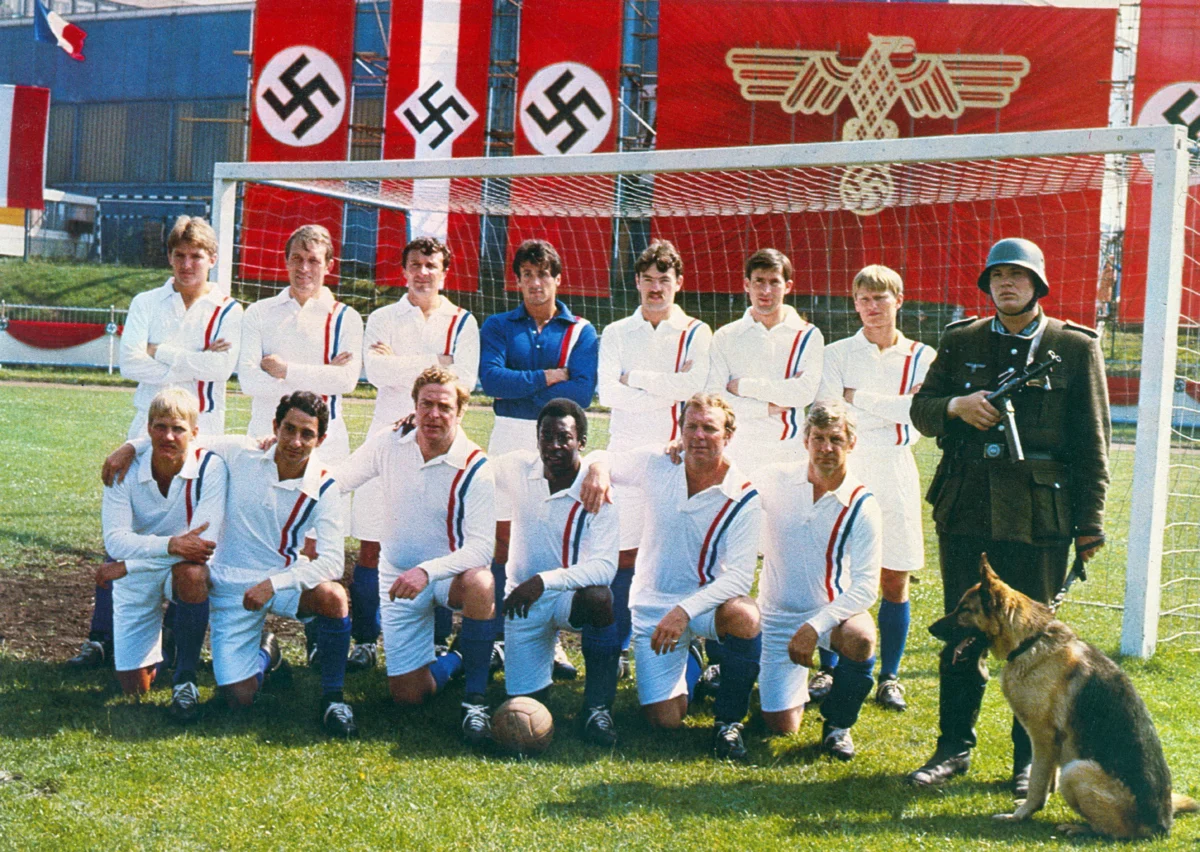
In the annals of 20th-century cinema, few projects possess a pedigree as eclectic or a premise as surreal as John Huston’s 1981 feature, Victory (released internationally as Escape to Victory). A high-stakes collision of World War II drama, prison-break thriller, and athletic spectacle, the film united an improbable ensemble: Academy Award winner Michael Caine, burgeoning action icon Sylvester Stallone, and the legendary Max von Sydow, alongside a roster of global soccer icons led by Pelé and Bobby Moore.
While initially received as a piece of earnest, old-fashioned escapism, Victory has, in the decades since its release, transformed into a fascinating case study of cinema’s relationship with propaganda, the sanitization of history, and the enduring power of the sports metaphor. As the global community prepares for the 2026 World Cup amid a landscape of shifting political alliances and human rights controversies, Huston’s film offers a hauntingly relevant mirror to the modern intersection of sport and statecraft.

Main Facts: The Architecture of an Unlikely Classic
Victory serves as a loose remake of the 1961 Hungarian film Two Half Times in Hell, which itself was inspired by the "Death Match" of 1942—a real-world soccer game in Nazi-occupied Kyiv. The plot centers on a group of Allied prisoners of war (POWs) who are coerced into playing an exhibition match against a German "national" team in Paris.
For the German high command, the match is a calculated propaganda maneuver intended to demonstrate Aryan superiority and the "benevolence" of the Third Reich. For the Allied prisoners, led by Captain John Colby (Caine), the match represents a rare moment of dignity and, eventually, a vehicle for a daring escape orchestrated by the French Resistance and the enigmatic American POW, Robert Hatch (Stallone).

The film is notable for its refusal to lean into the cynical or the avant-garde. Unlike the raucous, anti-establishment energy of Robert Aldrich’s The Longest Yard (1974), Victory is characterized by a classical, almost reverent construction. It treats the game of soccer with the same gravity that Huston previously applied to the hunt for the Maltese Falcon or the search for gold in the Sierra Madre.
Chronology: John Huston’s Final Act and the 1981 Landscape
To understand Victory, one must examine its place in the timeline of its director’s storied career. By 1981, John Huston was a septuagenarian survivor of the Hollywood studio system. While contemporaries like Billy Wilder were struggling to find relevance in the "New Hollywood" era, Huston remained prolific, maintaining a work rate of nearly one film per year.

The Late-Career Streak
Victory arrived during a remarkably experimental period for Huston. In 1979, he directed the hypnotic adaptation of Flannery O’Connor’s Wise Blood. In 1980, he pivoted to the Canadian-financed slasher film Phobia. Following Victory, he would helm the massive musical Annie (1982) before concluding his career with a trio of critically acclaimed masterpieces: Under the Volcano (1984), Prizzi’s Honor (1985), and The Dead (1987).
The 1981 Cultural Context
The film’s release coincided with a period of burgeoning American nationalism and the rise of the blockbuster era. Sylvester Stallone, fresh off the success of the first two Rocky films, was the embodiment of the American underdog. His casting as a soccer goalie—a sport he reportedly knew nothing about prior to filming—was a blatant play for the U.S. market. Paradoxically, the film also competed at the 12th Moscow International Film Festival in 1981, a daring move during the height of the Cold War that highlighted the film’s complex international appeal.

Supporting Data: Fact vs. Cinematic Fiction
The emotional core of Victory is the "Death Match" legend, yet the distance between the 1981 film and the 1942 reality is vast.
The Real ‘Death Match’
The actual events took place in occupied Kyiv between a team of former professional players (mostly from Dynamo Kyiv) known as FC Start and a team of German soldiers and fliers. While the 1981 film ends with a symbolic triumph and a mass escape of the POWs facilitated by the crowd, the reality was tragic. Following their victory over the Germans, several members of FC Start were arrested by the Gestapo, tortured, and sent to the Syrets concentration camp. Many were later executed.

The Athletic Pedigree
To bolster the film’s credibility as a sports movie, Huston cast actual world-class players. The roster included:
- Pelé (Brazil): Widely considered the greatest player of all time.
- Bobby Moore (England): The captain of England’s 1966 World Cup-winning team.
- Osvaldo Ardiles (Argentina): A 1978 World Cup winner.
- Kazimierz Deyna (Poland): An Olympic gold medalist.
This infusion of real talent allowed the film to capture authentic choreography on the pitch, even if the physics of Pelé’s climactic bicycle kick felt more like a superhero feat than a standard play.

Critical Perspectives: The Ethics of ‘Sportswashing’
In modern discourse, "sportswashing" refers to the practice of individuals, corporations, or governments using sports to improve reputations tarnished by wrongdoing. Victory is, in essence, a film about the origins of this phenomenon.
The Nazi Perspective
Max von Sydow’s character, Major Karl von Steiner, is depicted with a degree of nuance rare for the era. He is shown to be a genuine fan of the sport, yet he is complicit in a regime that views the game solely as a tool for subjugation. The film illustrates how authoritarian regimes use the "fair play" of the arena to mask the lack of fair play in their halls of power.

Critical Reception
Film historians often point to Victory as a synthesis of Huston’s two identities: the iconoclastic maverick and the old-school craftsman. While the film delivers the crowd-pleasing beats of a sports drama, critics like Jim Hemphill note that its value lies in "watching an old pro like Huston taking his own last victory lap as an escapist entertainer." However, modern critics, such as Alison Foreman, argue that the film’s "curdled politics" and the depiction of starving Eastern European prisoners being used as pawns feel far more "unsettling" when viewed through a contemporary lens.
Implications: Modern Geopolitics and the 2026 World Cup
As the world looks toward the 2026 World Cup, hosted across North America, the themes of Victory have resurfaced with unexpected intensity.

The Stallone Factor and Modern Politics
In 1981, Stallone’s Robert Hatch was a simple representation of American grit. Today, Stallone’s public image has become intertwined with the conservative backlash and nationalist rhetoric of the Trump era. This shift adds an uncomfortable layer to the film; watching an American "outsider" navigate a European conflict while looking out for his own interests feels less like a hero’s journey and more like a commentary on American isolationism and transactional diplomacy.
The Shadow of Ukraine
The subplot involving the recruitment of skeletal prisoners from labor camps—men who are essentially being worked to death—takes on a harrowing dimension in light of the ongoing Russian invasion of Ukraine. Given that the real-life inspiration for the film took place in Kyiv, the depiction of Eastern European suffering at the hands of an occupying force is no longer a distant historical footnote. It is a recurring reality.

The Remake Rumors
For years, rumors of a Victory remake have circulated, with Warner Bros. reportedly eyeing a modern update. However, industry analysts suggest that a contemporary version would struggle to maintain the 1981 film’s earnestness. In an era where FIFA is frequently embroiled in corruption scandals and host nations face scrutiny over labor abuses, a "crowd-pleasing" version of a POW soccer match might feel tone-deaf.
Conclusion: A Legacy of Moral Ambiguity
John Huston’s Victory remains a "baffling" masterpiece. It is a film that attempts to find beauty and sportsmanship in the shadow of the Holocaust, and while it largely succeeds as entertainment, its darker undercurrents refuse to be ignored.

The film stands as a testament to a specific moment in Hollywood history—one where legendary directors could still command massive budgets for weird, genre-bending experiments. But more importantly, it serves as a reminder that the stadium has never been a neutral space. Whether in 1942 Kyiv, 1981 Paris, or the upcoming 2026 World Cup, the game is always about more than what is on the scoreboard; it is a reflection of the power structures that allow the whistle to blow in the first place.
As viewers revisit Victory on VOD today, they are not just watching a soccer game; they are witnessing a cinematic veteran wrestle with the realization that, in the theater of war, even a win on the field can feel like a complicated kind of loss.
 Jia Lissa
 Lina Irawan
 Iffa Jayyana
