

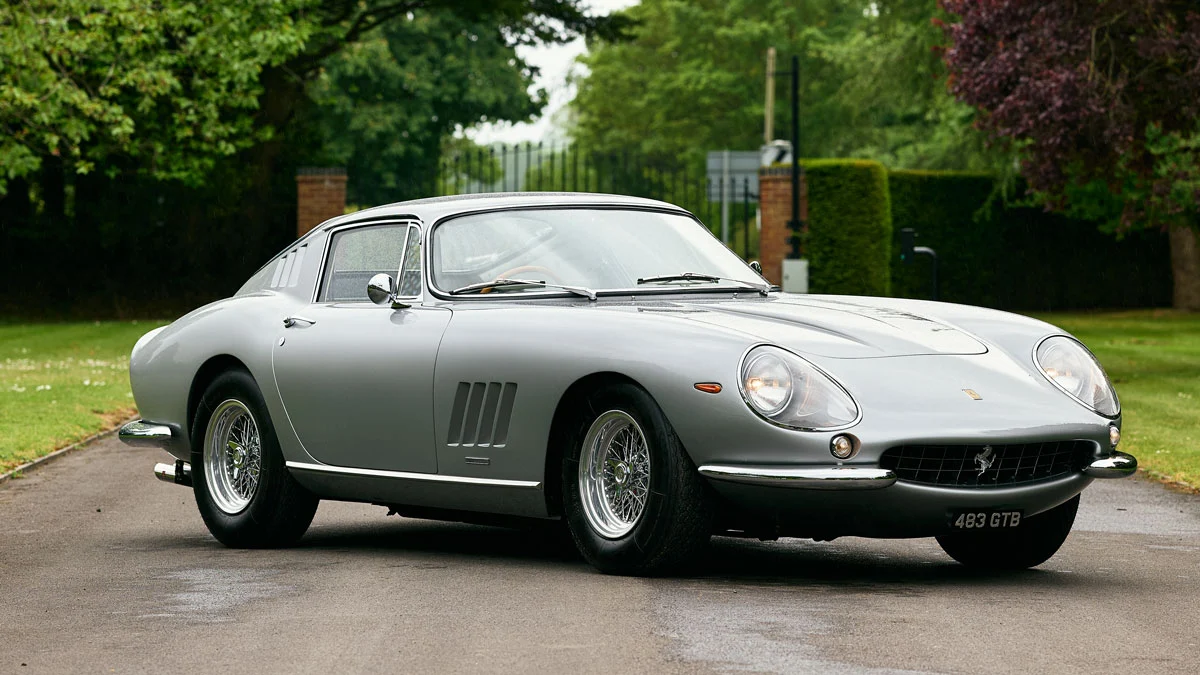
In the rarefied world of automotive collecting, few vehicles possess the gravitational pull of the 1966 Ferrari 275 GTB/4. It is widely considered the zenith of 1960s grand touring—a machine that harmonizes the sculptural grace of Pininfarina’s design language with the raw, mechanical symphony of a Colombo-derived V-12 engine. Among the 300 examples ever produced, chassis No. 09261 stands apart. It is not merely a pristine piece of Italian engineering; it is a storied artifact that has traversed continents, outrun aviation, and graced the private garages of music legends. Currently listed for sale by the esteemed classic-car specialists at Fiskens, this right-hand-drive masterpiece is a testament to the enduring allure of the Prancing Horse.
A Masterpiece of Engineering and Aesthetics
To understand the prestige of the 275 GTB/4, one must look at the era of its inception. Debuting in 1966 as an evolution of the original 1964 275 GTB, the "four-cam" model represented a significant leap forward in Maranello’s technical prowess. Pininfarina’s masterful design, executed by the artisans at Scaglietti, defined the aesthetic standards of the decade. With its elongated nose, power-domed hood, and aggressive yet elegant stance, the berlinetta remains one of the most visually balanced cars ever conceived.

Beneath the bonnet, the car featured the revolutionary four-camshaft iteration of the legendary Colombo V-12. This powerplant was capable of producing 300 hp, propelling the GTB/4 from zero to 60 mph in a blistering 5.5 seconds—a performance metric that was supercar-territory for the mid-60s. Furthermore, it was the first road-going Ferrari to feature a five-speed manual transaxle and all-round independent suspension, providing a level of handling and poise that solidified its reputation as a driver’s car of the highest order.
The Odyssey of Chassis No. 09261: A Global Chronology
The life of chassis No. 09261 is as unconventional as it is captivating. The story began on July 4, 1966, when the car was ordered by businessman Robin Houry. A man with significant interests in Kenya, Houry intended to keep the vehicle in the United Kingdom for a brief period before importing it to East Africa. However, a logistical miscommunication between the factory and the U.K. distributor, Maranello Concessionaires, saw the car shipped directly to the port of Mombasa.

Though Houry was reportedly incensed by the error, the car’s forced exile to Kenya set the stage for its legendary reputation. Rather than letting the Ferrari languish, Houry embraced its potential, entering the machine into amateur races organized by the East African Motor Sports Club. This period of the car’s history remains a point of fascination for collectors, as it proved that these delicate Italian beauties were capable of thriving in the harsh, rugged environments of the African continent.
By 1968, the car had passed to Houry’s business partner, Brian Lees. It was under Lees’ stewardship that the vehicle secured its place in folklore. Challenged by the pilot of a twin-engined Douglas DC-3, Lees wagered that his Ferrari could traverse the 300-mile stretch between Nairobi and Mombasa faster than the aircraft. Navigating roads that were little more than unpaved tracks, the Ferrari reportedly maintained an average speed of over 80 mph, ultimately arriving before the plane.

The vehicle returned to the U.K. in 1970, where it was purchased by the renowned automotive illustrator James Allington in 1971. Allington, a master of technical cutaway drawings, held the car for over three decades. In a fascinating act of artistic dedication, he famously disassembled the vehicle to study its mechanical intricacies for his work, eventually repainting the car in a striking red to match his famous illustrations.
From Auction Block to Rock-Star Status
Following Allington’s passing, his collection was consigned to a Christie’s auction in late 2002. While the car failed to meet its reserve at the time, its history and pedigree caught the eye of Eric Clapton. The guitar legend, known for his discerning taste in classic Ferraris, acquired the car shortly thereafter. Recognizing the need to restore the vehicle to its factory-correct specifications, Clapton commissioned the premier specialists at DK Engineering for an exhaustive 12-month restoration. The work was precise, returning the body to its original, iconic Grigio Argento (silver) paintwork and ensuring the mechanicals were in concours condition.

Clapton parted with the car in 2005, initiating a new chapter of ownership. The vehicle transitioned through several hands before being acquired in 2010 by Niall Holden, a prominent executive in the music-equipment industry and an avid collector. Holden’s tenure saw the car finished in a deep metallic blue, a testament to the evolving tastes of its custodians.
In January 2022, the car was acquired by its current owner, the world-renowned yacht designer Terence Disdale. Disdale, who has crafted some of the most iconic vessels on the high seas, including the massive 533-foot Eclipse, approached the car with a singular vision. Inspired by his lifelong desire to own a silver 275 GTB/4, Disdale initiated a second, comprehensive, "nut-and-bolt" restoration. Over two years, he invested approximately $250,000 in mechanical and bodywork, plus an additional $33,000 to re-trim the interior from black to a period-correct tan leather.

The Curator’s Perspective: Official Responses
Gregor Fisken, founder of the specialist dealership Fiskens, emphasizes the rarity of the documentation accompanying this specific chassis. "Ferrari road cars like this don’t often come with such a wealth of period documentation," Fisken notes. "09261’s history file is spectacular, containing factory correspondence, details of its African exploits, and personal letters between the original owners and Maranello Concessionaires."
For the current owner, the car represents the pinnacle of industrial design. "I believe the 275 GTB is the most beautiful car ever designed," Disdale told Robb Report. "It is a constant inspiration for its minimal style and elegance. Unlike modern design, which often feels angry or overly aggressive, this Ferrari is a masterpiece of balance and purposeful style."

Market Implications and Investment Value
The listing price of 2.95 million British pounds (approximately $3.9 million) places this vehicle in a competitive, yet well-supported, segment of the classic car market. Recent sales data illustrates a robust appetite for the 275 GTB/4. In May, a yellow 1967 model sold at Mecum’s Indianapolis auction for $2.86 million, while an ice-blue example fetched $3.4 million at The Amelia in March. While the current asking price sits below the $6.05 million achieved by a rare alloy-bodied variant in January, it reflects the premium commanded by "matching numbers" examples with impeccable provenance.
The value of chassis No. 09261 is not derived solely from its technical specifications or the current market trends. It is the combination of the Classiche certification, the rigorous restoration to its original Grigio Argento finish, and the undeniable "rock-star" provenance provided by Eric Clapton that elevates this car into a different tier of desirability.

Conclusion: A Legacy in Motion
To own such a vehicle is to act as a temporary guardian of history. From the dust of the Kenyan plains to the elite auctions of London and the private collections of world-famous musicians and designers, this 1966 Ferrari 275 GTB/4 has led a life that mirrors the high-performance, high-stakes world it was born into.
It remains a symbol of an era when automotive design was defined by the intersection of art and utility. As it awaits its next custodian, chassis No. 09261 stands as a reminder that the greatest machines are not merely transport—they are vessels of stories, legacies, and the timeless pursuit of perfection. For the collector who values not just the car, but the journey it has taken, this Ferrari is, quite simply, without peer.
 Evan Lee Salim
 Asep Darmawan
 Laily UPN
