

In the annals of luxury travel, few names evoke the golden age of discovery quite like the Orient Express. For over a century, the brand has been synonymous with opulent rail journeys across continents. Now, that legacy is being translated from iron tracks to the open ocean. In May 2026, the Corinthian—the first of two ambitious sail-assisted superyachts commissioned by Accor—embarked on its maiden voyage, signaling a seismic shift in the world of ultra-luxury maritime travel.
A New Titan of the Seas: Core Specifications
Stretching an imposing 721.8 feet, the Corinthian is being touted as the world’s largest sailing yacht. However, to call it a simple sailboat would be a misnomer. The vessel utilizes a cutting-edge hybrid propulsion system, combining sail-assisted technology with powerful electric engines to navigate the globe with unprecedented grace.
Unlike traditional yachts, the Corinthian features three massive 30-foot-high masts equipped with rigid sails. Engineered by the prestigious Chantiers de l’Atlantique shipyard, these sails are crafted from carbon fiber-reinforced glass panels rather than woven cloth. Fully automated and controlled directly from the wheelhouse, they allow for a seamless blend of traditional nautical prowess and 21st-century environmental efficiency.
Designed to accommodate a maximum of 110 guests, the yacht maintains a staggering crew-to-guest ratio, with 170 staff members ensuring that every whim is met. This commitment to exclusivity ensures that the vast, sprawling vessel never feels crowded, offering a sense of intimacy that is rare in modern maritime travel.
The Art of the Interior: A Chronology of Design
The gestation of the Corinthian began more than three years ago, when architect Maxime d’Angeac first put pen to paper to conceptualize a vessel that would marry the storied Art Deco heritage of the Orient Express with the demands of a modern superyacht.

D’Angeac, whose French design studio is celebrated for its masterful reinterpretations of historical estates, faced a unique challenge: translating the "railway" aesthetic to the "nautical" environment. During a recent tour at the shipyard in Saint-Nazaire, France, d’Angeac explained the philosophy behind the interior: "The central reception area is where guests embark, so we incorporated a lot of wood and detail to keep the vibe faithful to what people expect from the Orient Express train."
The design process was a meticulous curation of historical homage. Guests will find authentic luggage racks and vintage lighting fixtures—sourced directly from original Orient Express train cars—integrated into the decor of specific cabins. Even the 20-seater cinema serves as a museum-grade experience, featuring a custom carpet pattern inspired by the legendary flower bouquet glass panels of Suzanne Lalique.
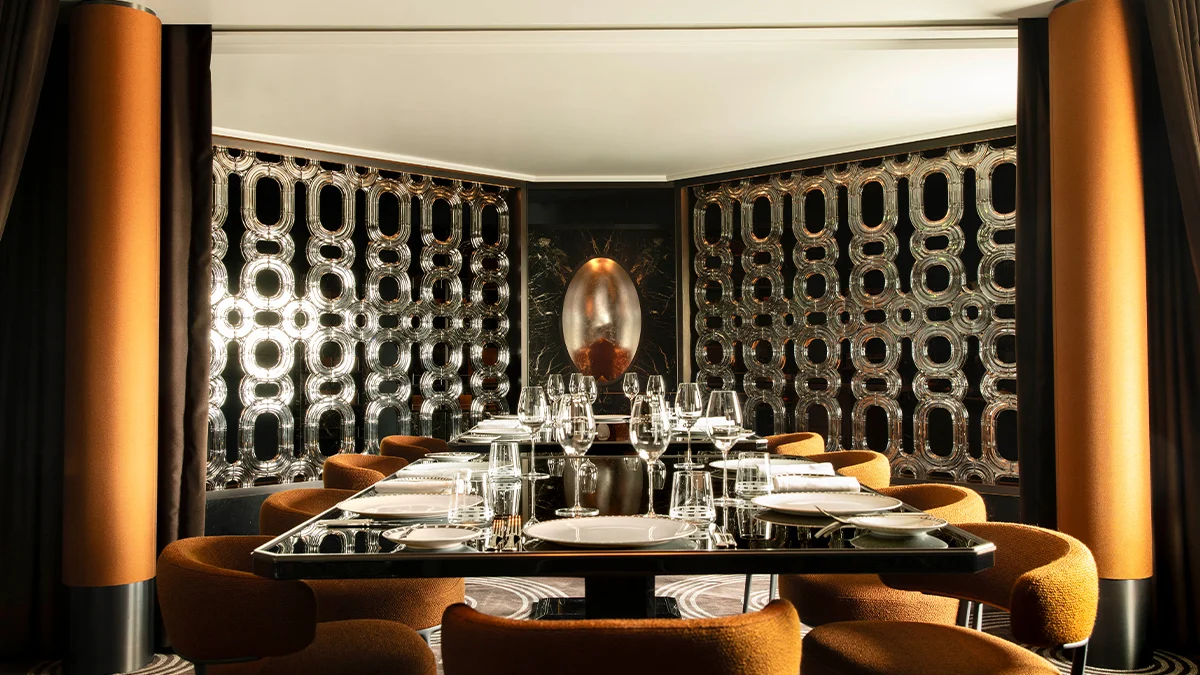
The material palette is decidedly masculine and moody, relying on the work of elite European artisans. Jean Brieuc’s signature wood embroidery, which will also feature on Accor’s forthcoming 2027 Istanbul train, adorns the headboards, while Franck Benito’s engraved crystal lighting provides a shimmering, ethereal quality to the marble-clad wellness centers.
Supporting Data: A Sanctuary of Opulence
The Corinthian is organized around 54 guest accommodations: 48 suites and six grand penthouse apartments. Every inch of the vessel is engineered to maximize guest comfort.
Perhaps the most significant design achievement is the stabilization of the ship. "The more centrally placed you are on board, the less you feel the boat moving," says d’Angeac. This insight dictated the placement of the vessel’s crown jewel: the Guerlain spa. Located amidships, this sanctuary features a hammam, sauna, tepidarium, and ice fountains. It is the first spa of its kind at sea, providing a serene environment for wellness that remains unaffected by the swell of the ocean.

For those seeking the pinnacle of luxury, the Agatha Christie suite offers 2,422 square feet of living space. Clad in rich rosewood and featuring a private terrace and marble bathroom, it stands as the largest suite on board. Furthermore, the ship offers a "superyacht owner’s deck" configuration, where the six penthouse suites can be combined to create a 10,000-square-foot private refuge for up to 22 guests.
Culinary excellence is similarly elevated. Executive chef Yannick Alléno, the mastermind behind the three-Michelin-starred Ledoyen in Paris and 1947 Cheval Blanc in Courchevel, oversees five distinct onboard eateries. The primary dining room is a marvel of engineering, featuring the only double-height space on the vessel. Here, floor-to-ceiling windows offer panoramic vistas of the horizon, punctuated by the striking "sculpture en plâtre" panels by French artist Etienne Rayssac.
The Strategic Alliance: Accor and LVMH
The Corinthian is not merely a vessel; it is the physical manifestation of a major strategic pivot for the hospitality giant Accor. In June 2024, the company entered a landmark partnership with LVMH, which included the luxury conglomerate acquiring a 50 percent stake in the Orient Express brand.
This alliance brings together the best of both worlds: Accor’s expansive hospitality expertise and LVMH’s unparalleled command of the luxury market, which already operates five trains under the Belmond banner, including the iconic Venice Simplon-Orient-Express.
"This alliance will accelerate the renewal of this travel icon," stated Bernard Arnault, LVMH Group chairman and CEO, during the announcement. The partnership aims to create "hybrid" travel experiences, where guests can seamlessly transition from a luxury train journey across Europe to a week-long sailing on the Corinthian. This vertical integration of travel assets is designed to capture the ultra-high-net-worth individual who demands a continuous, uninterrupted brand experience.

Implications: A New Era for Maritime Travel
The introduction of the Corinthian challenges the conventional definition of the "cruise." While traditional lines focus on volume and entertainment-for-all, the Orient Express approach is one of "carefully choreographed discovery."
The itineraries reflect this ethos. The vessel will spend its summers traversing the hot spots of the French and Italian Riviera, shifting to the Caribbean for the winter months. These are not standard port calls; they are deeply curated excursions. Guests might find themselves participating in an exclusive car rally through the hills of Provence, enjoying a private truffle lunch, or spending an evening on the ultra-private Moskito Island.
The technological implications are equally profound. By building a ship that cruises without heeling, the designers have solved one of the most persistent issues of sailing: the instability that prevents luxury experiences like full-lap pool swimming. The 56-foot "couloir de nage" (lap pool) carved into the sun deck is a testament to the fact that form and function can coexist at the highest level of engineering.
Conclusion: A Legacy Reimagined
As the Corinthian cuts through the waves, it carries the weight of 150 years of history. Yet, it does so with a lightness and modernity that belies its heritage. By moving from the static beauty of the train car to the fluid, ever-changing environment of the sea, Orient Express is not just preserving a legacy—it is expanding it.
For the modern traveler, the Corinthian offers a rare commodity: a space where the romance of the past meets the precision of the future. It is a bold statement that the age of grand travel has not ended; it has simply changed its medium. In this carefully curated environment, where hospitality, design, and high-performance engineering converge, the Orient Express proves that the journey remains, as it always has been, the true destination.
 Evan Lee Salim
 Asep Darmawan
 Laily UPN
