

Published on June 23, 2026
For over two decades, the Four Roses Distillery has stood as a bastion of consistency and technical precision in the world of American whiskey. Since its revival in the early 2000s, the brand has been defined by a rigid, scientific approach to bourbon production—utilizing a complex matrix of two mashbills and five proprietary yeast strains to create ten distinct recipes. Yet, for all its accolades, the Lawrenceburg, Kentucky-based producer has remained staunchly traditional in one specific regard: it has eschewed the industry-wide trend of secondary cask finishing.
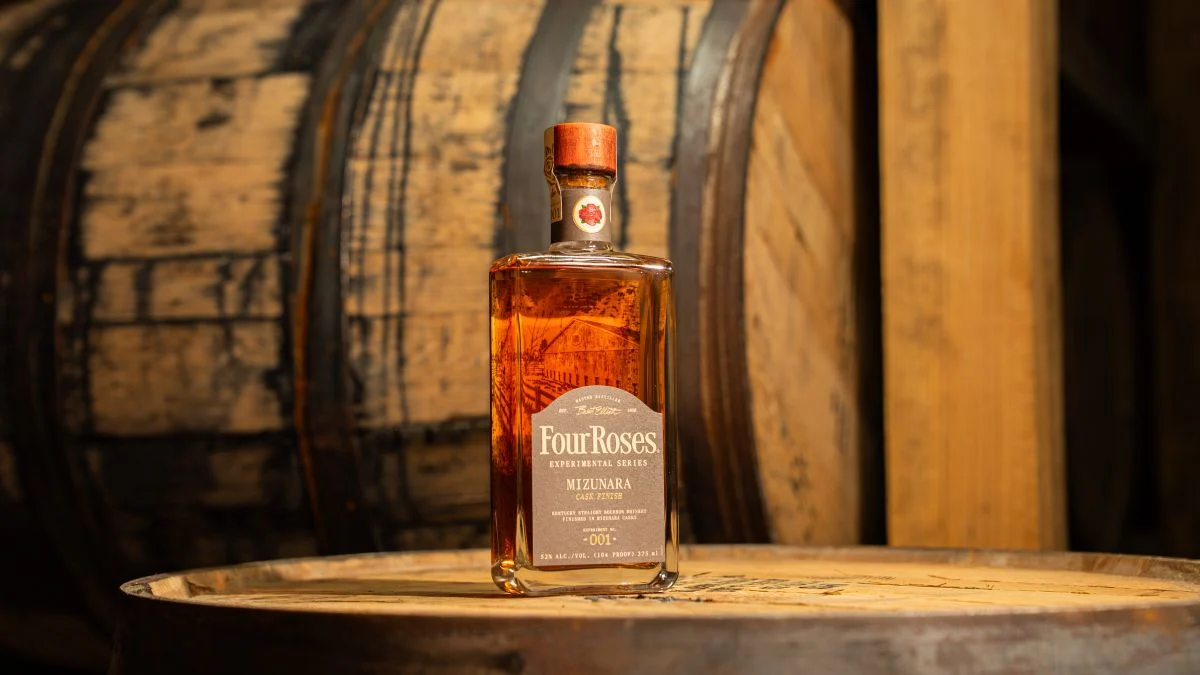
That era of restraint has officially ended. With the unveiling of "Experimental Series No. 001," Four Roses is wading into the waters of secondary maturation, utilizing rare Japanese Mizunara oak to impart a new sensory dimension to its signature bourbon.
The Main Facts: An Unprecedented Pivot
Experimental Series No. 001 represents a watershed moment for a distillery known for its meticulous adherence to tradition. The release features a six-year-old Kentucky Straight Bourbon, crafted from the distillery’s renowned "OBSK" recipe—a high-rye mashbill combined with the "K" yeast strain, known for its light spiciness and caramel undertones.
Following its initial aging period in standard charred new oak containers, the whiskey underwent a finishing process in Japanese Mizunara oak barrels. The resulting spirit, bottled at 104 proof, represents a calculated evolution of the Four Roses flavor profile. Rather than masking the base bourbon, the Mizunara oak introduces sophisticated, ethereal notes of incense, sandalwood, and a complex interplay of dried and fresh orchard fruits, which serve to elevate the bourbon’s foundational vanilla and maple notes.
The whiskey will be available to the public beginning July 30, exclusively in 375-ml bottles at the Four Roses Distillery Visitor Center, with a suggested retail price of $55.
A Chronology of Change
To understand the significance of this release, one must look at the timeline of Four Roses’ recent history, which has been marked by a transition in ownership and a shifting landscape in the global spirits market.
- Early 2000s: Four Roses undergoes a brand revival, solidifying its reputation for the ten-recipe system that distinguishes it from other Kentucky producers.
- Early 2026: E&J Gallo Winery completes its acquisition of Four Roses from the Japanese conglomerate Kirin Holdings, a move that sparked industry speculation regarding the brand’s future direction.
- Spring 2026: Master Distiller Brent Elliott hosts members of the press at the Lawrenceburg distillery to sample the Experimental Series, providing clarity on the project’s origins.
- June 2026: Official announcement of the Experimental Series No. 001.
- July 30, 2026: Scheduled public launch of the inaugural Mizunara-finished release.
Supporting Data: The Mizunara Factor
The choice of Mizunara oak is far from arbitrary. Known in the industry as "water oak" for its high moisture content and porous nature, Mizunara is notoriously difficult to cooper into barrels. It grows slowly and requires a significantly longer maturation period to impart its signature flavor compounds—specifically vanillins and lactones that provide a distinctively floral and spicy profile.
By selecting the OBSK recipe for this experiment, the distillery team leveraged a flavor profile that is already chemically predisposed to handle the intensity of Japanese oak. The "B" mashbill’s high rye content provides the necessary structural backbone to prevent the secondary maturation from becoming cloying or overly woody. At 104 proof, the whiskey maintains enough ethanol-driven heat to carry the nuanced, delicate aromatics of the Mizunara wood across the palate, ensuring that the bourbon’s "Four Roses DNA" remains the primary anchor of the experience.
Official Responses: Addressing the "Gimmick" Question
The introduction of secondary finishing at a distillery that previously shunned the practice has naturally invited skepticism from the "bourbon purist" community. Some fans have questioned whether the move is a symptom of corporate pressure following the E&J Gallo acquisition or a reactive measure to a softening whiskey market, where producers are increasingly looking for ways to differentiate their offerings in a crowded retail landscape.

Master Distiller Brent Elliott, however, is quick to temper these narratives. In discussions held at the distillery, Elliott clarified that the Experimental Series is not a reactionary strategy but the result of a long-standing desire to explore creative boundaries that were previously hindered by time and resource constraints.
"We wanted to do interesting and fun things, but we didn’t have the time or resources," Elliott remarked during the spring briefing. "I was amazed at how excited Gallo was to learn about what we wanted to do. There’s a scale—you have legitimate innovation, and straight-up gimmick. I think we’re doing the former."
Addressing fears that Four Roses might follow the path of competitors who have flooded the market with flavored whiskeys, Elliott was emphatic. "Gallo is not like, ‘Peach has been in the news lately,’" he laughed, dismissing the notion of a pivot toward mass-market flavoring. "That’s not their approach."
Implications: The Future of the Brand
The launch of Experimental Series No. 001 signals a fundamental shift in how Four Roses views its own legacy. By establishing a dedicated "Experimental Series," the brand is signaling that it intends to remain relevant in a modern market that increasingly values "limited edition" and "finished" products.
1. Market Positioning
The whiskey industry is currently experiencing a "softening" period. After years of explosive growth, demand for standard-tier bourbon has plateaued, while the demand for high-end, experimental, and transparently sourced products has remained robust. By introducing a series that focuses on high-level maturation techniques, Four Roses is positioning itself to capture the attention of the "collector" demographic—a group that drives secondary market value and brand prestige.
2. The Gallo Influence
The transition from Kirin Holdings to E&J Gallo Winery is significant. While Kirin was instrumental in reviving the brand’s quality, Gallo brings a massive distribution infrastructure and a different philosophy toward portfolio management. If Experimental Series No. 001 is a success, it is likely that the "Experimental" banner will become a regular feature of the Four Roses calendar, potentially paving the way for other wood-finishings, such as Sherry, Cognac, or perhaps even secondary maturation in different types of American oak.
3. Preserving the Core
Perhaps the most important takeaway for the longtime Four Roses devotee is the distillery’s commitment to its core ten-recipe system. The Experimental Series is designed to exist alongside the core offerings, not to replace them. The use of the 375-ml bottle size—often referred to as a "half-bottle"—is a clever strategic choice. It allows the distillery to offer a premium product at a lower price point ($55) while reinforcing the idea that this is a specialized, limited-run experience rather than a new standard-shelf expression.
Conclusion: A Delicate Balance
For Four Roses, the path forward is a delicate balancing act. The distillery must innovate to satisfy a modern palate while maintaining the technical rigor that made it a household name in the first place. The Mizunara-finished bourbon is a sophisticated, thoughtful start to this new chapter. It respects the history of the liquid inside the bottle while acknowledging that the world of whiskey is no longer a static place.
Whether this leads to a permanent expansion of the Four Roses portfolio remains to be seen. However, if the distillery continues to approach its experiments with the same level of intellectual curiosity and restraint displayed in this inaugural release, the "Experimental Series" may well become as essential to the Four Roses legacy as its original ten recipes. For now, collectors and fans alike will have to wait until July 30 to see if this marriage of Kentucky tradition and Japanese influence lives up to the anticipation.
 Evan Lee Salim
 Asep Darmawan
 Laily UPN
