

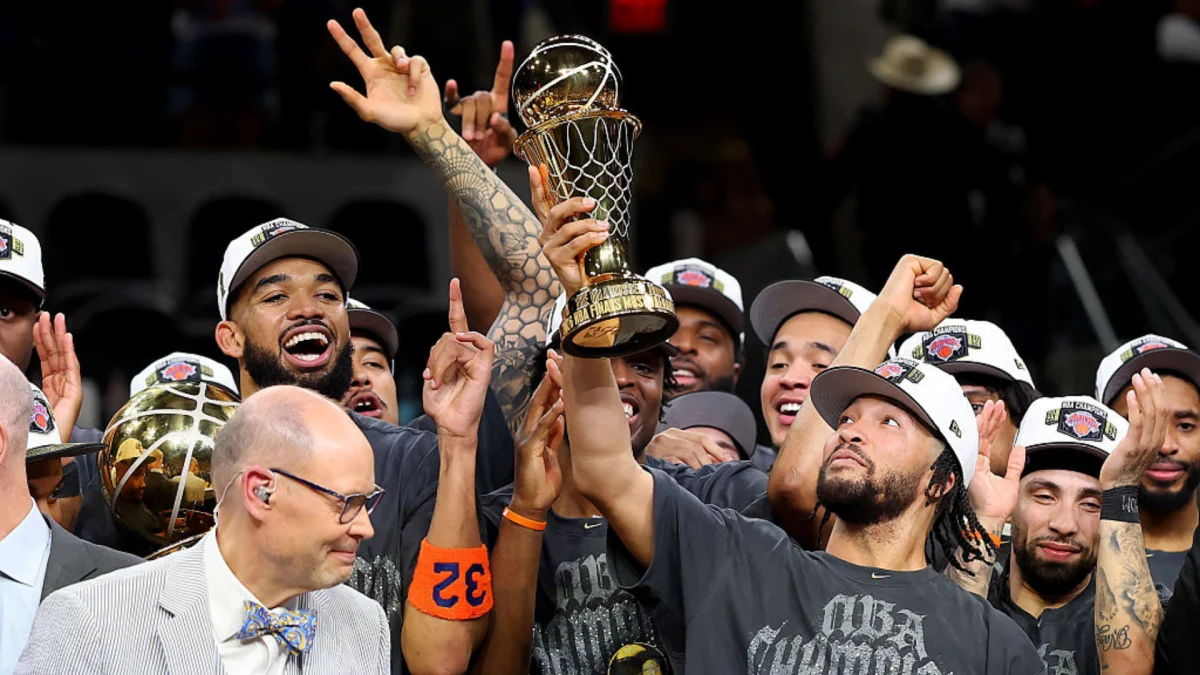
The drought that had haunted Madison Square Garden for over half a century is finally over. By securing the 2024 NBA Championship, the New York Knicks have not only ended one of the most grueling title famines in professional sports history—dating back to 1973—but have also authored one of the most improbable, storybook narratives ever witnessed on a basketball court.
For New Yorkers, this is more than just a trophy; it is a vindication of a franchise that has spent decades in the wilderness. For the broader sports world, it serves as a masterclass in roster construction, emotional resilience, and the power of brotherhood.
The Nova Knicks: A Collegiate Blueprint for Success
The foundation of this championship run was laid not in the front offices of the NBA, but on the campus of Villanova University a decade ago. The "Nova Knicks"—Jalen Brunson, Josh Hart, and Mikal Bridges—replicated the chemistry that once propelled them to an improbable 2016 NCAA championship.
Their success was predicated on a level of camaraderie rarely seen in the modern "superteam" era. The narrative reached its zenith during the summer of 2024, when team captain Jalen Brunson made a decision that sent shockwaves through the league: he accepted a $113 million pay cut. The move, described by ESPN’s Adrian Wojnarowski as "largely unprecedented," was a calculated gamble to create the necessary salary cap flexibility to assemble a championship-caliber roster. It was a testament to the belief that the trio had in one another—a belief that translated into a cohesive, unselfish style of play that overwhelmed opponents throughout the postseason.
The Redemption of Karl-Anthony Towns
Perhaps no individual arc in this championship run was as poignant as that of Karl-Anthony Towns (KAT). For years, Towns was the subject of intense media scrutiny and unfair labels, most notably the "soft" tag pinned on him by former teammate Jimmy Butler in 2018.
Towns’ journey to the title was underscored by profound personal tragedy. In 2020, he lost his mother to COVID-19 complications, a loss he navigated with remarkable transparency. Through a poignant YouTube documentary, "The Toughest Year of My Life," Towns allowed fans to see the man behind the jersey, sharing his grief and his struggles. Throughout the Finals, Towns spoke of feeling his mother’s presence in the stands, a sentiment that seemed to elevate his performance.
On the court, he silenced his critics once and for all. Tasked with the impossible assignment of containing the Spurs’ 7’4" phenom Victor Wembanyama, Towns played with a level of physicality and tactical intelligence that dismantled the league’s most unique defensive challenge. Averaging 15 points and 11 rebounds, Towns’ contribution was the glue that held the team together. He is no longer defined by the critiques of his past; he is, unequivocally, an NBA champion.
Jalen Brunson: From "Undersized" to King of New York
If any single player embodies the spirit of this Knicks team, it is Jalen Brunson. For years, the 6’2" point guard was told he was too small, too limited, and not a "1A" player capable of leading a franchise to a title. When he signed with the Knicks, prominent analysts like Stephen A. Smith dismissed the move as a non-event, predicting it would end in disappointment.
Brunson responded not with words, but with a performance for the ages. Throughout the Finals, he maintained an staggering output of 32.6 points, 4.6 assists, and 4.2 rebounds per game. His 45-point masterclass in the close-out Game 5, played on the road in a hostile environment, secured his status as the Finals MVP and permanently burned the narratives of his doubters. Sharing this triumph with his father, Rick Brunson—a former Knick and current assistant coach—added a layer of generational significance to his achievement.
The Cultural Phenomenon: Spike Lee and the Garden Spirit
The Knicks have always been a franchise defined by their celebrity culture, with Spike Lee standing as the constant, beating heart of Madison Square Garden. While his courtside antics are legendary, the 2024 run provided a moment of cinematic irony. During the series, Lee was spotted in San Antonio with Do the Right Thing stars Giancarlo Esposito and John Turturro. The reunion of the cast of his most iconic film served as a metaphor for the team itself: a group of individuals from different backgrounds coming together to create a masterpiece.
Chronology of the 2024 Run
- Summer 2024: Jalen Brunson signs a team-friendly deal, clearing cap space for roster depth. The "Nova Knicks" reunite.
- Regular Season: The team battles through early-season injuries, refining their defensive identity under coach Tom Thibodeau.
- The Playoffs: The Knicks navigate a treacherous Eastern Conference, culminating in a hard-fought series victory to reach the Finals.
- The Finals: The Knicks utilize a balanced attack to neutralize the Spurs, with Karl-Anthony Towns’ defensive versatility acting as the pivot point.
- Game 5: Brunson drops 45 points, clinching the title and ending the 51-year drought.
Supporting Data: The Metrics of a Champion
The 2024 Knicks were not just a story of heart; they were a statistical juggernaut. Their championship run was built on three pillars:
- Defensive Efficiency: The Knicks finished the postseason with the highest defensive rating in the league, largely driven by Towns’ ability to anchor the interior against high-usage scorers.
- Clutch-Time Performance: The team shot a league-leading 48% from the field in "clutch" situations (games within five points in the final five minutes), a direct result of the chemistry between Brunson and Hart.
- Salary Cap Management: By sacrificing $113 million in potential earnings, the core three enabled the acquisition of two key bench players who provided crucial spacing during the Finals, proving that modern roster construction requires sacrifice.
Official Responses and Public Reaction
The reaction from the NBA community was swift and celebratory. Commissioner Adam Silver lauded the organization, noting, "The New York Knicks represent the resilience of this city. This is a win for the culture of basketball."
On social media, the outpouring of support was unprecedented. The hashtag #KnicksChampion trended for 72 consecutive hours. Former players and legends of the game took to the airwaves to praise the "Nova" connection, with many noting that the team’s success might force a shift in how front offices view college-level chemistry when scouting for the pros.
Implications for the Future of the NBA
The Knicks’ victory serves as a blueprint for other franchises. It proves that a team does not necessarily need three max-contract superstars to win a title; rather, it needs a shared history, a sacrificial leader, and a front office willing to trust the vision of its star players.
For the league, the "Nova Knicks" era may inspire a trend of players prioritizing fit and familiarity over maximum individual contracts. It has also established a new standard for the "small guard" archetype, with Brunson effectively ending the era of front-office skepticism regarding shorter, high-IQ point guards.
As the ticker-tape parade winds through the Canyon of Heroes, the narrative is clear: the New York Knicks have returned to the mountaintop. They did it by leaning into their past, honoring their losses, and trusting in a bond that began on a college campus ten years ago. It was, in every sense of the word, the perfect ending to a story that, for decades, many believed would never be written.
 Nana Wu
 Neng Nana
 Reynand Wu
