

Welcome to Taste Test, where every week our critic Jonah Flicker explores the most buzzworthy and interesting whiskeys in the world. Check back each Sunday for his latest whiskey review.
In the high-stakes world of American spirits, few names carry as much cultural weight as Bulleit. For over a decade, its distinctive, old-timey bottles have anchored back-bars from dive bars in Brooklyn to high-end cocktail lounges in Los Angeles. While the brand has long been a staple of the American whiskey renaissance, its latest release marks a radical departure from its standard-bearer reputation.
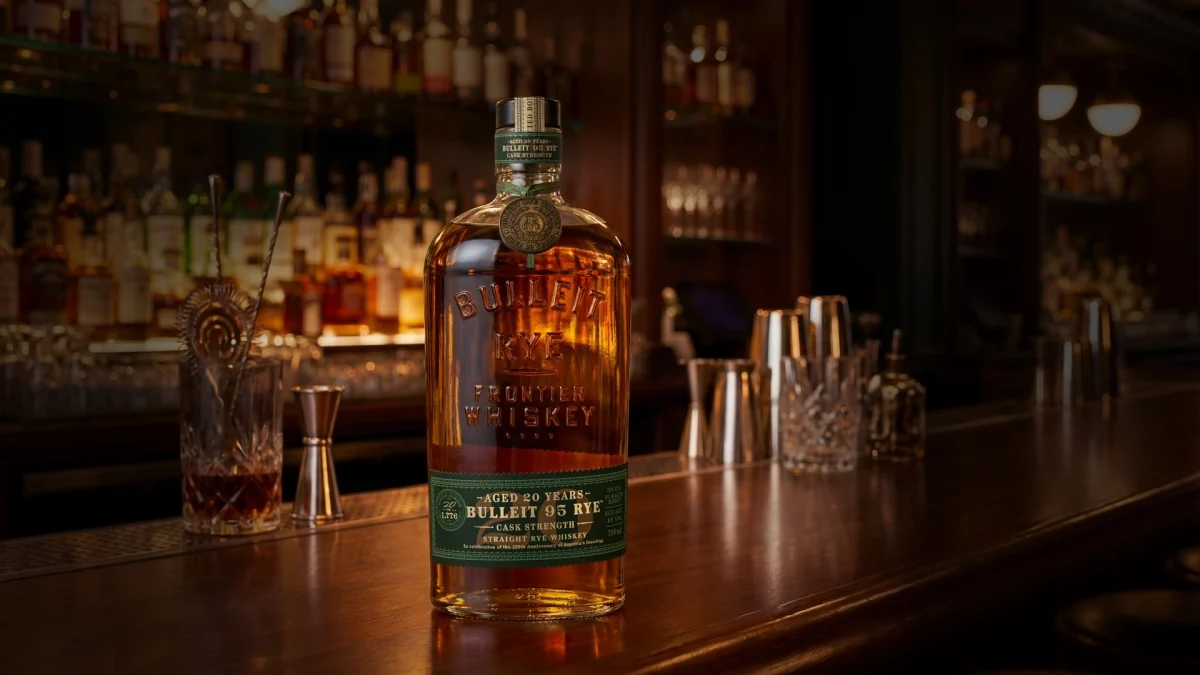
Bulleit has just unveiled its most ambitious project to date: a 20-year-old rye whiskey. On paper, the specs are enough to make any aficionado reach for their wallet. The liquid, sourced from the industry-standard MGP of Indiana, utilizes the classic 95 percent rye and five percent malted barley mashbill—the very recipe that helped make American rye relevant again. But this isn’t the standard shelf-staple. This is a two-decade-aged, cask-strength titan. However, as with all things in the world of high-proof spirits, the reality of the glass is far more complex than the statistics on the label.
The Main Facts: A Rare Frontier
The Bulleit 20-Year-Old Rye is, by every metric, the brand’s most significant release. It stands as the oldest and strongest whiskey to ever carry the Bulleit name.
The liquid was aged for two decades, a duration that is notoriously difficult for American rye. Unlike the cooler, more humid environments of Canada or Scotland, American warehouses experience dramatic fluctuations—blistering, humid summers followed by bone-chilling winters. These conditions cause the whiskey to expand and contract within the charred oak barrels, accelerating the interaction between the spirit and the wood.
The result is a whiskey bottled at a staggering 137 proof (68.5% ABV). For context, in the industry, anything hovering near 140 proof is affectionately, or perhaps cautiously, referred to as "hazmat" whiskey—a term derived from the shipping regulations that prevent the transport of flammable liquids above certain alcohol thresholds.
With only 1,776 bottles produced—a symbolic nod to the upcoming 250th anniversary of the United States—this is a limited-edition release in the truest sense. Priced at $300, it is positioned firmly in the collector’s tier, a far cry from the accessible bottles that built the brand’s fortune.
A Chronological Evolution of the Bulleit Brand
To understand the significance of this 20-year release, one must look at the trajectory of the Diageo-owned brand. Bulleit did not always have the luxury of its own distillery. For years, it was a brand built on the art of curation, relying heavily on high-quality contract distilling.
- The Early Years: Bulleit became synonymous with the "Frontier Whiskey" moniker, gaining popularity for its high-rye bourbon mashbill. It provided a reliable, spicy profile that was perfect for professional bartenders and home enthusiasts alike.
- The MGP Connection: The brand’s rye whiskey success was largely predicated on the legendary 95/5 rye recipe from MGP of Indiana. This liquid became the industry standard, and Bulleit was one of its most prominent ambassadors.
- The Expansion Era: Over the last decade, the company pivoted toward diversification. They introduced a 12-year-old rye, a cask-strength bourbon, and more experimental iterations like their American Single Malt and the polarizing, yet fascinating, Mesquite Smoked Malt.
- The Modern Milestone: The 20-year-old rye represents the culmination of this expansion. It moves away from the "accessible cocktail whiskey" persona and into the realm of "prestige sipping spirit," signaling that the brand is ready to compete with the ultra-aged, high-end independent bottlers that have dominated the auction circuit in recent years.
Supporting Data: The Science of Age and Proof
When evaluating a 20-year-old American whiskey, the primary concern is "oak fatigue." After 20 years, a spirit can easily become overwhelmed by tannins, resulting in a drink that tastes more like wood than grain.

Our analysis of this specific release reveals a delicate balance. The rye spice, which defines the category, is still present, though it has evolved into a deeper, more sophisticated profile. The fruit notes are concentrated, leaning into dried figs, baked apple, and dark molasses. However, the tannic influence is undeniable. The oak has leached into the spirit, creating a structure that is both impressive and intense.
The proofing decision is where the data becomes polarizing. By bottling at 137 proof, Bulleit has opted for an "unfiltered" aesthetic. While purists often decry the dilution of whiskey, "proofing down"—the art of adding water to reach a target ABV—is a foundational skill in master blending. It allows the blender to open up aromatic compounds that are otherwise locked away by high ethanol content. At 137 proof, the ethanol burn is significant. While the flavors of vanilla and black pepper are present, they are fighting for space against the heat, which, for many palates, may obscure the nuance that two decades of maturation should provide.
Official Responses and Industry Sentiment
The brand’s strategy with this release is clear: they are catering to the "proof-chaser" demographic. In the current whiskey market, high age statements combined with high proof are the primary drivers of secondary market value.
While the brand has not publicly commented on the specific decision to forgo proofing down, the move aligns with a broader trend among major distillers to offer "distiller’s strength" products. Critics and industry insiders are divided. Some argue that at $300, the consumer deserves a product that is "ready to drink" without the need for manual dilution by the consumer. Others argue that by providing the liquid at cask strength, Bulleit is allowing the consumer to control the experience, thereby offering the most authentic version of the barrel possible.
Implications for the Future of American Whiskey
The release of the Bulleit 20-Year-Old Rye has several implications for the industry at large:
- The Ceiling of Rye: This release proves that American rye can survive two decades in the barrel without turning into mahogany-colored paint thinner. It opens the door for other large-scale producers to explore longer aging profiles for rye.
- The Hazmat Trend: We are seeing an increase in the number of high-proof releases. As "cask strength" becomes a buzzword, brands are pushing the limits of what is comfortable to drink, creating a sub-category of "extreme" whiskeys.
- Pricing and Perception: By entering the $300 price bracket, Bulleit is testing its brand equity. It is moving beyond the "well-bottle" identity to see if it can command the same respect as ultra-premium legacy labels like Pappy Van Winkle or Michter’s 20-Year.
Final Assessment: The Verdict
The Bulleit 20-Year-Old Rye is an impressive feat of engineering. It is a bold, uncompromising, and intense expression that rewards patience. If you are a collector looking for a piece of history or a fan of high-proof, high-oak profiles, this is a bottle that warrants a spot on your shelf.
However, it is not an easy-drinking dram. It is a whiskey that demands attention—and, for most drinkers, a splash of water. If you are looking for the perfect Manhattan base, do not look here. The original 90-proof offering remains the superior choice for cocktails. For the 20-year-old, however, the experience is about the raw, unfiltered intensity of the frontier.
Score: 86/100
While it may not achieve the balanced perfection of lower-proof, slightly younger counterparts, it serves as a testament to the fact that even a household name like Bulleit can still surprise the industry by reaching into the deep, dark corners of its inventory to pull out something truly singular.
 Evan Lee Salim
 Asep Darmawan
