

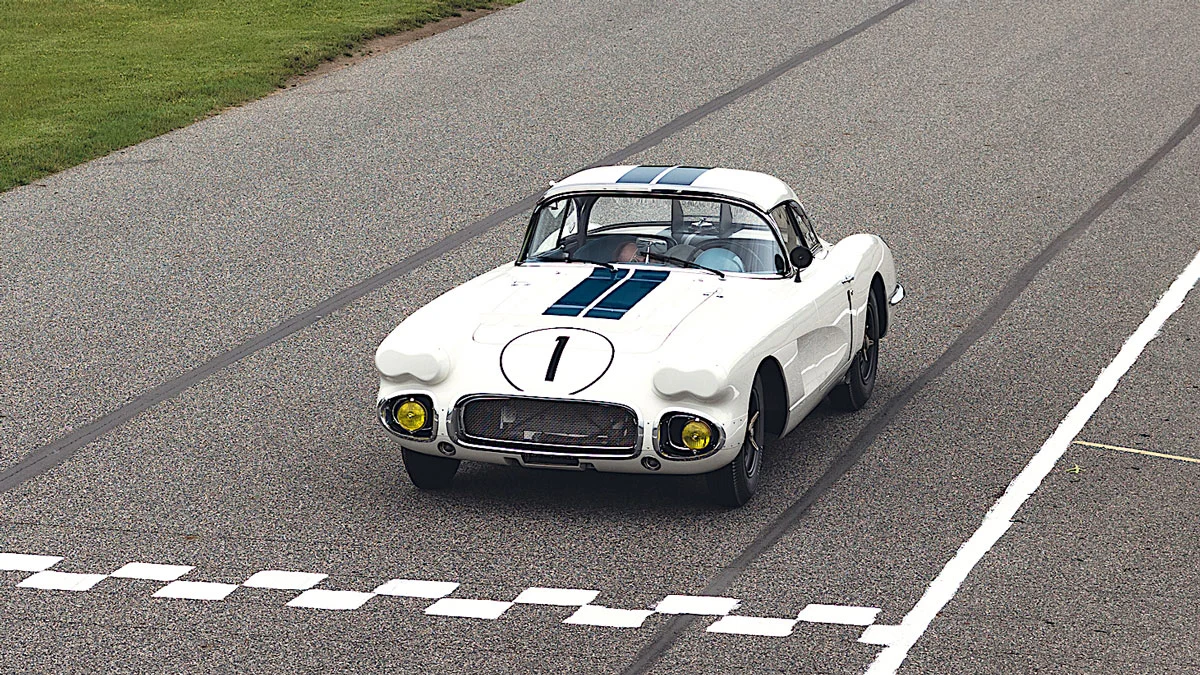
In the pantheon of American automotive history, few chapters are as evocative or as shrouded in intrigue as the 1960 24 Hours of Le Mans. It was a time when the "Stars and Stripes" were carried into the heart of European motorsport not by a factory powerhouse, but by a privateer with the spirit of a pioneer: Briggs Swift Cunningham. Among his most daring ventures were three specially prepared Chevrolet Corvettes, machines that dared to challenge the established dominance of Ferrari, Aston Martin, and Porsche. Today, one of those legendary racers—chassis No. 3535—has emerged from the shadows of history, fully restored and set to grace the auction block at the upcoming RM Sotheby’s Monterey Auction.
A High-Stakes Gamble in 1960
The 1960 Le Mans grid was a battlefield of prestige. For American manufacturers, however, it was a forbidden theater. Following the catastrophic 1955 disaster, American automakers had largely distanced themselves from international endurance racing. Yet, in the fall of 1959, Zora Arkus-Duntov—the visionary engineer rightfully dubbed the “Godfather of the Corvette”—approached Cunningham with a clandestine proposition: to bring the Corvette to the world’s most grueling test of speed and endurance.
Because General Motors could not officially sanction the effort, the project was executed with the subtlety of a covert operation. The three Corvettes were funneled through Don Allen’s Midtown Chevrolet in New York before being transported to the Queens-based race shop of Alfred Momo. There, under the watchful eyes of Arkus-Duntov’s engineering team, the road-going Corvettes were transformed into thoroughbreds. They were stripped of their civilian comforts and fitted with race-spec, fuel-injected small-block V-8 engines, lightweight Halibrand magnesium wheels, Koni competition shocks, and massive fuel tanks designed for the marathon ahead. Even the seating was repurposed from the cockpit of a Douglas C-47 Skytrain aircraft, underscoring the raw, functional ingenuity of the era.

The Race: A Momentary Flash of Glory
The 1960 race began with the traditional, frantic sprint across the track. Briggs Cunningham himself took the first stint in Corvette No. 1, sharing driving duties with Bill Kimberly, an heir to the Kimberly-Clark consumer-goods fortune. For the early hours, the car ran with promising strength, holding its own against the European titans.
Disaster struck on lap 26. As the field navigated the treacherous Circuit de la Sarthe, a sudden, localized downpour caught Kimberly off guard just after the Arnage corner. The Corvette hydroplaned, spinning off the track and rolling end-over-end. In a miraculous stroke of luck, the car landed upright, and Kimberly emerged without a scratch. The machine, however, was not so fortunate. It suffered a severe engine fire, scorched wiring, and significant structural damage. Its race was over, but its mythic status had only just begun.
A Forty-Year Exile
Following the race, the three Corvettes were shipped back to the United States on the RMS Queen Elizabeth. Once back on American soil, their specialized engines were returned to GM, and the shells were sold off, effectively ending their brief life as elite racers.

Chassis No. 3535 began a long, strange odyssey. It was acquired by Marshall “Perry” Boswell Jr., who sought to repurpose the vehicle. In a move that would later baffle historians, Boswell significantly altered the car’s aesthetic, adopting a single-headlight configuration reminiscent of the 1956–57 Corvette models. He added a hood scoop, a custom grille, and a modified rear end, coating the once-proud racer in black paint.
Over the next several decades, the car passed through various hands, receiving a coat of yellow paint under the ownership of Robert Lee Bollinger in 1966, before eventually finding its way to Richard Carr in St. Petersburg, Florida. Carr tucked the car away in a warehouse, where it remained largely forgotten for four decades, shielded from the eyes of enthusiasts and historians alike.
The Discovery and the Restoration
The re-emergence of No. 3535 is a testament to the persistent detective work of the automotive community. In 2011, while settling his late father’s estate, Carr’s son discovered the car—now painted a deep burgundy—tucked away in the family warehouse. Through the diligent research of Cunningham historian Larry Berman, the chassis number was confirmed, and the realization dawned that a piece of lost American racing history had been found.

The car was eventually auctioned at the 2021 RM Sotheby’s Amelia Island sale, where it fetched $785,000. It was purchased by the Cunningham family, who were determined to restore the machine to its former glory. They entrusted the task to the legendary Kevin Mackay of Corvette Repair, Inc. in Valley Stream, New York.
The restoration was a Herculean task. "The car was a train wreck when we got it," Mackay recalls. "We had to manufacture or source nearly everything. It took over 5,000 hours of meticulous labor." Because Mackay had previously restored Cunningham’s Corvette No. 3, he possessed the unique institutional knowledge required to ensure every bolt and component mirrored the original 1960 specifications. When the restoration was complete, the car was unveiled to the Cunningham family, marking a poignant return to the spotlight for a machine that had been presumed lost to time.
The American Ferrari 250 GTO
As the car prepares for its appearance at the Monterey Car Week, industry experts are placing it in a rarefied category. Harvey Stanley, director of Private Sales for RM Sotheby’s, does not mince words regarding its significance.

"This car belongs in the very best collection of great American sports racers," Stanley notes. "Alongside the greatest Shelby Cobra, the greatest Le Mans-winning GT40, and the greatest Gurney Eagle. This is the American Ferrari 250 GTO—only rarer."
This comparison is not merely marketing hyperbole. The 1960 Le Mans Corvettes represent a specific intersection of American engineering ambition and European racing heritage. They symbolize a time when the Corvette was still in its infancy as a global brand, fighting for legitimacy against established marques that had been honing their craft for decades.
Official Projections and Market Implications
With the 250th anniversary of the United States approaching, the provenance and historical weight of chassis No. 3535 are expected to drive intense bidding. RM Sotheby’s has placed an estimated value on the car between $2 million and $2.5 million. However, in the current market for blue-chip, historically significant automobiles, such estimates are often eclipsed by the passion of private collectors and museum curators.

The sale is not just a transaction; it is a coronation of the car’s legacy. Having survived a catastrophic crash, four decades of anonymity, and a radical visual transformation, its restoration back to its 1960 racing form is the final act in a story of redemption.
The Broader Impact on Collector Culture
The saga of the 1960 Le Mans Corvette serves as a case study in the value of preservation and the importance of professional restoration. In an era where many classic cars are either over-restored or lost to time, the return of No. 3535 underscores the role of historians like Larry Berman and technicians like Kevin Mackay in keeping the lineage of automotive innovation alive.
Furthermore, the car stands as a symbol of the "Cunningham Spirit"—a blend of amateur enthusiasm and professional-grade performance that paved the way for future American successes on the global stage. It reminds us that while Europe may have had the history, America had the audacity to challenge it.

As collectors gather in Monterey this August, the focus will be squarely on this burgundy-turned-racing-blue machine. It is a car that asks its future owner to do more than simply display it; it demands that they act as a steward of a moment in time when a small team from New York took a factory-supported American icon and pushed it to the absolute limit at the world’s most demanding circuit.
Whether it breaks records or simply finds a home in a prestigious collection, the 1960 Chevrolet Corvette LM No. 3535 has already secured its place in the history books. It is a survivor, a pioneer, and a testament to the enduring allure of the open road and the racetrack. The auction will serve as the final chapter in its long, winding journey home.
 rifanmuazin
 Laily UPN
 Suro Senen
